Voices for Justice: EPF PJN Member Ann Coburn Writes About A Witness Visit

Voices for Justice:  EPF PJN Member Writes About A Sabeel Witness Visit

Last month a group of 12 people from 6 countries went on a Sabeel witness pilgrimage.  The focus was the Forgotten Faithful, Christians living in Palestine today, seen through the lens of Palestinian liberation theology.  Led by the Rev Dr. Naim Ateek and Omar Haramy from Sabeel Jerusalem, we met with Christian clergy and lay people, worshipped with them, received hospitality from them, and listened to their stories and struggles.

Christians comprise only about 1% of the population, and many believe that as their numbers continue to dwindle only the holy places that are sacred to Christian history, faith, and formation will be left, and their stories will be left to be told by others who are trained guides but not practicing Christians.  In essence Palestine after 2000 years will become a Christian museum.

Christians in the land we call holy do not speak in one voice or practice their religion using the same formula.  Like Christians throughout the world they find voice and practice through a variety of paths.  But we found that what they all could agree on was that they belong to the land where Jesus walked, that God is walking with them and has not forgotten them, and that they are the living stones who cry out to a world that often does not hear them.

In many places we heard from church leaders, both ordained and lay,  who are binding together with one another to find ways where they can share their resources, gifts and talents.  Previously working in isolation, they now come together maybe out of necessity but we also discovered out of mutual respect and care.  

Just as we began our journey the Church of the Resurrection, what Western Christians call the Church of the Holy Sepulcher, was just being reopened after the various Christian leaders of that holy place closed it down following news that the Israeli government was going to begin taxing church properties not being used for worship, an act that would shutter many church institutions like schools, hospitals, and clinics.  Having spoken in one voice, they got the attention of the wider world and Israel walked back their threat – many believing only temporarily – because it was Lent and Holy Week and Easter, all big tourist draws.  Some have felt that perhaps the leaders spoke up because this crisis had to do with money and their voices are often more silent around the issues of ending the occupation, settlements, the crisis in Gaza, house demolitions, child detentions, checkpoints, refugees, etc.   One thing is clear: religion and politics cannot be separated in that part of the world.

What are we to do?

What we can do is pray that the Christian voices will continue to speak up as they seek justice not only for their flocks but also for all who live under occupation and oppression.  

We can raise our own voices in solidarity, challenging our own church and government to see the other narrative, to look through a different lens, to wake up to the cries of our sisters and brothers in Palestine.

We can educate ourselves by 

-reading Naim Ateek’s new book, A Palestinian Theology of Liberation: The Bible, Justice, and the Palestine-Israel Conflict and the Kairos Palestine Document; 

-using these study materials: 

PJN Toolkit, 

Steadfast Hope, 

Zionism Unsettled, 

Why Palestine Matters: The Struggle to End Colonialism [https://whypalestinematters.org]

We can familiarize ourselves with the Boycott, Divestment and Sanctions (BDS) movement and how we might change our own buying and investment policies to help influence the end of the occupation.

We can attend the General Convention in Austin this summer to bear witness to the plight of our Christian sisters and brothers in Palestine and testify to resolutions on these issues.   

We can go to Palestine with Sabeel and other alternative witness groups and hear the stories, walk the real walk of Jesus who sought justice for the oppressed, the occupied, and the marginalized, and then come home and tell what we have seen and heard.  

Next year in Jerusalem! May it be so.

Resilience and Hope in the South Hebron Hills

Editor’s note: Michael Kurth sits on EPF’s National Executive Council and convenes the Young Adult Network. He’s a seminarian and traveled to Israel/Palestine in March with a group of EPF PJN members and friends. He reflects on his time on the ground.

In moments of summer solitude and sanctuary (of which there seems to be fleetingly few), I have settled into a comfy chair to read.  My reading material has (unwittingly) coalesced around a common theme: resiliency. First there was Sheryl Sandberg’s “Option B”, a bestseller on how Ms. Sandberg and her family overcame the untimely death of her middle-aged husband. A friend then shared with me “The Stories That Bind Us”, a New York Times article on building resilient, happy children. Why did I keep reaching for this material? What attracted me to this theme?

Perhaps my current interest in resiliency stems from my experience visiting the Holy Land this March, and witnessing great resiliency amidst the anguish of occupation and unrest. Through the course of ten days, seven pilgrims (including myself) made our way through Jerusalem and the West Bank.  Our non-traditional pilgrimage had many goals, among them: to visit and walk the land that Jesus walked; to better understand the situation in Israel and the occupied territories of the West Bank; to learn about the status of Christians in the Holy Land and the ministries of the Episcopal Diocese of Jerusalem; to discover the common ground with contemporary concerns in the US, including racism, militarization of police, and colonialism; and to share experiences of ministering in places and settings of injustice.  These are all complex issues in the Holy Land, issues that I can only strive to understand and educate myself in so that I may be an effective advocate for peace.

Throughout the pilgrimage, I wondered to myself: where are the oppressed finding their strength and encouragement to be resilient amidst such agony? My fellow pilgrim Kevin Antonio, a first-year seminary student from Sewanee, made a point to ask many of the people we met: “where do you find hope amidst the struggle?” Answers varied. Thanks to a grant from the United Thank Offering, Kevin is making a video to document these answers. One answer stood out most to me: when subjects claimed their hope could be found in the next young generation, in their children.

It is always our children that give us hope. They are the ones we pray will seize our unfinished dreams, who have the innocence to see the world in the just sense God intended, and who have the gumption to bring that dream of justice to fruition. Surely our children will build bridges and not walls, clean wells and not dirty pipes. As the prophet Isaiah claims, “The wolf shall live with the lamb, the leopard shall lie down with the kid, the calf and the lion and the fatling together, and a little child shall lead them” (Isaiah 11:6).

This image – a little child leading our walk for justice – was most poignant for me on our final day. We travelled out to the Hebron Hills in hopes of meeting with Bedouin villagers to see how the occupation affects their way of life. It was a breezy day on the hilltops, the sun oscillating between warming my skin and hiding behind clouds. As we came to a small village, we met volunteers from Italy who lived in a small, bare home. For months, they (and other volunteers from around the world) have walked young Palestinian children from their school to their homes, keeping them safe from harassment and harm. More recently, the school children had been meeting halfway with members of the Israeli army, who would then escort them on the last leg of their journey past settlements and to their homes. The walk was many miles each day.  On this day, we joined as volunteers and shepherded the children before transferring them to the army escort. Here was an example of Palestinians, volunteers, and Jewish soldiers engaging in peace and trust, against all odds and cultural disparities.

How sad it is that someone would provoke and endanger the youngest, most vulnerable children on their way to and from school.  And yet, the children remained strong, walking miles from their home and around potential danger to attend school.  Little children leading us, little children leading the soldiers.

This is resilience. This is hope.

How might mustard seeds, yeast and treasure lead to costly discipleship for Palestine?

Our friend and colleague Dick Toll preached on 30 July at Grace Memorial Episcopal Church in Portland OR. We invite you to consider how working towards the kingdom of God as Dick sets out in his sermon might move us towards that more costly discipleship as we work for justice.

Sermon, July 30th, Gospel Matthew 13: 31 – 33, 44 – 52

Today Jesus speaks to us about the kingdom of God.

It is like a mustard seed that grows into a large tree.
It is like a yeast that adds to flour and makes a large amount of bread.
It is like a treasure hidden but when it is found, provides for the future.
It is like a merchant in search of fine pearls who finds the ultimate pearl and gives up all to purchase it.
It is like a net catching many fish good and bad recognizing our choices as to how people choose good or evil.

In the Gospels the most important theme for the ministry of Jesus relates to the kingdom of God. What is the kingdom of God in the past? What is it in the present? What is it in the future?

The word “kingdom” usually makes us think of a physical place…a palace, a country, or a king or queen. That is how we know history. Kingdoms have come and gone over many centuries. We have watched the histories of countries and how kings and queens have been chosen. Kingdoms usually relate to a physical space with borders and armies and all the attachments of power.

But as followers of Jesus took on the role of being disciples, they went out into the world in the early centuries and they believed that the kingdom Jesus spoke of was very different and people were called to be in a relationship with the creator of the world and the universe and to live in community together. The kingdom of God was all encompassing. The kingdom was seen as here and now and included all of what the future would unfold for the purpose of God. And the early followers of Jesus discovered that worship was a part of that relationship and over the centuries huge churches and cathedrals were built to express that relationship of being within the kingdom of God.

An interesting person in history around the issues of relationships to the kingdom of God was St. Francis. Francis was a crusader in the 12th century. He answered the call of the Pope to rescue the holy sites in Jerusalem. At that point in time he was young and brash. He went to war for the purposes of God. He learned from his experiences that the crusades were not good for him or the church and went through a personal crisis. He came back from the crusades, took all of his clothes off and became naked, gave his horse away, placed all of his personal items on the altar of the church in Assisi and became a solitary person wandering from place to place. He would preach, teach, and speak about the love of God, the kingdom of God, and the person of Jesus. Before long, others joined him and the movement began. It was a movement within and speaking to the kingdom of God. It later became an order of the Catholic Church that we know today as the Franciscans.

We have often confused our understanding of the kingdom of God with the temporal kingdoms of this world. As history unfolded the Roman empire became Christian under Constantine, the Moslem world after Mohammed in the 7th century took on a powerful image of what became the Ottoman Empire between the 14th & 20th century. We watch history unfold in Catholic Spain, Protestant Germany, Protestant England…. all the Catholic and Protestant battles that occurred after the Reformation. The battle lines of history reflect an understanding of Christianity that is empire based, land based and border based. Colonialism expressed these same issues as slavery was promoted and western countries colonized South America, America, Africa and other places throughout the world. This colonial system helped destroy existing cultures and religious systems. Something was found to be wrong in the way the church was establishing it’s relationship with new cultures and today we are trying to reflect a better way of presenting Christ to the world. We are recovering an image of the kingdom of God without borders and once again finding relationships with others as the building block of our common humanity. Human rights have become a rallying cry for those seeking a way forward to the issues of nationalism and war.

I believe that the kingdom of God is not just a Christian understanding. All religions play their part in furthering the kingdom of God. Jewish, Moslem, and many other major religions are relating to a God of creation and bring their own stories and relationships with them. Often secular humanists are more further advanced in the understanding of human rights than many Christian fundamentalists are able to understand.

Somehow we in our ignorance fail to recognize the work of God in others.

I see this happening in the old city of Jerusalem today. The Al-Aqsa Mosque is the third holiest site for Islam. It is also on the site of the first temple of Solomon in the 10th century BC. The Dome of the Rock was built in the early 600s. Religious settlers in the West Bank and in Israel are convinced that they must build a new temple to reestablish Jewish sacrificial worship at the site of the present day Dome of the Rock. In other words, to build a new temple would involve the destruction of the Dome of the Rock that has been there since the 7th century. A model of that new temple can be seen in the Old City within the Jewish Quarter. The volatility of the situation has been on display for the past two weeks in Jerusalem. This particular issue is probably as dangerous as any issue in the world.

If it continues to explode, it will cause great issues for Israel, Palestinians and Moslems throughout the world.

Where is the kingdom of God in this? Violence is not a part of the image of the kingdom of God. Violence is what our humanity does to one another. We often choose violence as our answers. How do we share our lives, our differences, our own uniqueness rather than take part in Holy Wars? We are far from the image of the kingdom of God.

Can we return to the mustard seed and what comes from it, the pearl of great value, the yeast that yields more bread, the kingdom that is life giving and not death dealing?

If we could only have eyes to see. If we could only have ears to hear. If we could only speak as Francis did to share our humanity and share our gifts to allow God’s kingdom to flourish in our present day.

And the future of the kingdom of God? That becomes the definition of the kingdom. All of the future belongs to God. What it will be and how it will flourish depends on our allowing God to work through us to make the kingdom available for those who come after us. God is the future. The scary thing about that is that God has trusted us with the gift to choose. We can choose life or death, good or evil. So our commitment to the future is that we have the ways and means to destroy ourselves, our planet, our future. We can also choose God’s purposes as discovered in the New Testament.

So here we are today. Our hope has always been the future which is our understanding of God but how do we respond today in order for that future to unfold. I would submit that God has given us the person of Jesus to help us fully integrate our humanity with the kingdom of God…..now. So as the future unfolds so does the kingdom of God.

The here and now was with our friend Francis in the 12th century. The following prayer is attributed to St. Francis. Even though he may not have written it, it expresses all of who he was. I would like to ask all of you to turn to page 833 in the prayer book and offer the prayer together. It is certainly an expression of who Francis was and expresses the past, present and future of the kingdom of God.

“Lord, make us instruments of your peace. Where there is hatred, let us sow love; where there is injury, pardon; where there is discord, union; where there is doubt, faith; where there is despair, hope; where there is darkness, light; where there is sadness, joy. Grant that we may not so much seek to be consoled as to console, to be understood as to understand; to be loved as to love. For it is in giving that we receive; it is in pardoning that we are pardoned; and it is in dying that we are born to eternal life. Amen.”

EPF PJN stands with colleagues denied entry to Israel, calls on Episcopalians to seek justice for all people

The Palestine Justice Network (PJN) of the Episcopal Peace Fellowship decries the undemocratic act of the government of Israel on July 24 in barring entry to Israel by five Americans. We join interfaith partners in this condemnation, including Jewish Voice for Peace and the Israel/Palestine Mission Network of the Presbyterian Church. These five travelers – Jewish, one a rabbi, Christian, and Muslim – were part of an interfaith delegation to the Holy Land and were barred from boarding their plane in the US on the order of the Israeli government. Although they were not permitted to see the order barring their travel, it is a reasonable assumption that the action was based on a recently passed law in Israel barring entry to anyone supporting the Palestinian-led movement to apply economic pressure to stop the unjust and illegal Israeli occupation of Palestinian land and lives; ie, the Boycott, Divestment, Sanctions movement (BDS).
This hostile act should alarm all persons of faith, as well as any persons of conscience who value justice. Boycott is a time-honored method of free speech and action, not least in bringing down South African apartheid and in the American civil rights movement. Virtually every American who engages in social justice work has employed it in one form or another. No wonder boycott has rightly been called “as American as apple pie”.
Among the destinations of the five barred travelers and their group was Jerusalem, possibly the single most sacred site on our planet for the most adherents. In 1947, the fledgling United Nations approved a Partition Plan to establish Jewish and Arab states in the Holy Land; included in that plan was designation of Jerusalem as an international city to assure and ensure its accessibility to the hundreds of millions of pilgrims around the world who hope one day to visit there.
As events transpired after 1947, however, the Partition Plan was ignored, the state of Israel was declared on land mostly violently taken from indigenous Palestinians who lived there, and the 70-year catastrophe of injustice upon Palestinians unfolded, continuing to this day.
And far from protecting Jerusalem for all adherents and pilgrims, the nationalistic and discriminatory policies of the Israeli government have turned that beautiful and holy city into a place of separation, violence, and injustice. Muslims are now regularly barred from Al Aqsa mosque and the Dome of the Rock. Many Palestinian Christians living in the West Bank and Gaza are barred from visiting Jerusalem by the restrictions of the occupation. Other holy sites are affected as well. Christian Palestinians in Nazareth suffer the same array of discriminatory laws as their Muslim neighbors, affecting their abilities to find housing, education, and employment. Bethlehem, in the West Bank, is walled off, its residents crushed by unemployment and oppression. And Christian pilgrims miss the opportunity to visit countless other holy sites because they are located in the West Bank; few pilgrims go there, discouraged and frightened by the harassing and threatening behavior of occupation soldiers and police.
The recent action to bar these five travelers – not the first to be barred under this law – should put all persons of faith and conscience on high alert. The occupation is going global and now will attempt to reach anyone anywhere in the world who exercises the right to act for justice.
PJN encourages all members of the Episcopal Church to learn more about the lives of Palestinians living under Israel’s occupation, and how the work of the many ministries of the Episcopal Diocese of Jerusalem is affected. We encourage clergy to provide opportunities for parishioners to learn more about Israel’s practices and policies, and discuss how the Gospels offer ways to respond to injustice wherever we find it. We encourage actions at all levels – among friends, in the parish, in the diocese, and at the Church Center – to join as community and live out unafraid our baptismal covenant to seek justice for all people. All people.

“Don’t call it a conflict.”

Kevin Antonio Smallwood is a seminarian at The School of Theology at Sewanee, T’19. He traveled to Palestine/Israel earlier this year with EPF PIN members and friends. He reflects on his time on the ground.
It has been about fifteen weeks since my time in the Holy Land and while the days have passed the journey of the pilgrimage remains in my mind and close to my heart. This is the first time that I am publicly exposing my thoughts and feelings concerning some of my experiences and I must say that it is both a beautiful and heart-breaking process as I recall my time in Palestine/Israel. As I began to think of how and where I would start my reflection I became overwhelmed with the numerous possibilities. I could have started from the moment I began to pack my luggage or at the point when I met with Michael Kurth, a fellow pilgrim, at the airport, or when I landed in Tel Aviv, Israel. I could have started at one of those points but they do not feel like the starting points for this particular reflection. No, I want to start with the words that have been stuck in my head since March 2017 which are “Don’t call it a conflict.”
“Don’t call it a conflict” was the response of Fayrouz Sharqawi, an activist and member of Grassroots Jerusalem, “a platform for Palestinian community-based mobilization, leadership and advocacy that helps Palestinian communities in Jerusalem strategically address the humanitarian, developmental and political issues which systematically disempower and dispossess Palestinians across the city.” Fayrouz’s response was to the question I asked her, and many others that I met before her, which was “Where do you find hope in the midst of conflict?”. Hope was and still is the focus of the work that I conducted while in the Holy Land. I was interested in where and how hope manifests itself in the face of violence and oppression within the specific context within Palestine/Israel. However, I was not conscious of my word choice and it was not until Fayrouz called me out on using the word conflict to define the situation in Palestine/Israel that I became aware and sensitive to my approach as an American, Christian, outsider. It was in that moment that I truly began to be transformed by the pilgrimage, my awareness opened in a way that I had not expected it to. To be conscious of how we engage as allies, supporters, activists, and reconcilers requires us to be aware of what we do and don’t do, but also what we say and don’t say. As Christians we are charged with meeting people where they are and in the full context of who they are in terms of their language, culture, social location, religion, race, sex, gender, and sexual orientation. We must come in a posture of an open mind and heart, for it was this openness that encouraged me to take Fayrouz’s correction as a bridge building moment, not an attack on me as a person. Fayrouz went on to gently yet passionately explain why calling the struggle, the occupation, a conflict, which rests on the fact that the oppression of Palestinians is systematic at its core and that to call it a conflict would suggest that both sides have an equal standing point in their opposition to each other. For the remainder of my time there I no longer called the occupation a conflict.
“Don’t call it a conflict.” These words race through my mind as I continue to think of ways in which we tend to misidentify struggles and oppression in other countries but also in our own. Language can be just as oppressive as physical violence; it can be systematically manipulated to keep groups of people seen as the ‘other’ from having access to life’s necessities such as water and food. Awareness of language, word choice, and syntax was the beginning of my transformation and I encourage all who read this to challenge yourselves to be conscious of the words you use for they can either add fuel to the fire or help build a common bridge. Remember to always ask questions and do your research, stay connected to sources of support, and be gentle with yourselves as you take up your cross and bear the role of a reconciler in the name of Christ Jesus. Peace be with you!

Voices for Justice: An early morning in March in Gaza

EPF PIN member Harry Gunkel writes about his time in Gaza earlier this year.
An early morning in March in Gaza. At the end of my three-day visit there, I am on my way to the checkpoint to return to Jerusalem. The streets are strangely, unusually quiet. It is Friday, prayer day, everything is closed, and everyone is with family at home.
But for tens of thousands of people in Gaza, “home” is a space made amidst rubble, or a makeshift structure thrown together from the detritus of the destruction brought from the murderous assault on Gaza by Israel in 2014. Or from the assault in 2012, or the one in 2008. I had occasion to visit one such home during my visit. I had been to a kindergarten in Beit Hanoun, one of the hardest hit areas, where I was invited to visit during a hot breakfast for the children there. For many it would be their only hot meal of the day. I watched several children eat some of the breakfast, then put the rest in their packs to take home. These babies, 4-5 years old, most of them undernourished and pale with anemia, already understand that they have a role in helping to feed the family. They have already learned the hard lessons of life in Gaza. I pray that they do not remember 2014 and that there will not be another attack that they will never be able to forget. I am not able to offer the prayer with much conviction.
A teacher asks me if I would like to visit the home where one of the children lives. We walk around the corner and there is a vast vacant lot that used to be a neighborhood. In the corner is a collection of – what shall I call them? – dwellings, composed out of blankets hung over ropes for walls, and a plastic covering for a roof that swelters in summer and roars thunderously during rain. Most of the space is open to the outside, blankets and mattresses are scattered about. This has been home for three years for this family. Israel will not allow the materials needed for reconstruction to enter Gaza. They say the wood, cement, and metal might be used against Israel. It is only one of many examples of collective punishment, a violation of international law that the Zionist colonialism project disguises as “self-defense” so that the international community can play along.
During the five years I lived in occupied Palestine and now on subsequent visits, it saddens me to see hordes of Christian pilgrims go there and scurry about to find Jesus. In this church here and that site there. On a bus to see where Jesus might have given a sermon or to the lake where he might have called friends to be fishers of men. But I fear that they are not finding the Christ who is living there now, today, hiding in plain sight. In Gaza, people wake up every day to find themselves still in captivity, but they step out into that harsh brutal world knowing that death is coming and facing it with faith and hope for new life. I don’t know about you, but I call that Christ-like.
I wish that visitors to the “holy land” would bypass that visit to the Dead Sea and instead go to Hebron where 800 Jewish settlers and almost 2000 Israeli soldiers create terror every day for the 150,000 Palestinians who live there. Go to Bethlehem and by all means visit the Church of the Nativity, but then step outside and talk to a shop owner about the members of his family in prison, or not being allowed to visit his relative in Jerusalem, or his neighbor whose home was demolished. Go to Jacob’s Well in Nablus and then step across the street into Balata refugee camp where people came when their homes were taken in 1948 and are still waiting to go back. Stand in line with Palestinians at Qalandia checkpoint and ask who is inciting violence and who suffers from it. Attend services at the cathedral in east Jerusalem and ask the Palestinian parishioners what it’s like to know they can lose their status as residents of Jerusalem or their home at any moment.
Then, after your holy land experience, go home and ask your priest or bishop why you aren’t talking about this in church. Ask why it’s more important to maintain those “interfaith” relationships than to talk about why children in Gaza live in blanket-houses and are hungry. Too often, too many of us are Peter. Not the good, post-resurrection Peter who led the Jesus movement, but the pre-crucifixion Peter who sided with the Empire and denied Jesus out of fear.
The holy land has a special claim on us as Christians. Today, it is a place where crucifixions are occurring every day. We have a responsibility to bring new life out of those deaths. Our church has nearly unbridled capacity to effect change. We can, if we only will.

Voices for Justice: Standing with Standing Rock – It’s more than just a pipeline

EPF PIN member Vicki Gray reflects on her time at Standing Rock.
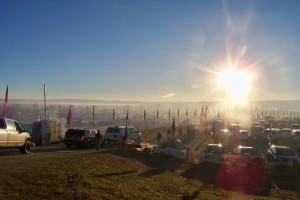
image1-300x200

When did it start? What does it all mean? How are we called to respond?

We’re talking, of course, about the Dakota Access Pipeline (DAPL) that snakes 1,700 miles from the Bakken oil fields of North Dakota to southern Illinois and that, if completed, would transport 450,000 barrels of fracked, highly volatile Bakken crude through land sacred to the Standing Rock Sioux and under the Missouri and Mississippi Rivers.

The original planned route of the pipeline had it crossing the Missouri north of Bismarck. That route was scrapped in late 2014, due, according to the Bismarck Tribune, to the “potential threat to Bismarck’s water supply.” Shifted now to the south, through unceded land of the Standing Rock Sioux tribe, it would cross the Missouri just north of the Cannonball River and the intake valves for the tribe’s water supply. This rerouting was done without an adequate environmental impact study and without any conversation with the tribe.

As construction neared U.S. Army Corps of Engineers land on the north side of Cantapeta Creek this April, the people of Standing Rock set up camp just south of the Route 1806 bridge and began efforts to block construction physically and through litigation. They obtained a stay in federal court and, over the summer, were joined in that camp – Oceti Sakowin or Seven Council Fires – by growing numbers of people from other Native American nations and allies.

Then, in late August, a federal judge lifted the stay and the Texas-based owners of the pipeline, Energy Transfer Partners, bolstered by new funding from Marathon Petroleum and Canada’s Enbridge Partners, began round-the-clock construction under the protection of local and state police, the National Guard, and company vigilantes.

The population of Oceti Sakowin Camp swelled to over 2,000 and, in September, clashes escalated between the Native American “water protectors” rallying round the cry “Mni Wiconi” (“Water is Life”) and “law enforcement” massively arrayed at the north end of the Cantapeta bridge.

“Law Enforcement” at the bridge

As protectors and journalists, exercising their First Amendment rights, found themselves facing armored cars, dogs, pepper spray, and rubber bullets…arrested, strip searched, and confined, in many cases, in dog kennels, the Episcopal Church stepped forward to stand with the people of Standing Rock. Bishop Michael Smith and the Diocese of North Dakota issued a strong statement of support. Presiding Bishop Michael Curry visited Cannon Ball and, describing what he experienced a “new Selma,” called upon Episcopalians to stand with their besieged Native American sisters and brothers. And, at its October convention, the Diocese of California passed a resolution applauding the Presiding Bishop’s actions; calling upon Bay Area Episcopalians to support the people of Standing Rock with money, study, and pilgrimage; and urging the Army Corps of Engineers to halt construction under the Missouri.

Still the construction continued – right up to the bank of the river – and violence threatened on an even larger scale. Then, in late October, the Rev. John Floberg, Canon Missioner to Standing Rock and Rector of St James Episcopal Church in Cannon Ball issued an urgent call for “more than a hundred” faith leaders to gather on November 3 at the bridge over Cantapeta Creek – an ugly frontline of burnt-out vehicles, a Jersey wall, and, now coils of barbed wire – in peaceful, prayerful, legal witness for justice and peace.

To his surprise, more than five hundred faith leaders – clergy and laity – responded…mostly Episcopalians, but Christians of all denominations, as well as Muslims, Jews, and others. Among that cloud of witnesses were a dozen or so – deacons, priests, laity, and a bishop – from the Diocese of California. Bishop Marc Andrus, Alan Gates of Epiphany, San Carlos, and a lay person or two slept in their tents in the camp. The older, less hearty among us slept in the comfortable beds of the nearby Prairie Knights Casino. All of us, however, spent considerable time in the camp, listening to the stories of those who had been there for months, imbibing their resolve, and rejoicing in the “opportunity to testify.”

For me it was a mountaintop experience…an experience that began with a November 1 evening arrival at Bismarck airport with two other deacons – Kathleen Van Sickle and Nancy Pennekamp (later joined by Phyllis Manoogian who flew up from Guatemala). Driving south on 1806, we were turned back at a National Guard roadblock and directed twenty miles north to a dirt road and a roundabout alternative route to Cannon Ball where we arrived close to midnight.

After lunch with most of the DioCal delegation, we headed to the camp, greeted at the entrance by signs insisting “No drugs, alcohol, or firearms,” directing new campers to obligatory non-violent direct action training, and, facing the highway, a banner, probably intended for would-be attackers, that proclaimed “We are unarmed.”
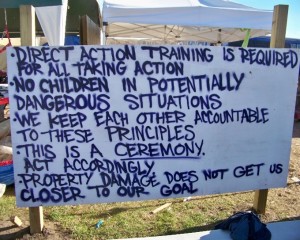
image4-300x240

WE ARE UNARMED

Inside we found an orderly, stable, clean mini-city digging in for the long haul. A main road of sorts was lined with the flags of nearly every Native American nation, smoke rose from a couple of well-supplied kitchens, and winter clothes were being distributed from several depots. Shelters ranged from the tiny one-person variety to huge army tents and dozens of tipis.

Main Street Oceti Sakowin

In a central square a sacred fire burned continuously. On one side of the square a steady stream of announcements emanated from an open-air administrative booth.

Off to the south was a small stable for the beautiful horses later ridden bareback by a protectors’ cavalry of sorts and, on a hill, a variety of “offices” housed a media team, the Indigenous Environmental Network, and a legal aid/medical team of doctors and lawyers. It was at that latter tent that the seriousness of the endeavor hit home. Briefed on what to expect and how to behave if arrested, we filled out forms with our next of kin contacts and special needs and were urged to write the legal aid phone number on our arms. I was somewhat amused, when, having later remembered my need for my asthma inhaler, I returned to note that on the form I had filled out earlier. Rifling through a stack of forms, a member of the staff found mine, now bearing a stencil pen star and a circle around the “transgender” I had included under “special concerns.”

Taking care of legal affairs

For three days, we spent time walking around the camp, meeting the campers, and listening… above all listening…listening to the stories, the history of indignities, the yearning for justice. I again recalled those Lakota words of wisdom “Listen to the wind, it speaks. Listen to the silence, it talks. Listen to the heart, it knows.” It was clear that what was about water had evolved into something even bigger. It was no longer just about a pipeline.

That was a theme that we heard later that evening during non-violence training in the gym of the Cannon Ball school, as one tribal leader after another described the richness of their culture and how they had been denied access to it.

At that meeting, John Floberg, who had earlier been handed a check for $2,000 from All Souls, Berkeley, stressed again and again that our witness the next day was to be peaceful, prayerful, and legal. It was, therefore, saddening to see a rump group of Presbyterians take the microphone under false pretenses and urge provocative actions that would surely lead to arrests and most likely violence.

John preaches non-violence

Despite that effort, our action the next day, November 3, unfolded peacefully and indeed prayerfully. For some of us it began with a 7:30 am sunrise Eucharist at Rev. Floberg’s St. James Church. North Dakota Bishop Michael Smith presided and Deacon Brandon Mauai, a member of the Standing Rock tribe, delivered a moving sermon about how he had been denied his heritage, how he would ensure that his children would not, and how he would forgive.

After a breakfast on the run – a banana in my pocket and a bagel smothered in peanut butter – we drove in caravan to the camp. I’ll never forget the shouted “Thank You”s from the campers assembled on the hill. Gathering at the sacred fire under the rising sun, leaders of our different faith traditions read our renunciations of the Doctrine of Discovery. Elders from the several tribal nations then burned a copy of the hated document in an abalone shell.

Renouncing the Doctrine of Discovery And burning it.

In our hundreds, we were individually blessed by those elders with the smoke of burning sage, as we marched in silence to the bridge. For a stretch, I also felt blessed, helping Warren Wong, a lay General Convention deputy, carry the huge Episcopal flag that has flown so many years from San Francisco’s St. James Church where I once served as deacon.

We were sent off with a blessing
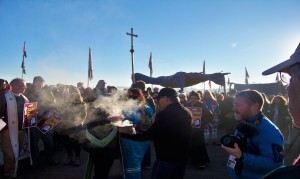
image10-300x179

At the bridge, beyond which close to forty police cars and a few armored vehicles stood ready to repel the faithful, while, overhead, a police helicopter circled low in an apparent effort to drown out our prayers and songs. Perhaps they felt threatened by the rousing rendition of “God’s Gonna Trouble the Waters” by the Rev. Stephanie Spellers, Canon to the Presiding Bishop.
As the prayers turned to speeches, I drifted to the fringes, anxious to talk with others in the crowd – a Muslim couple, a rabbi, a developmentally disabled deacon, Native Americans from Standing Rock and as far away as Mexico and the Peruvian Amazon, the young warriors on horseback and guarding the bridge, lest the previous night’s troublemakers seek to spark a confrontation.

There were Muslims, Jews, Christians and warriors on their horses.
And, at the end, we formed a huge Niobrara Circle of Life, each of us walking the circle, passing the peace. How incredibly moving to look into each other’s eyes, to shake each other’s hand, as we offered our “Peace,” a greeting I interspersed with “Shalom,” “Salaam,” “Paz del Senor, and the occasional African greeting “I see you.” Having removed my sun glasses to do just that, I left myself vulnerable. They could see my tears. But, then, too, I could see theirs.

The Niobrara Circle
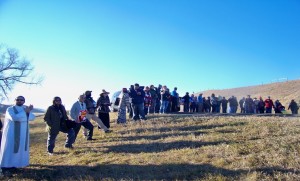
image15-300x181

Returning to the bridge long enough to enjoy a sandwich, we dispersed as silently and peacefully as we came, to return to our homes and tell our stories…as I have tried to do here.

To be sure, I and my sister deacons returned to the camp after lunch and again the next morning to continue the conversations we had started the day before. And, on Friday morning, we discovered that the “law enforcers” had strung rings of barbed water across the bridge and into the water on either side. And I found myself asking “Are we still in America?”

The ugliness of it all

Repelled by the ugliness of it all, we climbed into our rental car and drove down to Fort Yates, a pretty town that is home to the tribal headquarters and Sitting Bull College where we enjoyed a particularly rewarding conversation with the school’s Library Director Mark Holman.

Recalling the history I had learned at Wounded Knee and how the events leading up to the massacre there had included the killing of Sitting Bull at Fort Yates, I left a tiny stone on his grave.

I had, I thought, completed my witness But, returning to Prairie Knights Casino and taking the elevator up to my room, I found myself sharing the elevator with a Native American mother and her adult daughters. “Were you part of the action by the faith leaders?” she asked. When I answered “Yes,” she threw her arms around me and hugged me ever so tightly…no words, just a firm hug. And, when I got off, a smile and simple “Thank you.” I slept well.

Now I’m home, still learning, working my way through Mark’s recommendation, Roxanne Dunbar-Ortiz’s Indigenous Peoples’ History of the United States, the history we non-Native Americans have yet to learn…the history so well summed up by the words of Tatanka-Iyotanka (Sitting Bull) engraved on his memorial:

What treaty that the whites have kept has the red man broken? Not one. What treaty that the whites ever made with us red men have they kept? Not one. When I was a boy the Sioux owned the world. The sun rose and set in their lands. They sent 10,000 horsemen to battle. Where are the warriors to-day? Who slew them? Where are our lands? Who owns them? What law have I broken? Is it wrong for me to love my own? Is it wicked in me because my skin is red; because I am a Sioux; because I was born where my fathers lived; because I would die for my people and my country?

Yes, it’s more than just a pipeline.

But the struggle to block the pipeline goes on at Oceti Sakowin. Winter has arrived. A foot of snow has fallen and, as I write this, the high was 38 with wind whipped white out conditions across the plains. Worse yet, a defiant Kelcy Warren, the CEO Energy Transfer Partners, insists that “There’s not another way. We’re building at that location,” adding that the Army Corps of Engineers should cease its “political interference” and get out of the way. Perhaps bolstered by the President-Elect’s investment in the pipeline and disbelief in climate change, North Dakota Governor Jack Dalrymple has labeled the Corps-ordered delay “unnecessary and problematic.”

It is clear that further actions to stand with the people of Standing Rock, both at Oceti Sakowin and in local non-violent demonstrations (such as one I participated in Albany, California) will be necessary to demonstrate solidarity with our beleaguered Native American sisters and brothers and to raise public awareness about an issue that has gone unreported in the corporate media.

To that end the East Bay chapter of the Episcopal Peace Fellowship is planning to host an early January forum to share the experiences of those who have been to Standing Rock and to provide information to others who may wish to go or otherwise support the people of Standing Rock. Those in the area interested in sharing their experiences or interested in learning more at such a forum should contact Vicki Gray at vgray54951@aol.com or (707) 554-0672.

Voices for Justice: The Nakba Storyteller

EPF PIN member Tinka Perry reflects on the Nakba, commemorated in May, and an artwork she saw at the Native American Museum in Santa Fe after the EPF PIN leadership retreat in February.

This week I have been acutely aware of the Nakba anniversary. Over the past 4 years I have been learning more and more about Palestine, from reading, meeting Palestinians, and visiting there last summer. The more I learn, the deeper the inhumanities suffered by Palestinians, at home and in the diaspora, touch my heart. And it seems to get more and more difficult to talk with some people who just shut it out because of the ‘Israeli Narrative’ that we are told and believe until our eyes are opened.

I was blessed last February to be with 21 other people who feel the same, at the PIN conference in Albuquerque. Everyone in the room had Palestinians whom they know on their hearts. We were working on how we and our church can best help Palestinians, as some shared with us the trips they have made to Palestine. The most touching was when 4 PIN leaders showed a video from their trip into Gaza after the 2014 “war”…scenes from driving around Gaza, one scene of destruction after another. We were told this is former homes, this is a former school, this is a hospital. Yet here are women playing with kids, working to dispel the PTSD they are all experiencing. A ray of hope in a very broken world, yet the people there carry on…

After the conference I was at the Native American Museum in Santa Fe, and one of the first things I saw was a storyteller…a clay figurine of a Grandma/Grandpa telling the tribal stories, and there are many smaller figures on their chest, shoulders, arms, etc. This, for me, became a symbol of the conference. Except those on our hearts are not the ones hearing the stories, but the ones about whom we are telling the stories. The many Palestinians who remember the Nakba this week, and pray for a better future, as we do for them.

Christian Schools in Israel Remain Closed, Seek Equality in Funding

Editor’s Note: Resolution C018 Pursue Justice, Peace and Security in the Holy Land, passed at this year’s General Convention, resolved ‘That the 78th General Convention of the Episcopal Church express its solidarity with and support for Christians in Israel and the Occupied Territories.’  EPF PJN member Randy Heyn-Lamb from the Diocese of Los Angeles lifts up the funding crisis in the Christian schools in Israel and the witness of one Episcopal priest and his congregation.  Stay tuned for updates on the EPF Palestine Justice Network Facebook page and for updates on any calls to action.

Nearly a half million Palestinian students in Israel were not going to school this past Monday. According to the Israeli newspaper, Ha’aretz, a strike was planned by Arab schools in Israel in solidarity with the ongoing protest by Christians in Israel over funding cuts and tuition caps imposed by the Ministry of Education.

Forty-five schools administered by the Latin Patriarchate, the Melkite, and Greek Orthodox churches have remained closed since the September 1st school year start. Two Episcopal schools, St. John’s in Haifa, and Christ School in Nazareth, hurt by the same cuts, are also closed, as is the Baptist School in Nazareth. Some 33,000 students and 3,000 teachers are directly affected.

The Jerusalem Post reported more than 3,500 students, parents, teachers and school administrators participated in a rally on Sunday morning in front of the Prime Minister’s Office in Jerusalem. The protestors, who claimed more than 8,000 present, and whose numbers included twelve busloads from the town of Shefaram (Shef’Amr) in northern Israel, called for equality in funding with other religious schools, such as the ultra-Orthodox yeshivas of the Shas and United Torah parties affiliated with the government.

Fuad Dagher, the Rector of St. Paul’s Episcopal Church in Shefaram, rescheduled Sunday morning worship so he and his congregants could join in the Jerusalem protest. “This is about preserving the heritage of Christian education in Israel,” Father Dagher said. “We want to continue the tradition of excellence they offer.”

Ayman Odeh, chairman of the Knesset’s Joint Arab List, noted, “Almost a third of Arab university graduates and a majority of Arab high-tech workers are graduates of the schools the government is trying to paralyze.”

Christian schools are considered “Recognized but Unapproved” by the Israeli Ministry of Education. Until about 6 years ago, the Ministry funded between 60 and 75 percent of the costs of approved independent schools, with parental contributions and fundraising filling the gap. Since that time, the support offered by the Ministry has dropped to a third, and for some schools, less than 30% of their costs. At the same time, the Ministry, now led by MK Naftali Bennett, has placed caps on the amount that schools can charge in tuition.

The reason or such caps may be other than concern for financially-stretched Palestinian parents. Studies by the Follow-Up Committee for Arab Education show that Jewish students receive five times more funding than Arabs – $1,100 each compared to $192.

Earlier this summer, the independent journalist Jonathan Cook wrote in Al-Jazeera, “Israel is seeking to bring dozens of church-run schools under government control; a move that community leaders have warned will curb the last vestiges of educational freedom for the country’s large Palestinian minority.”

Quoting Yousef Jabareen, an Arab Knesset member, Cook reported that unlike the state-run schools, the church-run schools had been relatively free of governmental interference. “In the Arab state schools, Jewish officials appoint the principals, vet the teachers and dictate the curriculum. Christian schools have the flexibility to choose their staff, and teach pupils about their national identity, Palestinian culture and history, and their rights as citizens.”

Negotiations between the Office for Christian Schools in Israel and the Ministry of Education ground to a near-halt over the summer after the Ministry offered to increase school funding by 20 Million Israeli Shekels, a tenth of the 200 Million shekels school administrators feel they are due. Further discussions planned for September 10th have been rescheduled until after a period of mourning following the death of Mr. Bennet’s father.

In the meantime, parents like Fuad Dagher of Shefaram can only tell their children to be patient for the opening day of school.

The Wall

EPF PIN member Tinka Perry reflects on her time in Palestine/Israel with Episcopal Relief and Development.

I returned last week from a trip to Jordan, Palestine and Israel with Episcopal Relief & Development, and I am still trying to process everything. We saw sites where Episcopal Relief & Development is helping to heal a hurting world, and we saw the Christian pilgrimage sites where many people have their faith strengthened and confirmed. We renewed our baptismal vows in the Jordan river, we experienced a desert sunrise, with a eucharist service just after sunrise, we sailed on the Sea of Galilee, experienced Nazareth and Bethlehem, the Garden of Gethsemane, the Church of the Holy Sepulcher, etc.

do not enter

But for me, it was experiencing the Palestine/Israel of today that touched my heart so deeply. Our guide, Iyad, is a Palestinian Christian, and was eloquent about what we were seeing. We met with a Palestinian member of the government, with a Palestinian Anglican priest in Nazareth, a Palestinian Muslim, as well as Dalia Landau, the Jewish woman in the book, The Lemon Tree. And we passed signs that warned Israelis not to enter this territory, by law, because it is dangerous. We saw that only people with certain color license plates may enter certain checkpoints or drive on certain roads which save an hour driving time. We saw young Israeli soldiers at checkpoints, uzis at the ready, walking through our bus to make sure we were no threat.

watch tower

And we saw the wall. And we saw the wall again. The “security barrier’, wall of separation, the apartheid wall, the wall of exclusion, it does not matter what you call it. It is a wall of oppression. We live in a nation of racism, exclusion, inequality in education and services, classism, etc…which are very evident if you know where to look and what to look for. But this wall in Palestine is a constant visible reminder of the occupation and oppression imposed on the Palestinians. It does not separate the Palestinians from the Israelis as much as it separates Palestinian families and neighborhoods; it keeps Palestinians away from medical care if someone is in labor or having a heart attack; it keeps people from jobs, it keeps businesses from suppliers or buyers. What used to be a 900 foot walk to work is now over an hour’s drive. It keeps children from schools. It slices through neighborhoods like a knife. It is more than twice the height of the Berlin Wall, and runs 435 miles, whereas the ‘border’ is only 202 miles.nativity set

And the world sits idly by. I cannot wrap my brain around this. It is inhumane. I believe that this wall is another WAILING WALL…it is causing trauma and oppression. What would it be like if this wall had hundreds of people every day coming to a specific location to pray for peace, to press against its cold concrete to pray, to leave words of wisdom or pain on the concrete…To sing songs of peace and hope together. To lift our voices to the world about what is happening to Palestinians. What would we call THAT wall?


Living the Gospel: Some Concluding Reflections from Harry Gunkel on EPF PJN’s education work group and friends time in Palestine/Israel

Our journey has ended and we’re all back home in the US. It’s only been a few days but I’ve been in touch with some companions and we’re all struggling with re-entry. It’s nice to be home, and those of us with spouses, kids and grandkids are happy to be reunited. But some of us feel bereft of our time together – it was intense and intimate for 2 weeks – and our experiences there. It’s early days but on the whole, I’d rather be in Palestine at the moment.

It wasn’t a “holiday” and it wasn’t even what I would call “fun” most of the time. We certainly had laughs (and plenty of wine) but fun isn’t what it’s like to be with so many people suffering and so much pain.

But we didn’t go to have fun. We went to learn and see and listen and experience and stand up against what we all believe is a great wrong occurring and for those there who are engaged every day in it. We didn’t want to go bubble-wrapped in our white privileged perspective, to the limited extent we could step out of that.

We planned the whole journey, we made all the arrangements, we did not have a guide and we followed an itinerary that we hoped would bring us right up against what is happening. It was not a holy land visit. The only times that even came close to that were visiting the Ibrahimi Mosque/Cave of the Patriarchs synagogue in Hebron and our private Way of the Cross along Via Dolorosa but using a liturgy that contemporized the walk for a Palestinian Theology of Liberation. We often used public transportation and we stumbled and fumbled our way along. We were often tired, dirty, thirsty and disheveled.

This is not a paean to our foreign magnificence and generosity. We were not either of those things. But we were sincere and as intentional as we could be to look for truth, walk right up to it and look it in the eye. Sometimes that was affirming and sometimes it was awkward and uncomfortable and even hurtful for some of us.

But there were magnificence and generosity during our time there in the heroes that we met. And we met plenty. Nawwal, a woman from a small village near Hebron who knew early on in her life that she honored what was to be her expected role of wife, mother and housekeeper, but also gave expression to something in her that was ambitious, clever, and resourceful, so she started a women’s sewing cooperative that now gives power to other women also. Issa, a man of about 30, husband and father, who works all the time at substantial risk to stand against injustice in his land. His heroism is in his courage but it’s also in the integrity of it, refusing to demonize or hate. I cried a lot in Palestine, usually in the presence of suffering but I also wept after our short time with Issa at the sheer enormity of his humanity. And the young Jews from Tel Aviv who go as often as they can to join the demonstration in Bil’in against the illegal appropriation of village land. It’s illegal for them to be there but they know wrong when they see it. They talked with wisdom beyond their years about their compulsory service in the IDF and how they hold that in perspective now that they’re older.

Bil’in is a West Bank village near the border with Israel. Several years ago the separation barrier came across the fields that villagers need for their work. Although it’s been declared illegal by the Israeli Supreme Court, the barrier still stands because “Security” trumps the law there. For several years, every Friday after prayers, there is a demonstration against the barrier. We joined them one day. We arrived a bit early, so Abdullah, one of the leaders, invited us into his home for tea and conversation. Abdullah has been in prison so much for his actions that once he was holding one of his children. She was asked who her father is and she pointed to a poster of him in the village and not to the man holding her.

The demonstration began and as the group of villagers and Israeli and foreign supporters walked toward the barrier, the IDF immediately shot a barrage of tear gas cannisters. An enourmous cloud was created that comes upon you quickly and invisibly. It hurts alot and makes it difficult to breathe. It’s hard not to panic. So it’s effective in disbursing the crowd. Still tearing and coughing, Iyad invited us to his home and from his roof we watched phase 2 of the process. Young Palestinian boys/men now get serious with the soldiers. Some throw stones (it carries a 20 year sentence for Palestinians) and shots are fired.

Iyad’s 16 year old son was shot in the leg during the demonstration some months ago and has residual nerve damage. Iyad didn’t want his other 15 year old son to join that day, as he normally would. We watched that younger son pacing on the rooftop, wanting to be with his mates and comrades. It was one of the revealing moments of the journey for me. His desire to resist, to join his brothers was organic; it came from a young but deep well of justice that he learned from his father and neighbors. It was not about violence or machismo, it was about defending his home and family. It was magnificent and generous.

In Bil’in that day I saw generosity and hospitality, courage, commitment, suffering, solidarity, injustice, violence and love. It was a living Gospel day.


The difference between comedy and tragedy is “then”~ Lynn W. Huber

EPF PIN member Lynn Huber was part of a Compassionate Listening delegation to Palestine/Israel earlier this year.  She continues reflecting on what she experienced through current events on the ground.


Today I read an article in Time Magazine by Joe Klein entitled “Burned Books in the Holy Land: Jewish and Arab parents watch as Israeli’s hopes for peace fade.”

It is about an incident of attempted book burning (the little suckers are harder to get rid of than the vandals expected) by Jewish extremist terrorists who left the messages “No co-existence with cancer” and “Death to Arabs”.

The incident took place at Hand in Hand, an Israeli school in a border area between Israel and Palestine which houses a bi-lingual (Arabic/Hebrew) student body, staff and curriculum. There are regular meetings of the families of students, and a powerful program of on-going problem-solving and peacemaking. Then this.

The key word is “then”, not “this”. The difference between comedy and tragedy as I remember it from a college lit course is not whether or not there is conflict and suffering, but whether it is overcome. If evil wins, it is tragedy. If hope and love and peace win, it is called ‘comedy’.

For the first time perhaps in my life I suddenly became aware that as long as I continue to believe in, hope in, work for, practice the spiritual practices of love, hope and peace (not to mention the other ‘fruit of the spirit’ named by Paul of Tarsus1 such as patience, faithfulness, humility, self-control and kindness), there can be no tragedy. If the deaths of Michael Brown and Eric Garner do not turn us toward greater fear and hostility, but renew in us our commitment to continue to work for racial justice and peace in this country, THEN those deaths are not, in this sense, a tragedy.

While we grieve, it is hard to remember that. And we are inundated by so much grievable news.

But as a friend of mine reminds me from time to time when I need such reminding (and as I remind her when she forgets), hope and love and peace and kindness and persistence are Christian virtues (and, I note, similarly virtues recommended to their practitioners by Jewish and Muslim wisdom teachers). So tragedy is not dependent on
the worst that can happen, but is never the last word if, holding on to the best of which we are capable, we refuse ever to give up.

Find what you need to nurture your own hope, love and peace. THEN never give up.

_______________________

1 Galatians 5:22.

Palestine Justice Network | Copyright © 2026 All Rights Reserved

2045 West Grand Ave, Suite B #40058, Chicago, IL 60612-1577

info@epfpjn.org

LOGIN