PJNontheGo: Campaign to Release Female Palestinian Prisoners – a Call to Churches & People of Conscience 

The Israeli occupation prison system is exclusively for Palestinians and governed totally by Israeli military law and rule. The courts—including the prosecutor and judge—are also military run. Consequently, the conviction rate for Palestinians who are charged with anything is about 99.7 per cent. One-third of the 9,500 children, women, and men in prison today are held under “administrative detention.” They have no charges against them and no way to be released. Reports by B’Tselem, an Israeli human rights organization, and Francesca Albanese, the UN Special Rapporteur on human rights in the Palestinian territories, have documented the ways in which Israeli prisons use systematic methods of extreme violence and torture as a tool of genocide and ethnic cleansing.

 When did we ever see you sick, or in prison, and visit you? (also see Blog #9,  revjoycepenfield.substack.com )

The “Campaign to Release Palestinian Female Prisoners”, is an ongoing call to churches and people of conscience to answer the mandate of the judgment parable of Matthew 25:35-45 with a concrete plan. The campaign was launched in January 2026 by Friends of Palestinian Detainees– a network of faith groups across the U.S. from diverse Christian denominations and one Islamic center. The purpose of both the E-mail and the Post card parts of the campaign was to draw global attention to the conditions in Israeli prisons and to break through the barrier of silence among many church leaders about the ongoing violation of international rights, including the Geneva Convention and the Rome Statute of the International Criminal Court. The two reports, Welcome to Hell (2024) and Living Hell (2026) by B’Tselem document the systematic and grave violence used against Palestinians in these prisons, including beatings, sexual violence including rape, psychological torture, night raids involving dogs, tear gas and beatings, strip searches, food and medical care denial, torture, prolonged shackling, and sleep deprivation. 

E-mail Initiative

The E-mail campaign [ https://www.fosna.org/ friends-of-palestinian- detainees-project ] is on-going. It includes a suggested letter and email addresses to Israeli prison and military officials, the U.S. Ambassador, and others which includes demands for all Palestinians in occupation prisons: full access of International Red Cross to monitor all sites; an end to torture and sexual abuse; an end to the military court system and administrative detention; accountability for officials responsible for these human rights violations. Please send your letter and share the link to the website as widely as possible.

Post Card initiative 

The post card initiative focused on the release of Palestinian female prisoners and took place during the 2026 Lenten season. 

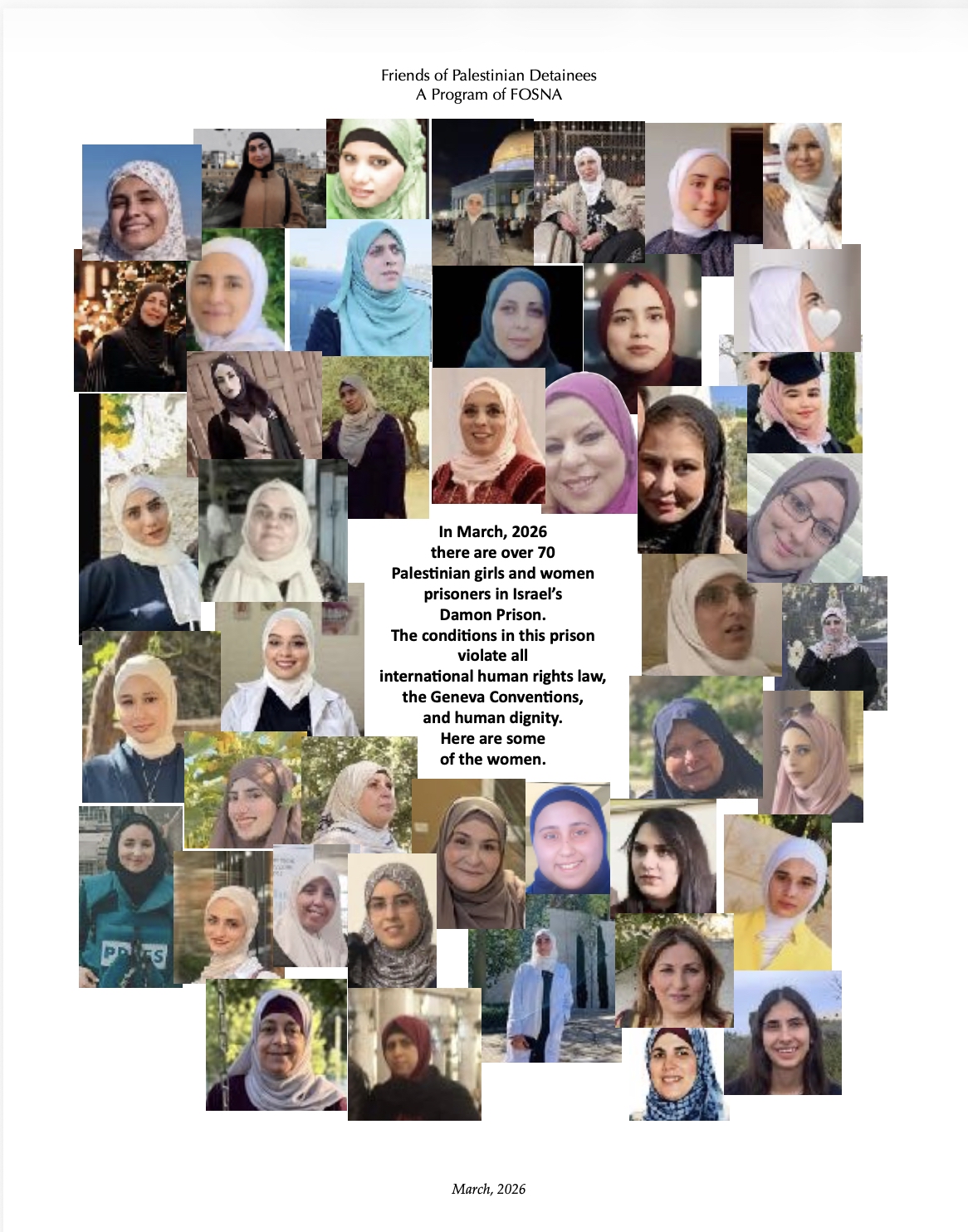
 Over 1,000 postcards were written by hundreds of people gathered by 14 different faith groups and one Islamic center across 15 states in the U.S. Photographs of all postcard messages were sent to the organizing team before cards were mailed to the 53 women (including 2 teenagers) at Damon prison, near Haifa. 

 As the postcards illustrate, most messages included a greeting, a prayer, a reference to the prison conditions, and a reminder of accountability in the words: The whole world is watching. 

The power of the postcard initiative did not end after the postcards were mailed. The fact that prison officials would not allow the women to receive any of the postcards became a story in and of itself as soon as we began informing reporters and media outlets and social media contacts (FB, Instagram, etc.). Many articles were generated both at local levels (written by faith teams who have covenanted to be part of Friends of Palestinian Detainees) and global level, including Mondoweiss.

One of the faith teams– St. Mark’s Episcopal Church in Washington, D.C.—was invited to do a video interview with Al Jazeera—a prominent media outlet focused on the Middle East. Lindsey Jones-Renault, a member of their team, did an excellent interview and description of the post card campaign provided by Lindsey:  https://www.facebook. com/share/v/1BPL3P14mw/

The post card initiative was very successful in involving faith communities who were new to the Palestinian struggle a concrete, positive and personal action they could take. This, in turn, helped them learn more about the suffering side of Palestinian daily life and the way in which Israeli prisons are tools of apartheid and genocide. The post card campaign invited others at any level of knowledge about the Palestinian struggle to participate in answering a prayer of guidance that was offered by a Sabeel weekly prayer service:

God of justice and love, embolden us to live out your mandate to “care for the hungry and to visit those in prison” by shedding light on the systemic violence in Israeli occupation prisons. Strengthen us to raise our voices on behalf of those who suffer from this brutality—captives and family members alike. Show us ways that we can work for the release of all Palestinians in Israel’s occupation prisons. ( www.Sabeel.org  ) 

Look for more on the postcard campaign in this month’s SOLIDARITY email which goes out on the 4th Thursday.

Friends of Palestinian Detainees 

The advocacy Campaign described above was initiated and organized by a Coordinating Team of Friends of Palestinian Detainees, a faith-led, all volunteer program of FOSNA (Friends of Sabeel North America –  fosna.org ) which began as a pilot project shortly after General Convention in 2024. The program draws its inspiration and guidance from FOSNA Executive Director Jonathan Kuttab and his effort to create pathways and space to be in solidarity with the Palestinian people in sustained and long-term ways based on respect and advocacy. This new program has implemented Jonathan’s vision by connecting a Palestinian prisoner and family member with a faith team in North America. The program currently has 14 faith teams of diverse denominations scattered across 15 states who are paired with a Palestinian prisoner. Most communication is with a close family member who is free and agreed to be paired so that their voice and struggle could help shed light on the conditions and violations of international law that the thousands of prisoners suffer. 

One of the first pairings we completed in 2025 was between Oak Life Church in Oakland, California and Layan Nasser and her mother, Lulu. Many know Layan’s name because of General Convention’s resolution to advocate for her freedom. FOSNA and all of the 75 people currently part of the Friends of Palestinian Detainees paired program rejoiced with Lulu on May 15– an otherwise sad day (Nakba Remembrance Day) for Palestinians, but a moment of joy also when Layan was released from Damon prison. 

 This program is still in the process of growing and expanding to go where God calls us to be faithful to the Sabeel prayer. We need faith teams to join us as well as faith groups and individuals who may only be available to help in our capacity building or advocacy campaigns. To learn more about the program and how to apply or offer your volunteer services see:  www.fosna.org/GetInvolved/ FriendsofPalestinianDetainees   or contact one of the members of the Coordinating Team: Mary Segall ( mesegall@icloud.com ), Rev. Joyce Penfield ( peacebuildersacademy@gmail. com ), Rev. Phil Lloyd-Sidle ( phil.lloydsidle@gmail.com ). 

PJNontheGo: Building a Pro-Palestinian Justice Ministry in a Fearful or Unsympathetic Episcopal Parish or Diocese

9 April 2026

Melissa Yarbray shared her vision on 4/9/26. My commitment to addressing Palestinian suffering began over 50 years ago while studying at the American University of Beirut (1969–70). There, I heard firsthand accounts from Palestinians about the torture and trauma their families endured—displacement, loss of homes and livelihoods, and violence during 1948 and 1967. The presence of refugee camps near campus made visible an injustice I did not yet fully understand.

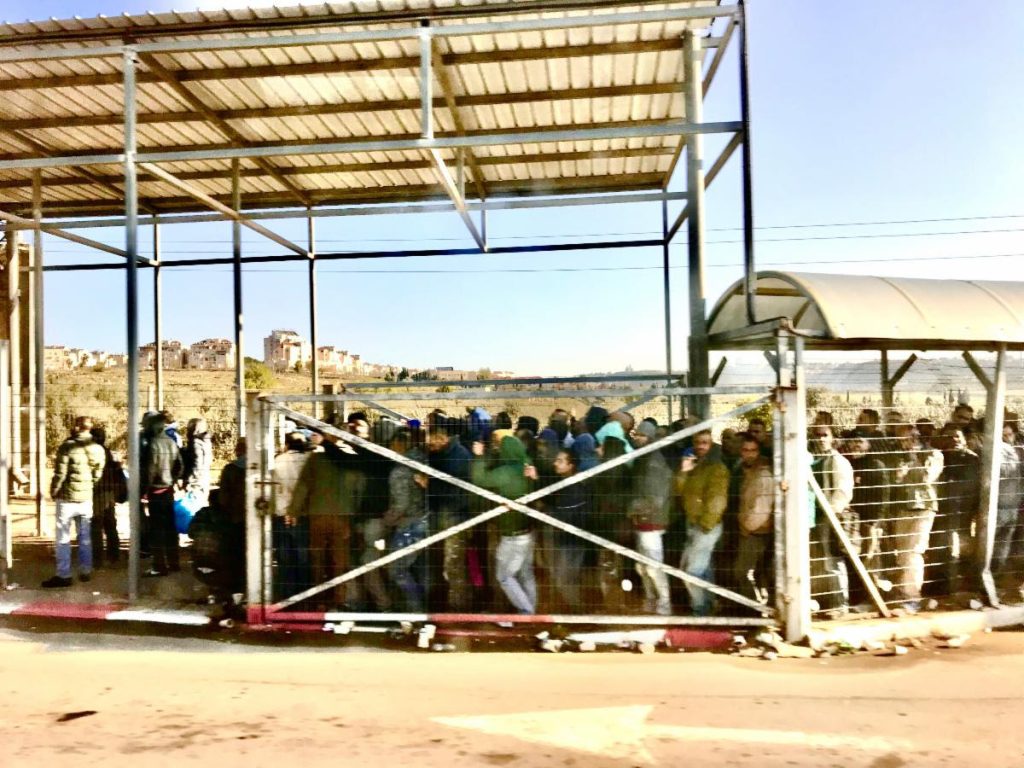
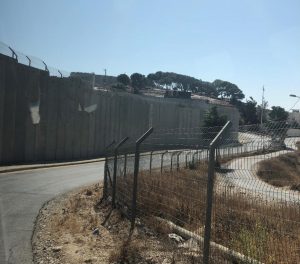
Photo: Checkpoint from Bethlehem to Jerusalem 2019.

Visits to the Holy Land in 2009 and 2019 deepened my passion for justice. Staying in Bethlehem, meeting local pastors and human rights organizations, witnessing checkpoints, different license plates and laws for Palestinians, revealed daily realities of living under military occupation. What I had studied for years became undeniable and urgent. I saw how dominant narratives prioritize Israeli security while Palestinian voices and lives are marginalized .

These experiences strengthened my resolve to foster awareness and action within my own community. At St. Margaret’s Episcopal Church, Diocese of San Diego, I discovered their Compassion and Justice Ministry, which called for advocacy on behalf of immigrants, refugees, and “Muslims”, with a commitment to “replacing fear with facts”. With the support of a new Rector, I began a discussion of adding “Voices for Peace in the Holy Land” as part of that ministry—taking the first steps toward creating space for truth, education, and faithful action.

Key principles for building a parish ministry promoting a just peace. 

Building Relationships is the entry point. Connect with a vestry member, clergy, or any individuals who are open to the topic. Spending time with the Rector, describing my background and vision, along with educational materials, was most beneficial. Educate yourself on communicating around controversial topics with respect and active listening, using resources available on-line. 

Initiating Interest: 

begin with bulletin notices that include news from the  Episcopal Diocese of Jerusalem AFEDJ , Palestinian pastors,  FOSNA EPF- PJN Churches for Middle East Peace  and the Episcopal News Service. My first bulletin notice invited parishioners to attend a new group to raise questions, share experiences with the issue, and learn how American Christians can contribute to peace in the Holy Land. Other good proposals: a book study or a film discussion. Build on early activity to form a committee and nurture trust.

Start small, and maintain patience. 

Build interest through tangible, educational, and non-threatening events. Over time, patience becomes a strategy, not a luxury. To raise interest, consider selling products from the Holy Land – Palestine olives with pamphlets about its history, alongside olive-wood carvings– with a clear statement that proceeds support EDOJ through AFEDJ. Highlight the Good Friday offering each year.

Education: 

from my experience, the #1 priority for success is parish education, especially because many people only know the issue through U.S. media or church narratives that avoid naming Palestinian suffering. They are hearing “Israel” weekly in liturgy and Bible studies without clarification of the difference between Israel in the Bible and the current State of Israel There are excellent curricula available from the denominations, such as Why Palestine Matters.

Curriculum tips:

  • Provide resource lists, books, films, credible definitions of terms like apartheid, ethnic cleansing, occupation, with lists of news sources that report honestly.
  • Clearly distinguish between Judaism and Zionism.
  • Study the several definitions of antisemitism, to avoid confusing criticism of a government’s policies with hatred toward Jews.
  • Stress the role of Christian Zionism and how it shapes interpretations of “the Holy Land.”

Voices: bringing Palestinian and Jewish perspectives into the same room. 

Palestinian voices can speak directly from experience. Via Facebook and social media, local Palestinians, Jews and Muslims have been drawn to our parish meetings. Invite Jewish voices that oppose injustice and challenge harmful policies. Recently our Jewish member led a book study on 100 Years War on Palestine. Have meetings/forums that make space for both fears and grief, especially during major escalations when people are carrying pain. One successful example was a brunch after Sunday service a few weeks after Oct. 7, 2023. A Jewish Voice for Peace speaker shared “Peace, Propaganda, and the Holy Land.” Attendance showed that the “too dangerous to ask questions” assumption is wrong—people come when the format is careful and the tone respectful, despite disagreements.

Common Obstacles: The biggest barriers are often inside church culture, such as disapproval by clergy or vestry. There is fear of losing parishioners, pledges, or offending Jewish friends. There is fear of being labeled antisemitic or being charged with supporting “terrorists.” There is fear of the unknown, expressed in the notion that churches should be active in ‘local issues’ and rely on prayers/ offerings to address Holy Land injustices, despite U.S. taxes supporting war.

Fear is a practical reality: clergy and parish leaders may resist naming the system clearly. But when Palestinian pastors insist on naming apartheid/ occupation/ethnic cleansing accurately, that instruction reshapes the ministry’s integrity. Justice work cannot be honest while avoiding precise language. Study Rev. Munther Isaac, Mitri Raheb, Father Fadi Diab of St. Andrew’s Episcopal Church in Ramallah, Holocaust survivors including Norman Finkelstein, and many others who are Jewish and speaking up against Israel’s illegal policies.

If our Baptismal Covenant is to be real, it must move beyond sympathy, thoughts and prayers into action—especially when the “other” is being treated as less deserving of dignity. Building a Palestinian justice ministry in an Episcopal parish is not an interruption of faith; it is how faith becomes accountable.

A Voice from the Ground Standing in Solidarity

A Voice from the Ground Standing in Solidarity

The Friends of Sabeel North America (FOSNA)-Sabeel “Solidarity Trip with Palestinian Civil Society” (November 26-December 6) was a pilgrimage for human rights – an opportunity to demonstrate support for Palestinian human rights and social service agencies that have in recent years been targeted for intensifying repression by the Israeli Occupation and settlers and simultaneously isolated by the pandemic. 

Sabeel is a Christian voice for liberation theology in the Palestinian context. Having experienced systematic discrimination, dispossession, and ethnic cleansing often justified by selective recourse to Scriptures revered by Jews, Christians and Muslims, Palestinians thirsted for a theology that emphasized justice, equality, and human dignity. In 2022 limitations on traditional Muslim and Christian religious gatherings during Ramadan and Holy Week, the attack on St. Andrew’s Episcopal Church in Ramallah on August 18, and the recent provocative visit to Haram al-Sharif on January 3 by National Security Minister Itamar Ben-Gvir have illustrated the Israeli Government’s growing disrespect for religious rights and ballooning sense of impunity. Encounters with religious leaders – the Rev. Munther Isaac of the Evangelical Lutheran Christian Church in Bethlehem, Bishop Emeritus Munib Younan of the Evangelical Lutheran Church in Jordan and the Holy Land, and Fr. Abdullah Julio, priest of the Greek Melkite church in Nablus – introduced us to courageous defenders of religious freedom.

The trip involved an intensive schedule of meetings with a rich array of activists. Certain themes resonated from one to the next: courage, creativity, and resilience in resisting the Occupation; the need to replace an ossified Palestinian Authority (P.A.) that serves primarily as an Israeli enforcement arm with a secular, democratic polity that allows diverse opinions to flourish; efforts to foster national unity in the face of the Occupation’s systems for crushing it; programs to develop youth leadership and increase the role of women. All of our meetings helped us piece together an understanding of how the Occupation operates and raised some useful ideas for advocacy. Any one of these encounters would be worth a write-up. Two, however, stood out for me as distilling the essence of a situation or assembling pieces of a puzzle. 

One was our meeting in Hebron with Ghassan, brother of Nizar Banat, which illustrated why many politically engaged Palestinians and their allies see the Palestinian Authority as corrupt and autocratic. Nizar was a carpenter who organized the movement known as “Freedom and Dignity” during the elections called for 2021 and then cancelled. Many felt that this campaign represented a serious threat to the Palestinian Authority’s reign. One night, fourteen P.A. soldiers stormed Nizar’s house, beat him brutally, and carted him away on a stretcher. Within an hour they delivered him to a hospital, where he soon expired. According to the autopsy report and nine forensic experts, his death was caused by damage to his respiratory system and heart. The P.A. insisted that he had committed suicide by banging his head against the wall of his cell and refused anything beyond an internal, sham investigation. No soldier was ever punished or disciplined. In response to the killing, the U.S. cut off subsidies to the P.A. police. Nizar’s brother is currently pursuing recourse in U.S. courts and plans a tour to raise donations. He has a gun for protection and, for their safety, lives apart from his family. 

Normally when a Palestinian living under the P.A. dies and after the authorities ascertain that the death is due to natural causes, the family submits the I.D. of the deceased in order to get a permit to bury the body. After the funeral the I.D. is returned, usually with its edges cropped to indicate that it is no longer valid. In Nizar’s case, given the disputed circumstances, the family got neither a permit nor his I.D. From the P.A.’s standpoint, the burial was not carried out according to law. The family instead produced 35,000 copies of Nizar’s earlier I.D. that are circulating in the West Bank and keeping his memory and cause alive.

For understanding how the Occupation undermines Palestinians’ efforts to forge a nation, our day with Salwa Duaibis and Gerard Horton, co-founders of Military Court Watch, was particularly instructive. MCW is a Palestinian NGO staffed by Palestinian and international lawyers who collect testimonies to document military detention of youth under 18 and how Occupation practices generally ignore both Israel’s own laws and the Geneva Conventions. Gerard described martial law’s origins in Military Order #3 issued on June 7, 1967. He outlined how the system of night raids intimidates and manipulates Palestinians, particularly in Area C, softening up the accused to get confessions, creating a network of informants through a combination of bribes and threats, sowing mistrust that destroys social links and communities, hobbling efforts to organize, and stifling unity. Salwa reported the devastating psychological impact on both detainees and their families. In the afternoon she took us to Ofer Prison, where we managed a very brief exposure to a military court hearing in one of the container-like sites. Thirty such hearings take place daily in each of a number of “courtrooms.” All are hasty, all conducted largely in Hebrew with erratic translation.  Most result in confessions because collecting the evidence and getting the legal support for countering accusations are practically impossible. 

While I took full advantage of nine days of the ten-day trip, I tested positive for Covid on day 10 and quarantined to avoid sharing. During this time, our Sabeel host and the staff at Saint Andrew’s Guesthouse in Ramallah provided abundant, reassuring support. I missed the meeting with the respected Palestinian human rights organization Al-Haq, whose offices were raided on August 18. I also missed the discussion with Palestinian-American Sam Bahour, who moved to the West Bank in 1995 to help develop the economy of the future Palestinian state promised by the Oslo Accords. Such a position provides a ring-side seat for observing how Israel’s stranglehold on Palestinian economic development demonstrates the extent to which the Accords are a charade.

Overall, this recent experience of the Occupation left me feeling much as had my Sabeel Witness Trip in November 2012. It was at once heart-rending and enraging to see its subtle cruelty and its physical brutality. At the same time, it was awe-inspiring to witness the steadfast courage and resilience that the vast majority of Palestinians daily demonstrate through their nonviolent resistance and their ability, despite everything, to smile, laugh, experience and radiate joy. Two questions haunt me. How does a commitment to nonviolence survive the grind of the Occupation – its unrelenting intimidation, humiliation, and brute force under the umbrella of U.S. protection? Were I living under such a regime, could I remain nonviolent?  

Thanks to EPF PIN member Priscilla Read for this report.

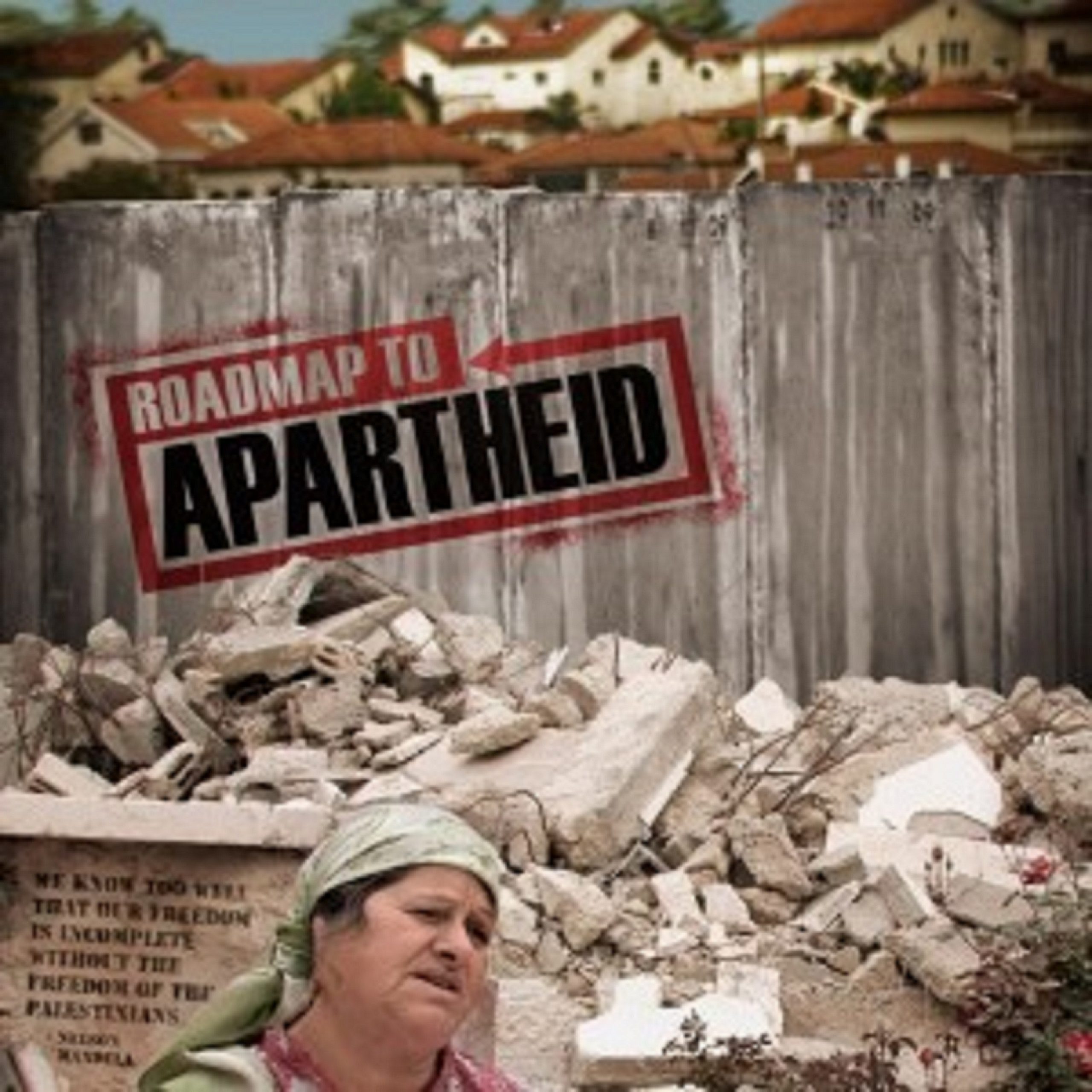
Save the Date: An Online Film Salon: Roadmap to Apartheid

Save the Date: 13 September 3PM ET

VFHL Online Film Salon   “Roadmap to Apartheid”

Hosted by Voices From the Holy Land and EPF-PIN 

The film “Roadmap to Apartheid” graphically asserts that the Israeli system of total military, economic and social control over the lives of Palestinians constitutes Apartheid. Historical footage and the compelling testimony of South Africans take us back to see and understand the system of White Supremacy that gave its name to a UN-banned crime against humanity.

Side-by-side with what happened in South Africa, the highly acclaimed film takes us to Palestine-Israel, where we see the same kind of rules and the same brutality inflicted on Palestinians. South Africans make the connection and say: “This is another Apartheid.” Palestinians and Israelis detail how Israeli Apartheid operates and how it is being resisted.

Is it really Apartheid? Many in Israel and the U.S. deny it. … 

On September 13, please join us in a 90-minute interactive discussion of the film, which will be made freely available to view in advance at your convenience. Guest experts will update us on subsequent developments that are making the Israeli-Apartheid reality ever more evident and ever harsher.

In a time of crisis, when Americans and the whole world are waking up to the profound harm of racism – and insisting that things must change – the issue of Israeli-Apartheid demands our urgent attention and response. Please mark your calendars for Sept. 13 and be on the lookout in the coming weeks for registration details and instructions for accessing the film.

On Pilgrimage 6

One who journeys without being changed is a nomad.
One who changes without going on a journey is a chameleon.
One who journeys and is transformed by that journey is a pilgrim.
–Mark Nepo
The EPF PIN-led delegation to Palestine has completed its time there. All the pilgrims have returned to their homes in the US now, but the pilgrimage continues in each participant. These final reflections are deeply personal, excellent examples of the process of pilgrimage as Nepo defined it. As any holy land pilgrimage ought to be, this one was unsettling but, ultimately, transformative.


October 23, 2019


Bethlehem

By Neal Halvorson-Taylor

Mary and Joseph crossed hills and valleys

to be counted here by their Roman occupiers.

.

Tall, cement walls cut into hills and valleys

For miles and miles.

To cross it,

Palestinians stand in line for hours

With permits and identification,

Taking off belts and shoes and dignity,

Emptying their backpacks, pockets, humanity.

.

To travel from Bethlehem to Jerusalem,

A short distance through an urban landscape,

We take a cab to a checkpoint crossing,

Walk up a ramp, go through turnstiles,

Place our things and bodies to be scanned,

Open our passports, cross the line.

.

We went through the Erez Crossing,

A tense, tedious security process,

Israeli military first,

and then Hamas,

Show permits, open bags.

Cross into Gaza. Cross into trauma.

  .

Walls and crossings ensure Israeli security,

Conventional life behind them

Guarded by young soldiers and high-tech weaponry

Keeping watch on the restricted inhabitants.

.

Fear met the holy child.

Fear builds walls.

Fear covers the land like a layer of desert dust.

.

How to shake it off?

How to cross into the danger of humanizing the other?

On Pilgrimage 5

 One who journeys without being changed is a nomad.

One who changes without going on a journey is a chameleon.

One who journeys and is transformed by that journey is a pilgrim.

–Mark Nepo

The EPF PIN-led delegation to Palestine has completed its time there. All the pilgrims have returned to their homes in the US now, but the pilgrimage continues in each participant. These final reflections are deeply personal, excellent examples of the process of pilgrimage as Nepo defined it. As any holy land pilgrimage ought to be, this one was unsettling but, ultimately, transformative. 


Distracting Ourselves from Hopelessness

Kathy Christison

Since returning three weeks ago, trying to pen some reflections on this my umpteenth trip to Palestine to witness to the human catastrophe that Israel and my government have visited on the Palestinian people, I’ve been wrestling with sadness, grief, depression, I’m not sure what. More so than has been usual for me. Thoughts about hope tumble around in my heart—whether what I witnessed in Palestine this time, especially in Gaza, gave me hope for the Palestinians’ future or stripped me of hope, whether our group’s visit inspired some bit of hope in the Palestinians we met, whether these Palestinians inspired us with hope, whether ultimately we’re all simply distracting ourselves from hopelessness. I think my answer to all these questions is yes in some measure.

To me, Palestine has always been magical in so many ways: the abrupt undulations of its landscape almost heart-stopping in their majesty, the expanses of desert and mountain deeply evocative of life as Jesus must have lived it here, the people—especially the beautiful people of Palestine—remarkably warm, gracious, resilient. It’s always wonderful to be there. But it’s also always sad. I wasn’t even really aware of all the history the first time I visited, coming up to 60 years ago—of the fact that various actors had already given Palestine away, or simply taken parts of it, multiple times. But even back then, there was the knowledge of dispossession and refugees, and sadness.

On each trip in the decades since then, things have grown worse—worse in reality, not merely in my understanding and perception. Each visit, each year, you think nothing could get worse, but “worse” is a bottomless container when Israel is filling the pit with killings, walls, movement restrictions, home demolitions, cages, sieges, bombings, land theft. And when the United States just adds more and more to Israel’s arsenal: use up a lot of bombs to flatten multistory apartment buildings in Gaza, did you? Don’t worry—one US president or another, one Congress or another, will simply replace the armament, and add more for good measure. And, while they’re about this, will cut more and more from the aid budgets of any organization, international or otherwise, that helps Palestinian recovery.

Enough of my complaining! This reflection is, after all, not about me and my feelings; it needs to be about the Palestinians and what they endure. So, ultimately, if I feel hopeless on behalf of the Palestinians after again witnessing what they live with under Israeli domination, I cannot show it. The Palestinians we met didn’t show it—they can’t because hope is the only thing that keeps them going. Hopelessness is not really an option for any of us, American or Palestinian, and I have absolutely no right to it—no right to stop at least working as though I have hope. I’m not the one suffering this catastrophe; as someone whose government supports Israel’s settler colonial regime and serves as armorer of Israel’s massive military machine, I’m complicit in what has been done to the Palestinians, so I cannot simply give up.

The task that I and all of us solidarity activists and pilgrims perform during each witness trip, with each street protest, with each prayer that we recite and article we write that speaks truth to power is to distract ourselves from hopelessness. I can always come home and escape the bad water, the aroma of sewage spilling into the sea, the lack of electricity, the grinding poverty, the desolation of life in Gaza, the nighttime military raids and arrests of children in the West Bank. But I can never separate my heart or my spirit from Palestine and the suffering of its people, so I can remain filled with sorrow and righteous anger, but I can never stop hoping and working.

.

Below is a kind of poem that I wrote 15 years ago for the online magazine Counterpunch.org. It expresses the way I still feel about Palestinians today. (If I were writing today, I would add more about Gaza, which I hadn’t even visited 15 years ago. I would particularly add some thoughts about the young men we saw in Gaza outside a hospital, with missing legs or leg injuries that require casts or prominent orthopedic hardware protruding from lower legs, because they’ve been shot in the leg by Israeli snipers during nonviolent protests at the barrier that encloses besieged Gaza and separates it from Israel. The protesters have been asking, for the last almost two years, for the ability to return to homes and land that their families lost in 1948 when Israel was established. Israel has responded with a violent NO!, by shooting many to death, including first responders there to rescue the injured, and by precisely shooting many young men in the leg. Thousands have lost limbs or been permanently disabled. One can only assume that Israel is trying to shoot the legs out from under any prospect of Palestinian resistance.)

.

CounterPunch ( https://www.counterpunch.org/2004/12/22/imagining-palestine/ )

December 22, 2004

Imagining Palestine: A Cri de Coeur

By KATHLEEN CHRISTISON

A Palestinian child died in my arms today. It was a young boy; it was a girl. It was an infant; it was a 13-year-old. She had been shot 20 times by an Israeli soldier firing U.S.-made bullets; he had been dismembered by a missile fired from a U.S.-manufactured Israeli helicopter gunship. I am a Palestinian, and these were my children.

I am a Palestinian. I say I am a Palestinian to express my solidarity and that of many silent Americans with a suffering people under Israeli domination. But I must bow my head in shame, for it is my government that pays for Israel’s oppression of the Palestinians, my government that is committing ethnocide against the Palestinians, my government that is killing Palestinian children. I am a Palestinian, and I reject my American government.

I comforted a woman today whose house was demolished by Israeli bulldozers, monsters of destruction made in America. I helped her pick through the rubble of her home to retrieve her children’s clothing and toys. I comforted her children, who will have no toys and no place to sleep tonight. I listened, thunderstruck, as her husband wailed aloud, standing in front of the pile of broken concrete that was his home. I will not be able to persuade his children that he has not failed them, not failed to provide the protection that any father must give his children. I imagined my own home in ruins, my own children bereft, and I wept. I am a Palestinian, and this woman, this man, these children are my countrymen.

I stood with a Palestinian farmer today whose agricultural land has been destroyed by Israelis. He is a middle-aged man whose olive orchard, his only means of livelihood, was burned and cut down by U.S.-subsidized Israeli settler thugs. The farmer is a young man whose greenhouses and prime agricultural land, left to him by his father and his grandfather, were leveled by Israeli soldiers driving U.S.-manufactured Caterpillar bulldozers, clearing land for a concrete separation wall meant to grab prime land for Israel. The farmer is an old man who watches daily as Israelis build new homes in settlements on land that belonged to him until it was stolen. I am a Palestinian, and these farmers once fed my now-impoverished people.

I stood in the hot sun at the notorious Huwara checkpoint south of Nablus with hundreds of Palestinians waiting for permission to go to work, to school, to medical appointments. I stood in the driving rain at the Qalandiya checkpoint between Jerusalem and Ramallah, waiting with hundreds of others who must pass here every day, waiting for hours to get to work and then hours more to return home. There is no sun more searing, no rain more cold and driving than in Palestine, yet we all stood like automatons, fearful of arousing the anger of the power-mad teenage Israeli soldiers who control our lives and our freedom, fearful that they would shoot us if we showed any evidence of emotion. In the middle of the night last night, I consoled a woman who gave birth on the ground at a checkpoint because an Israeli soldier in his teenage wisdom regarded her as a security risk, and later I rode in the ambulance as she bled and her baby turned blue and perished. I am a Palestinian, and I stoically endure the peculiar humiliation of these checkpoints with my countrymen.

I gave solace to a Palestinian political prisoner today and to his wife. I am a Palestinian, and this man is serving time for fighting for my freedom. I picked a fig from a tree in my front yard today and ate it. It was the most delicious sweetness I had ever experienced. I believe this because I am a Palestinian, and the fig tree grows in Palestine.

Ordinary words fail. The horrific fate of Palestine cries out for the power of poetry. This is no powerful poem, or any poem at all, but it is a cry from the heart. I care about murdered Israeli children too, but there are far fewer of them, and my government already embraces them. I embrace Palestinian children because so few others do, because my government cares nothing about them, because my government kills them.

I am a Palestinian. I live the daily lives of Palestinians. I cradled a dying Palestinian child in my arms today.
On Pilgrimage 4

One who journeys without being changed is a nomad.

One who changes without going on a journey is a chameleon.

One who journeys and is transformed by that journey is a pilgrim.

–Mark Nepo

The EPF PIN-led delegation to Palestine has completed its time there. All the pilgrims have returned to their homes in the US now, but the pilgrimage continues in each participant. These final reflections are deeply personal, excellent examples of the process of pilgrimage as Nepo defined it. As any holy land pilgrimage ought to be, this one was unsettling but, ultimately, transformative. 


It’s been 14 days since I left Palestine to return to the comfort of my own country & my beautiful mountain home. But like grief, my dis-ease lingers in the background only to overwhelm me with tears and heartache as the pain I feel intensifies without warning. I grieve for the Palestinian people I’ve met and wonder how they can go on–a preposition without an object for the foreseeable future. I marvel that they have any hope left, for their condition is older than my 70 years as they were invaded by the world’s guilt a year before I was born. Until my early twenties I used to feel good that the Jews returned to a homeland but slowly and surely the horrors perpetrated upon Hagar’s descendants have seeped into my consciousness. Now after visiting the not so Holy Land, the Inhumanity Land, the concrete nature of the human rights violations has cured into a huge weight upon my head and heart. I see my task on their behalf as replicating the education I have received–a preacher of the Bad News says the cynic within me but perhaps more accurately a preacher of my experience of said inhumanity.

Throughout the 11 days I spent with the Palestinian people I continued to ask myself how can human beings do such things to human beings, how can the Israelis be so blind to the horrors they inflict when 80+ years ago they were the victims of the Final Solution. Throughout their existence they have been reviled, have been “done dirty,” and dismissed as less than human. It reminded me of my mother in law who had to run from the Nazis in 1939 because she was 1/4 Jewish. Fifty years later I was holding her granddaughter as we stood with her in front of an elementary school in Northern Italy. She wept for it was here that she had hidden from the growing Nazi presence in her Viennese homeland. The school had offered stability and comfort, a parental security, in the face of uncertainty and fear as her home had become no home. While in Palestine my anger rose as I continued to ask myself, how can people do evil to fellow people: Nazis to Jews, Jews to Palestinians, white men to Native Americans, federal government to Japanese Americans, whites to blacks (Hispanics, Arabs, Asians)? The names of places are a heart ache as well: Bosnia, Rwanda, El Salvador, Ireland, Wounded Knee, Syria, Gaza.

Then it suddenly struck me that every so often over the years I’ve had an answer to the question of how the Jews can do this to the Palestinians or how any people can inflict human rights violations on the “other.” In the summer of 1989, my wife and I and our 11 month old daughter were driving to Paris. We had just left my mother in law in Vienna. She had shared her pre-World War II memories of the Nazi “occupation” of her Austrian homeland, the Italian elementary school above, and the Anschluss. Given those stories we were intrigued to get a first hand look at the Nazi concentration camp outside of Munich near the village of Dachau.

As we got closer and closer I found myself experiencing not anticipatory grief so much as anticipatory sadness or suffering. It was as if I was working myself up to feel the emotional wrenching that I expected would come. I still remember my first reaction as we entered the Dachau Camp. I was stunned at how vast it was. The immensity of it was astounding as I realized the incredible numbers of prisoners who must have suffered there at any one time. The rows of barracks were so enormous I couldn’t see them all. (Ironically, the length and look of the fencing in Dachau is eerily similar to that of the walkway for Palestinians at the Arez checkpoint into Gaza.) As we strolled through the memorial, seeing the images and reading the accounts of the horrendous history, I started to get depressed. I felt sick to my stomach. But without warning my daughter began acting out. My anger flared as I was instantly irritated. How dare she!! I was preparing to give my heart to one of the worst, most disgraceful acts of inhumanity in human history. I yearned to feel the self-righteous indignation of feeling so good about condemning such atrocity. But my daughter was crawling around on the floor of the museum, wouldn’t be still, and as I remember began to cry in a fit of no attention. I was suddenly raging inside: You want attention!! I’ll give you attention!! Can’t you understand I need this time!! The Light within suddenly burned brighter than my anger. I was standing in one of the darkest places in recent history yet looking into a mirror reflecting one of the darker, more embarrassing corners of my psyche. I have the Nazi inside of me. I am the Jew oppressing the Palestinian. For I am capable of seething anger at a baby for no other reason that it upsets my perceived, emotional needs. While the “darkness will never overcome the Light,” it does not do well to ignore one’s own darkness & cast it upon any you consider “other.” Jung called it the Shadow.

Again, another memory serves me well here. During seminary I did some group therapy with one of the wisest women I’ve met in my life. Anytime one of us in the group would begin condemning someone else’s action or identify someone else’s foibles or begin to offer solutions for someone else’s problems, she would begin singing an old Southern spiritual: “It’s me, it’s a me, it’s me, Oh Lord, standin’ in the need of prayer. T’ain’t my brother, t’ain’t my sister, but it’s me, Oh Lord, standing in the need of prayer.” As the years have gone by I’ve gotten better at seeing my own projection as I did in Dachau and I picked up on it at times in Gaza and Bethlehem and Hebron. I’m not as good at dealing with my own darkness. I want to ignore it or deny it as I’m afraid to deal with the horrors going on in Hebron or the Hebrons here at home.

It helps to talk about it, own up to it. As I finish my reflection here I come back to the counsel of one of our Palestinian guides, which was something to the effect of: “What we need from you is not so much being on the ground here but instead carrying our story out to your world while focusing on correcting the injustices in your own country, state, and village.” 

Two thoughts come to mind in that regard

1) Last night as I told a friend about our Palestinian experience, he commented that the Jews have not done well in dealing with the suffering and the violation they experienced during the Final Solution. It reminded me of Richard Rohr’s words: “Pain that is not transformed, is transmitted.” I have some major hope as I experienced many Palestinian folks facing their pain and seeking to transform it without transmitting it. I’m standing in the need of prayer here as I admit my own inner pain which is touched by the suffering we saw in Palestine and the suffering I see in the hospital each week. It is up to me to bring that before God and work on processing it so as not to transmit it to the world. I will work for justice based on my own need for mercy.

2) I saw a cartoon years ago during the Bosnian ethnic cleansing. The first panel read, “Never again in our lifetime!” with a silhouette of a concentration camp; the second panel had an asterisk with the phrase, “Some restrictions do apply!” I do get sad and I do get “whelmed over” as our kids used to say and I do fear at times that nothing can be done. But when I lose hope little things pop up like the words my Jewish colleague has posted over our shared desk:

      “Everyone and everything we encounter is a shell or a container for a hidden spark of holiness. It is up to us to help free the hidden holiness in everything and everyone. We restore the holiness of the world through our loving-kindness and compassion … every act of loving-kindness, no matter how great or small, repairs the world.” Rachel Naomi Remen, My Grandfather’s Blessings


On Pilgrimage 3

My First Pilgrimage of Companionship to Jerusalem, Gaza and Palestine:

Some Wonderings

We have been here for three days and my spirit is on overload. The sights and sounds and smells that surround me heighten all of my senses as I pass through the Damascus Gate into old Jerusalem for the first time. Holy sites, Israeli flags, bustling markets, and a mass of humanity from all parts of the globe. I’m humbled by the thought of literally walking in the footsteps of Jesus, yet confused by the conflict and “dis ease” I feel as a follower and disciple of the Prince of Peace.

In just three days I have been introduced to three amazing organizations with passionate leaders; I have heard their stories, witnessed their vocational vision and been touched to my core. I feel as if I’ve been privileged to bear witness to the work and ministry of modern day prophets.

On Day One we were given a “political tour” by Fayrouz Sharqawi, the Global Mobilization Coordinator for Grassroots Jerusalem. We saw how neighborhoods and villages have been systematically destroyed and taken over and how the wall has divided and cut-off Palestinians from their land and from each other. She has great clarity that this is a long-standing political battle and not a religious one. She believes that the Palestinian people are the one’s who need to set the agenda for a solution in order to reclaim their humanity. We can best support the Palestinians by taking a hard look at the realities in our own country and doing the work we need to do to bring about justice. A candle is lit in the darkness.

On Day Two we were driven to Bethany and saw for ourselves much of what had been pointed out from a distance the day before. What used to take 15 minutes took us an hour and a half due to check points, and the division caused by the wall. We visited House of Hope, Vision Elementary School and Kindergarten, a Waldorf School in Bethany and met with the founder/director, Milad Vosgueritchian and his spouse and lead teacher Menar.

In describing their decision to stay in Bethany despite the many difficulties they face he said, “We prefer to light a candle rather than living in the darkness.” They attempt to bring healing to the children’s hearts through music and the arts. We can’t solve all of the corruption but if we can save one child we have made a huge impact.

Constant trauma is one of the major problems facing the children. They are used to being stressed. Their son’s drawings of bombs dropping from the sky and smoking buildings show his reality. A couple of weeks ago they had a lot of increased violence and bombs in their neighborhood. Their son’s asthma was acting up and he said, “Oh no! I won’t be able to breathe again.” Menar asked him to go and get some lemons and he came back with 3 lemons and 3 bombs. Nissan is 9, Menar is 34…she relives her upbringing and the violence she experienced through his eyes and that helps her heal even though it’s very hard watching the impact it is having on her son.

In Dec. 2016 Milan and Menar received a grant from Japan to serve more communities. They took children 3-16 years old; kids that had been divided by the wall, that have never seen the sea even though they live just about 30 miles from it, have never seen a green forest. They attempt to shift the children’s anger through music and the arts and they notice that the kids begin to forget they are enemies. Applying the world of education, working on their hearts and then their minds, shaping a new generation of Palestinians. A school that provides a safe place for children of all faiths in Bethany. A candle is lit in the darkness!

The morning of Day Three we set out for Gaza. Why? Because no one visits Gaza; we go because we can and our presence helps to remind the Gazans that that they are not forgotten. We are taken to Al Ahli Arab Hospital and meet with the Director, Assistant Director, and the Medical Director. The passion and vision they have for their hospital and the urgency of ensuring that Al Ahli Hospital continues to be there for all Gazans in the future, offering the best medical care possible in a war torn area is palpable. I had heard before of the difficulty for amputees waiting for prosthetics and surgeries. What I didn’t realize is the significant increase in these injuries since the Great March of Return. They described how many times their patient’s limbs are affected because the Israeli soldiers shoot at their legs. At the hospital, they are working hard to enhance their microbiology so that they are able to provide the correct antibiotics in order to save the patient’s limbs and sometimes their lives. When that is unsuccessful the resultant need is for prosthetics. All of this would be difficult anywhere, but in Gaza where there is very limited access of materials in and out it is miraculous what they are able to do. Candles are lit in the midst of great darkness.

I wonder what candle I’m called to light? How do we do our own work in our country and spheres of influence in such a way that we support and shine a light on the work of our Palestinian brothers and sisters?

On Pilgrimage post 2

October 15, 2019

Jerusalem

The olive trees that line its streets are filled with ripening olives. The distinctive tan limestone used in the Old City wall and many other buildings produces a certain soft uniformity to the architecture dating back centuries. And the food is amazing. Lots of hummus, baba ganoush, mujadura, za’atar, tabbouleh.

It’s night time, and like any city there are traffic sounds, street lights, and from somewhere the bark of a lonely dog. During the day throngs of pilgrims empty their buses and walk through the Old City to the Church of the Holy Sepulchre and the Western Wall. Pilgrims from Kenya, China, Germany, the United States. You name it. They’re here. In great number. Seeking religious history, some spiritual renewal. That which they seek, Jerusalem seems to fulfill. And yet the backdrop to these sites, the city itself, is not devoid of an ongoing perplexing reality.

Tonight’s darkness descends once again upon the glaring complexity of the political situation that besets the people of Jerusalem and those who live on the other disputed land of Israel and Palestine. Being here forces me to confront the vexing reality of the present conditions. Yet any attempt to explain the problem fully and to reach any possible resolution stymies me.

The players of this living theater are the Israelis and Palestinians. And audience neutrality doesn’t seem an option. And so, in such a dilemma, Christians go to where the suffering is. It is the cross that leads the way—a present day Via Dolorosa. And, while suffering is surely universal, the chronic suffering here in this holy place is hidden in plain sight. Poetry may be the only means to convey what I’m starting to see. Darwish (1941–2008) was a Palestinian poet.


“In Jerusalem” by Mahmoud Darwish

In Jerusalem, and I mean within the ancient walls,

I walk from one epoch to another without a memory

to guide me. The prophets over there are sharing

the history of the holy … ascending to heaven

and returning less discouraged and melancholy, because love

and peace are holy and are coming to town.

I was walking down a slope and thinking to myself: How

do the narrators disagree over what light said about a stone?

Is it from a dimly lit stone that wars flare up?

I walk in my sleep. I stare in my sleep. I see

no one behind me. I see no one ahead of me.

All this light is for me. I walk. I become lighter. I fly

then I become another. Transfigured. Words

sprout like grass from Isaiah’s messenger

mouth: “If you don’t believe you won’t be safe.”

I walk as if I were another. And my wound a white

biblical rose. And my hands like two doves

on the cross hovering and carrying the earth.

I don’t walk, I fly, I become another,

transfigured. No place and no time. So who am I?

I am no I in ascension’s presence. But I

think to myself: Alone, the prophet Muhammad

spoke classical Arabic. “And then what?”

Then what? A woman soldier shouted:

Is that you again? Didn’t I kill you?

I said: You killed me … and I forgot, like you, to die.

Full moon behind Jaffa Gate, Old City Jerusalem


On Pilgrimage post 1


IN JERUSALEM

“There are no unsacred places; there are only sacred places and desecrated places.” Wendell Berry

Being in Jerusalem is living in the prosaic Best of Times/Worst of Times. The anticipation of a thrilling spiritual experience quickly becomes a troubling moral struggle.
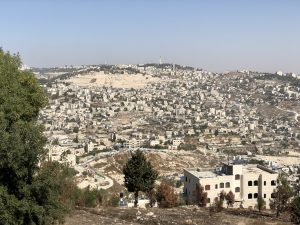
Jerusalem is surely one of the world’s most singular places, a living phenomenon of history and mythology, but while it inspires and exhilarates, it simultaneously disappoints and crushes. As with Beszel and Ul Qoma in the novel The City and the City, there are two cities in the Jerusalem municipal boundaries, virtually overlapping but existing on separate planes. Moving between them requires “a shift in perception, a seeing of the unseen.”

The city plans call for “balance” which in this world means 70% of the population is one people while the other is 30%. It means that some are citizens and others are residents. It means that the 30% need to constantly prove, by answering knocks on the door late at night and showing their toothbrush and milk in the refrigerator, that Jerusalem is their “center of life”, or else lose their right to live there. But in this dystopia, the proof must be made by Palestinians whose lives there go back for multiplied generations to Israelis who immigrated a few decades ago with a zionist vision, weapons, and international silence, and set their sights on land already inconveniently lived in.


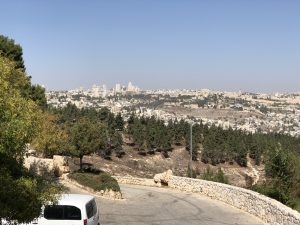
Even from a far hilltop, the city and the city tell the story. One is bursting with construction and development, cranes roaming the streets building modernity among swaths of green space and parks. The other is brown, bare, and rocky, homes haphazardly placed wherever there might be space left for them. There’s hope for parking, schools, playgrounds, trash disposal, sidewalks and such, but those are rarely found. There’s no municipal money left for those because the residents’ taxes are paying for those cranes and modernity. The homes are cherished because one day they might be demolished for lack of a permit that cannot be obtained. Follow?


The name for Jerusalem in Arabic is Al Quds. The Holy. But there’s little holiness there these days and hasn’t been for decades. And it will take more than prayer vigils and interfaith conversations to make this city holy again. Holding persistently to the false beliefs that “the situation is complicated”, and that “both sides are to blame” is wasted time. Radical action is needed, truth is needed, courage is needed. Justice and only justice will restore these two cities to one.

Witness Palestine Film Festival Rochester, NY

This fall, Palestine advocates in Rochester, NY, will host the eighth annual Witness Palestine Film Festival.  From October 14 – November 9, the festival will present five films and will end with a Celebrate Palestine event.  The first of the films will be shown at St John Fisher College.  The other four will be screened at The Little Theatre, Rochester’s finest and best-known independent film venue.

The festival was born in 2012 as a project of Rochester’s ecumenical group, Christians Witnessing for Palestine.  The festival planning committee is open to members of our local chapter of Jewish Voice for Peace, the Muslim community, and secular activists.  Committee members contribute as they are able to a wide range of tasks, including evaluation of possible films for the following year, securing licensing agreements, recruiting panelists (whenever possible, a person associated with the creation of the film), fundraising, publicity, coordination with the venues, and logistics at the showings.  It’s a significant effort spanning many months that is made manageable by a dedicated mix of experienced and more recent volunteers.  The festival is the largest advocacy effort of Christians Witnessing for Palestine.


At the festival’s website, we have descriptions of this year’s films along with the dates, times, and location of the screenings.  The archive section lists films shown each year since the festival’s inception in 2012.  Where do we find the films?  In a variety of places!  Festivals in larger cities such as Boston and Toronto are often helpful resources.  One of the films we’ll show this year was mentioned in a footnote of a book that one of us was reading.  When one starts to look, ideas emerge!  And, now that we’re somewhat established, film makers and distributors reach out to us suggesting that we consider a new film of theirs.  Once we’ve identified a number of possibilities, we contact the distributors and request “screeners”, which provide us with links and passwords enabling committee members to view the films privately for evaluation.  When we’ve made our selections, we then proceed to work out a licensing agreement to show the films publicly and charge for admission.


Celebrate Palestine this year is an example of a special event we attempt to include each year.  It will feature an afternoon workshop on storytelling, led by Boston-based, Palestinian American Nadia Abuelezam, creator and host of Palestinians Podcast.  Our hope is that the workshop will offer members of Rochester’s Palestinian community an opportunity to tell and share their stories.  That evening, we’ll host a dinner open to the public where Nadia will speak.  In recent years, the special events of our festival have featured Palestinian human rights attorney, author, and activist Noura Erakat and author Susan Abulhawa.


And the costs?  Our 2019 festival budget is about $7,300.  The budget includes expenses associated with using The Little Theatre, honoraria to our panelists and guest speaker, advertising, printing, and film licensing.  Most of our revenue comes from two sources – donations and the sale of ads in our Program Booklet, which is distributed to those attending the films.  Ticket sales are another source of festival income.

During its first seven years, the Witness Palestine Film Festival has attracted an audience of over 3,200.  It is perhaps the most visible form of Palestine advocacy in the Rochester area.  We have no paid staff, no endowment, nor do we receive any grant funding.  We have made it work.  And we would welcome the chance to share our experience and resources with you.


EPF PJN commemorates Nakba Day with allies

EPF PJN member Steve France reports on one of many Nakba Day actions around the country.  He begins by summing up the purpose of these public witnesses: 

On Nakba Day  (May 15) in the Nation’s Capital, about 30 interfaith clergy and leaders of the DC-area Palestinian solidarity movement gathered at the Embassy of the State of Israel to deliver a KAIROS Global Justice petition expressing the suffering and injustice inflicted upon the Palestinian People since 1948 at the hands of the State of Israel — and demanding that the government of Israel respect Palestinians’ basic human rights and their established rights under International Law. 

There were Christian clergy of many denominations, a Muslim imam, and representatives of the Orthodox Neturei Karta International.

Rev. Graylan Hagler (UCC) and the other clergy prayed aloud and spoke movingly of the 71-year Palestinian quest for justice and placed their struggle squarely within the larger global struggle against “White Supremacy.” He led other African-American clergy, as well as Baptist, Episcopal and Presbyterian clergy — and the group as a whole — to the guarded gate of the embassy to deliver the petition. But Embassy personnel hastily slammed the door shut. So, EPF PJN member Steve France read out in a loud voice the words of the petition and left it at the gate.

EPF PJN member Priscilla Read continues with an account of the public witness in New York City:

At 10 a.m. on Nakba Day, May 15, a group assembled in Manhattan at Second Avenue and 42nd Street aiming to deliver the petition based on the Kairos Call to officials at the Israeli Consulate. Our plan was for three Presbyterian clergy to try to enter the building while the rest of us stood in quiet vigil across the street, holding signs and distributing flyers to passers-by to explain our presence.

Upon entry, the three pastors were immediately accosted by a consular security officer. They stated their mission; he asked them to step aside while he found a staff person to meet them. Shortly an employee from the mail room appeared and indicated that the envelope would have to be x-rayed before delivery. As one member of our delegation handed over the petition, another quickly snapped a photo for documentation, whereupon the employee became agitated, asserted “You can’t take my picture,” and insisted that she hand over her phone so he could delete the image. She refused, citing her right to privacy, and the three said they were leaving. At that point, the Israeli security guard loomed back into view and demanded the phone. Apparently expecting support, the guard consulted the New York police officer posted outside the building, who instead confirmed the privacy argument and told the three they could exit. As they walked away, the security guard followed them down Second Avenue muttering, “We’re won’t be so polite next time.”

Meanwhile the gathering across the street had grown to some thirty people, including members of Adalah-NY, Blauvelt Dominican Sisters, Catholic Workers, Episcopal Peace Fellowship-Palestine Justice Network, Jewish Voice for Peace-Westchester, Maryknoll Sisters of Ossining, rabbis from Naturei Karta (Jews United Against Zionism), Pax Christi Metro NY, and Presbyterian Peace Fellowship. Our EPF-PJN representative made a short statement about the purpose of the petition. Then one of the Presbyterian clergy read a prayer, and an Episcopal priest read a poem he had written. To be heard over the loud provocation of two people brandishing an Israeli flag and wielding a video-camera as they hurled insults, we repeated the prayer and poem line by line in unison. Many passers-by and the police officers standing watch were sympathetic. Ultimately, our steadfast refusal to engage with the disrupters defeated their purpose, and they desisted. A journalist from a Turkish news agency interviewed several of us. Before we disbanded at 11 o’clock, our Adalah- NY participant led us in song.

Palestine Justice Network | Copyright © 2026 All Rights Reserved

2045 West Grand Ave, Suite B #40058, Chicago, IL 60612-1577

info@epfpjn.org

LOGIN