The Work of Zochrot and the Village of Lifta – 600 Localities 12 September 2019

EPF PIN member Tom Foster, who convenes PIN’s local organizing work group, was part of an Eyewitness Palestine  delegation to Palestine/Israel last year.  He writes here about one of the sites visited and the group with whom they met, Zochrot.

600 LOCALITIES

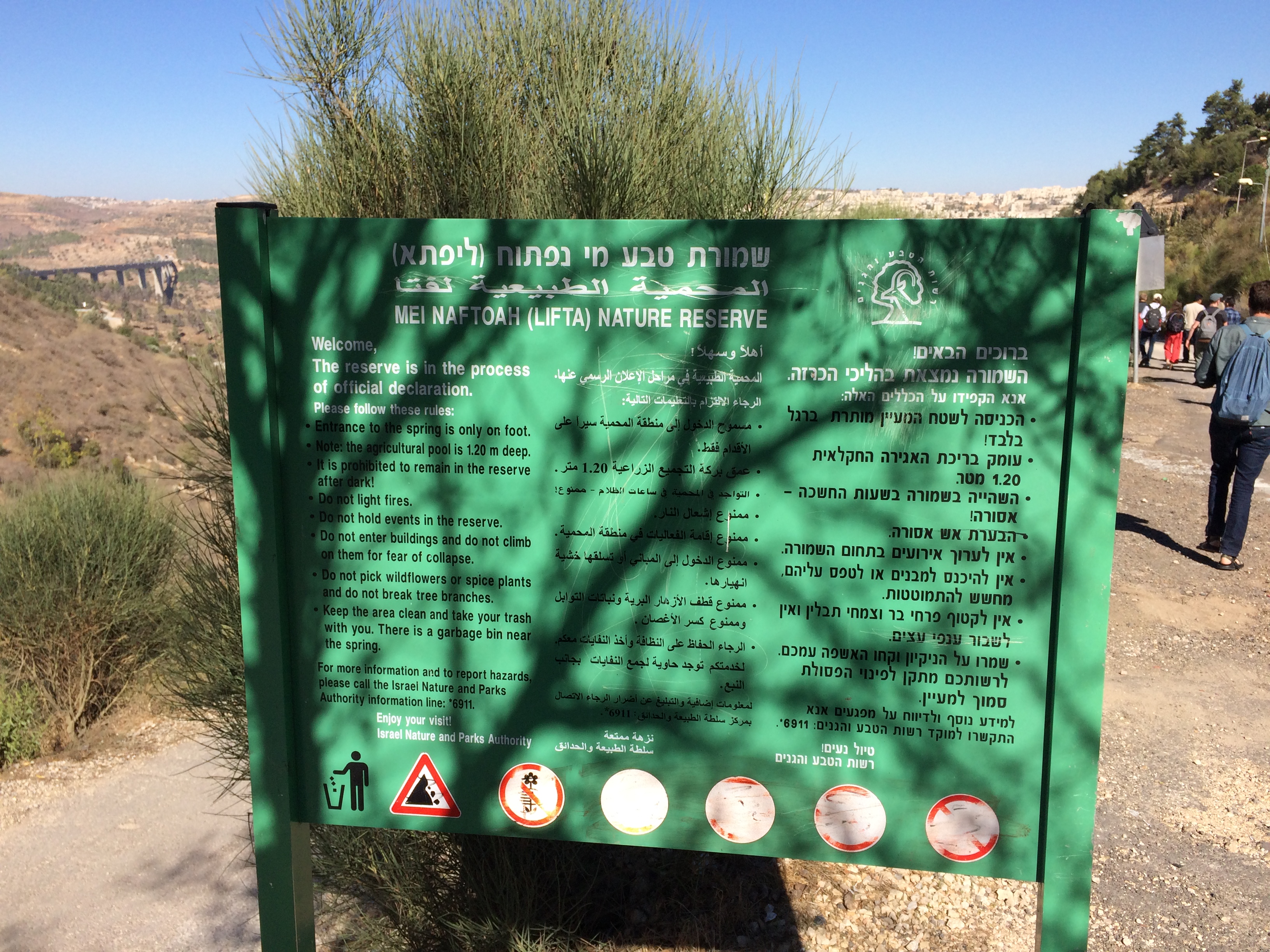
We visited the site of Lifta, one of over 500 localities from which Palestinians were expelled by force in 1947-48.

Lifta is unique or nearly unique in that the broken shells of the stone houses still stand.  The Israeli government has established the area as a nature preserve, one of many tactics to erase the history of this occupied land.  The sign at the entrance makes no mention of the town or of its inhabitants.

Our guide, Umar, and the organization with which he works, Zochrot, has undertaken the work of documenting 600 places cleansed of their Palestinian inhabitants between 1948 and 1968 – where they were, their names, who lived there, their GPS coordinates.  Zochrot is creating new maps and translating them into Hebrew – the first of their kind.  Stories from these villages, wherever possible based on first-hand interviews, are being published and, again, translated into Hebrew.

Do we dare to dream of reconciliation in Palestine?

Through the lens of my faith tradition it seems….
Reconciliation must be preceded somehow by forgiveness.
But forgiveness follows repentance.
And repentance demands acknowledging the sin.

Let us hope, pray, and act that these precious new maps and stories contribute to a path that leads through acknowledgment of the sins of violent expulsion and occupation, to a collective repentance, and finally to a reconciliation grounded in justice.


From Zochrot’s website: “Zochrot (“remembering” in Hebrew) is an NGO working since 2002 to promote acknowledgement and accountability for the ongoing injustices of the Nakba, the Palestinian catastrophe of 1948 and the reconceptualization of the Return as the imperative redress of the Nakba and a chance for a better life for all the country’s inhabitants..”

Read more about Zochrot’s work of justice here.

Please note this program featuring Zochrot at The Palestine Center on 16 September.

Jonathan Myrick Daniels, Rachel Corrie and Palestine 22 August 2019

EPF PIN member Harry Gunkel writes about his time in Alabama and makes connections about what standing witness means in our work for Palestine. 

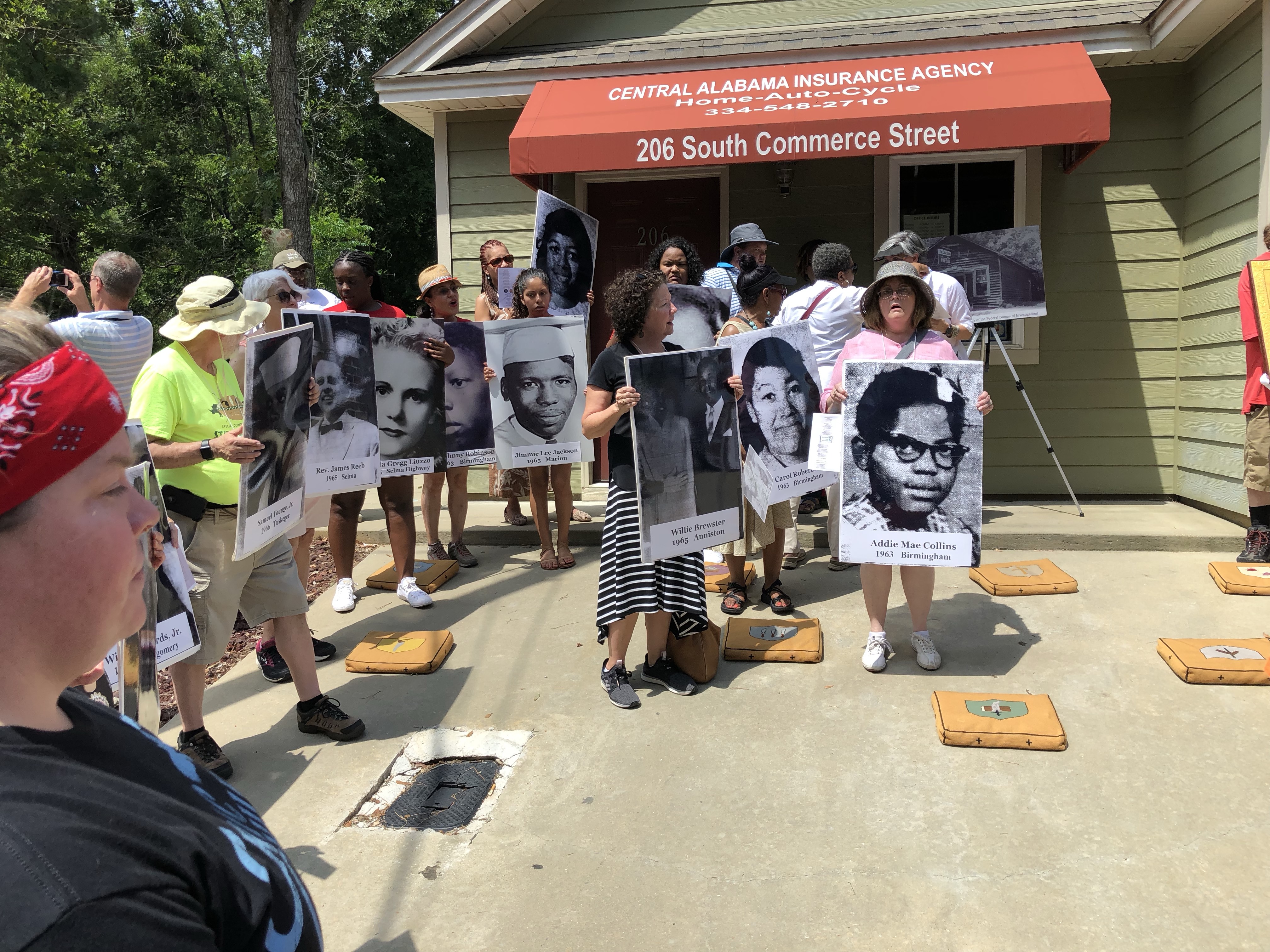
The humid, sweltering August heat of Black Belt Alabama enfolded us all as we stood at the former site of Varner’s Cash Store in Hayneville. On this spot on another August day in 1965, Jonathan Myrick Daniels and three companions, including 17-year-old African American Ruby Sales, were about to step into the store to buy cold drinks. They had just been released from the crude jail around the corner where they had been detained on arrest for protesting against suppression of African American voters in Alabama. A man with a shotgun, born and raised in racism and enraged about the civil rights movement and its activists who had come to Selma and Montgomery that spring and summer, met them at the door. Seeing the man’s rage, in the few moments he had, Jonathan pushed Ruby behind him, took the point-blank shotgun blast, and died as he fell. 

This past August 10, about 300 of us came to Hayneville on pilgrimage to remember Jonathan and the many who died in the struggle alongside him. We stood in silence at this place of his martyrdom, quieted by the immense grace of Jonathan’s Christ-like action. A few of us sang Swing Low, Sweet Chariot. Many kneeled on the hot pavement and bowed in veneration. There was ineffable power in the occasion and in the place, where Jonathan showed us all what following Jesus even unto the cross actually means. 

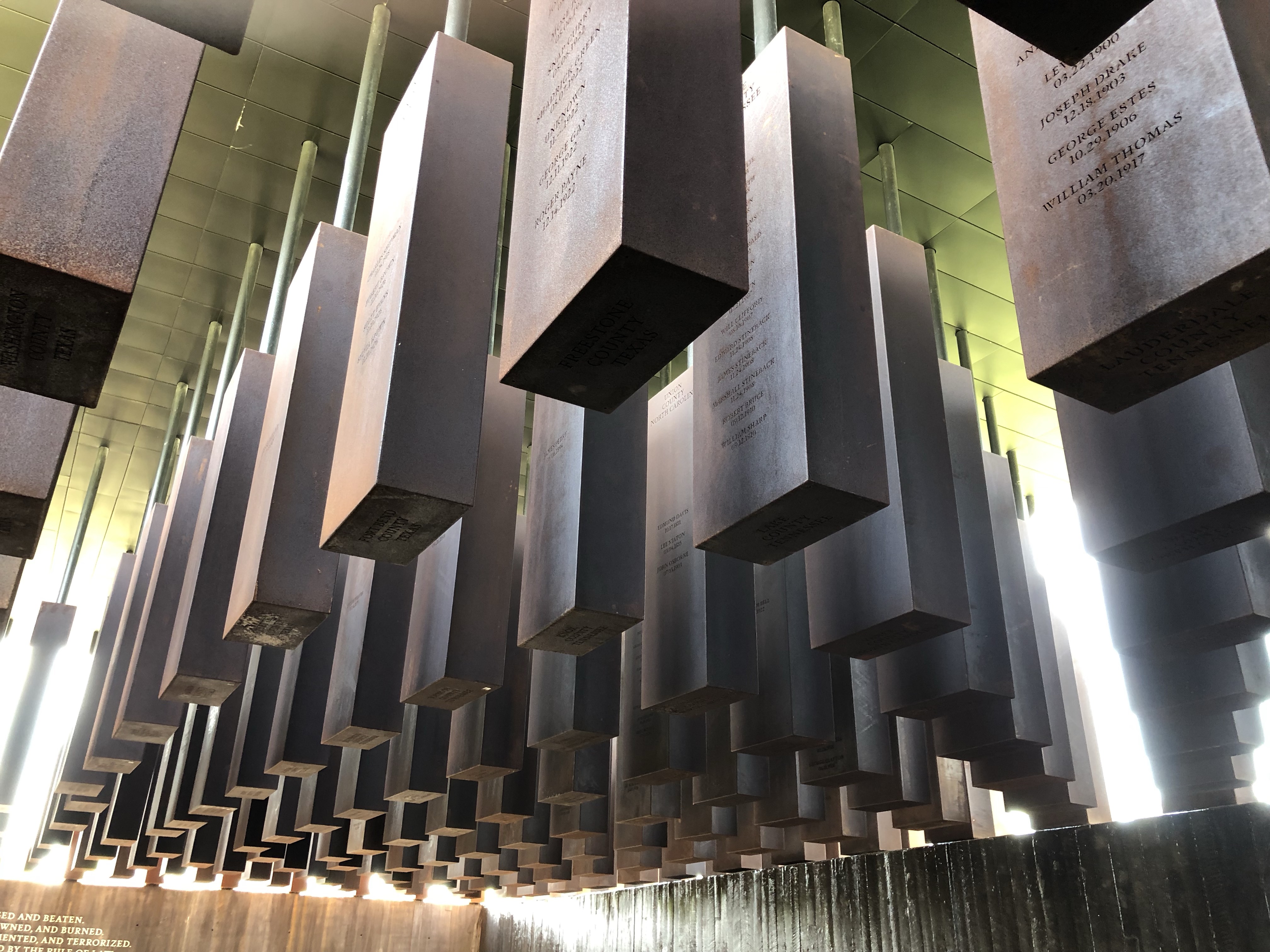
The pilgrimage for Jonathan and the martyrs of Alabama was co-sponsored by the Episcopal Peace Fellowship thanks to the dedication of Executive Director Melanie Merkle Atha, who grew up just down the road from where we stood. On the day before our witness in  Hayneville, our EPF group had visited the National Memorial for Peace and Justice and Legacy Museum in Montgomery. The Memorial, sometimes called The Lynching Memorial, shakes you to the core. Brilliantly conceived and created, the memorial leads the visitor on a path through hundreds of hanging steel monuments, each representing a county in the US where terror lynchings occurred. Names of people known to have been lynched are chiseled into the monuments. The names are difficult to read in the rust-colored steel; difficult to read through the tears. This memorial, set on the blood-soaked soil of lynching and dedicated to the legacy of enslavement and terror of black people, demands that we examine our own thoughts and actions and hold ourselves responsible and accountable. It demands that we not forget what happened and that we not countenance it, no matter how subtly. It demands that we not look away or be cowed into silence by the phony excuse of good manners and civility. 

All through these days of remembrance and atonement I heard echoes – in the memorial, in the museum, and in the streets of Hayneville, Montgomery, and Selma. Echoes of other martyrs, in other places. While the never-ending, noble and ferocious struggle for equality and justice for people of color in the US continues, half a world away their Palestinian brothers and sisters also face a supremacist regime where demanding justice is a capital offense. The Black Lives Matter platform recognizes the kinship of their struggles. Palestinians in the state of Israel are thwarted in employment, housing, education, and civic and political engagement by dozens of discriminatory laws rooted in Jim Crow. Thousands of Palestinians in the West Bank understand incarceration as a weapon of the state to silence and subdue them. And Palestinians understand lynching; it is their neighbor or their son or their sister lying dead in the street, executed on suspicion. 

I cannot help but think of Rachel Corrie. In Gaza in 2003 she stood before an Israeli military bulldozer to block its demolition of a Palestinian home, but was murdered when the driver ran her down, perhaps consumed by the same primal hatred that had come for Jonathan 30 years earlier. 

But Rachel and Jonathan did not just show up one day in Gaza and Hayneville. By all accounts, their young lives embodied a deep and indelible drive to do good, to be honest, to be just. It was surely their profound and transcendent determination that brought them with their crosses to Gaza and Hayneville. Their violent and tragic deaths should not be read as calls to all of us for martyrdom. For a very few, perhaps, but for most of us, it is Jonathan and Rachel’s lives, not their deaths, that are our call. All of us – you, me, princes of the Church – can best honor Jonathan, Rachel, and the martyrs of Alabama and Palestine by emulating the sincerity of their purpose, the unyielding determination of their journeys, the fearlessness of their actions, and the ideals of their vision. 

Voices for Justice: Jerusalem from the Lens of a Native Son — Ghettoization and Pauperization

Philip Farah, a member of EPF PIN’s advisory council and a key member of the Palestinian Christian Alliance for Peace, traveled to Palestine in June.  He reflects on his time on the ground.

Last month, I participated in an Eyewitness Palestine delegation of 22 Americans. Over a 10-day period, our intensive tour took us to cities and villages all over Palestine/Israel. We met with over 22 groups involved in various forms of resistance to Israeli domination. Our home base was Jerusalem, the city where I was born and spent the first 27 years of my life before emigrating to the U.S. in 1978.

East Jerusalem had been—overall– a very pleasant city to live before the Israeli occupation of 1967. It was a small city of about 65,000 people, but with strong connections to nearby suburbs and villages. It was the main transportation hub for all the West Bank, and hence a major commercial center. Its status as the home of al-Aqsa Mosques and the Holy Sepulcher has always made it the center of life of all Palestinians— physically for its inhabitants, and spiritually or culturally for all Palestinians.  Because of its spiritual importance, it has also always been a far more cosmopolitan place than most cities of its size anywhere in the world.

This was the Jerusalem of my childhood and youth. Not a wealthy city, but generally prosperous. I received all my pre-college schooling a school that was established by English Anglicans, where most of my schoolmates were Muslim. I was born in a hospital established by Germans and received medical care in clinics established by Austrians and American. Palestinians from all over the West Bank came to my town to sell their fresh fruits and vegetables; and the magnificent Old City would be filled with shoppers and worshippers from all over the West Bank and far beyond on Fridays and Sundays.

Today, only the Gaza Strip and the so-called H2 section of the Palestinian city of Hebron surpass East Jerusalem in the sense of strangulation that the Palestinians feel under Israeli domination. 

Israel’s belligerent policies have effectively fragmented the Palestinian territories in a complex scheme, shutting Gaza into the world’s largest open-air prison, and dividing the West Bank into several segments separated by blocks of colonies (settlements) and roads that only Israelis and international visitors can traverse. East Jerusalem has been ghettoized, making it extremely difficult for any Palestinians from other locations in the West Bank to enter it for any reason. No longer is it the transportation and commercial center that it used to be. It feels isolated from its historic lifeline and, while Israel does everything to make life miserable for all Palestinians under its control, Jerusalem seems to be the saddest of all urban centers in the West Bank. 

pastedGraphic.png

Israel claims that it has united East Jerusalem and West Jerusalem into one Greater Jerusalem. Nothing can be farther from the truth. The loss of East Jerusalem’s position as the center of the West Bank’s economy has far from been compensated by stronger integration with the Israeli economy, and things are getting worse. A 2018 report from the National Insurance Institute of Israel reported poverty rates among Palestinians of East Jerusalem rising from 70 to 75 percent from 2016 to 2017.

As far back as 2003, a British House of Commons report concluded that “[i]t is hard to avoid the conclusion that there is a deliberate Israeli strategy of putting the lives of ordinary Palestinians under stress as part of a strategy of bringing the population to heel.”  Nowhere has this been more apparent than in East Jerusalem, where Israel is obsessed with stifling normal population growth of the Palestinians in order to maintain Jewish demographic dominance in Greater Jerusalem.  Israeli authorities had actually set a target for a Jerusalem population of 70 percent Jews vs. 30 percent Palestinians.  This plan has actually failed in this regards, and forced the authorities to revise the ratio to 60/40, but Israel has intensified its belligerence towards the Palestinians of Jerusalem. Israel’s toolkit includes various manipulations of the law as well as blatant discrimination to rob Palestinians of their land, evict them from their homes, and place barriers to their livelihood.

It is incumbent of people of good conscience everywhere to oppose these racist policies for the city that millions of people around the world venerate. Real actions of solidarity are needed, not just declarations of good will. In the words of the Palestinian Christian Kairos document of 2009:

We call on [faith communities everywhere] to say a word of truth and to take a position of truth with regard to Israel’s occupation of Palestinian land. … [We] see boycott and disinvestment as tools of non-violence for justice, peace and security for all.

American Jews Tell a Big New Story EPF PJN member Steve France reviews ‘Reclaiming Judaism From Zionism’

A new book, “Reclaiming Judaism From Zionism,” wants to start a big new conversation about Israel. The book presents the personal stories of 40 American Jews of all ages and descriptions who pull back the veil on a topic that is largely taboo in the U.S.: the trouble the Jewish establishment is having keeping the lid on Jews who are critical of the Jewish State.

The mini-autobiographies tell the stories of women and men who object to Israeli policies against Palestinians. They challenge Zionism as inherently flawed. Most disturbing, no doubt, to Jewish supporters of Israel, the authors have concluded that Zionism is a mortal threat to their deepest Jewish identities. That position, which each narrative makes with passion and personal precision, is an existential threat to Israel as a Jewish supremacist state. Nothing, perhaps, could give more comfort and hope to the long-shunned Palestinians.

The stock Zionist response to their Jewish critics is to label them as self-hating Jews, or at least indifferent, overly assimilated Jews who have forgotten their Jewish identity. But the Jews in these pages are passionately self-loving Jews; they are earnestly blazing a trail to a new Jewish liberation, rebelling against a “mental prison” of Zionism that stifles Jewish values and Jewish creativity.

“As I began to broaden my worldview, everything began to crumble. I unearthed a broken root of my Jewish existence, and I began to hurt because I didn’t know how to balance these two identities – my vast and expansive love for the Jewish people, and my urge to speak up for justice, for the loss of lives being carried out in my name,” writes Columbia University religion major Eliza Rose Moss-Horwitz. Her declaration comes on the heels of an incident she recounts when she was attacked on campus as “a betrayal of your ancestors,” and a foolish “girl” for not knowing that “Arab men would kill you if they found out you were Jewish.”

Ironically, like most of the authors, Moss-Horwitz is rebelling now because she believed so deeply in the goodness of Zionism. As a child, she was entranced by the “fabricated truth” about Israel that portrayed the Jewish State as the embodiment of Judaism’s uncompromising commitment to social justice and “healing the world.” When she got to know an actual Palestinian, it all began to fall apart. The story had no place for the Palestinians. Indeed, she recalls, even the word “Palestine” was to be avoided.

Other authors, who look back over a lifetime of relationship to Zionism, describe the same basic trajectory from an idealized understanding of Israel to a deep opposition. Some have to deal with happy childhood visits to Israel, which Tali Ruskin, for example, remembers as “a utopian playground for me and all Jews … supported and complemented by my experiences at a Jewish day school and Zionist summer camp.” A few pages later she is “grappling with the reality that I am implicated in the slow genocide of a people.” By age 30 she is a leader of her Jewish Voice for Peace local chapter.

History professor Marjorie N. Feld’s transformation took decades. She tells of “growing up Kosher” and feeling Israel linked “to the core of my Jewishness, and to the safety of all Jews,” especially as she defended her Zionism against critics within the field of civil and human rights. But when she published a biography of Lillian Wald, she found herself condemned for including discussion of Wald’s anti-Zionism. Instead of backing off, she began to study notable Jews who worked for progressive issues but had been “ostracized” for criticizing Israel. Then Feld wrote about American Jews’ “complicated responses to South African apartheid.” She came to feel “completely out of place in Jewish studies,” until to her joy she learned that Hsia Diner, “a towering figure in American Jewish studies,” had also “left Zionism behind.” Needless to say, neither woman has left Judaism behind in her stand for truthful history and Palestinian rights. Diner’s separate essay describes her long journey away from “passionate identification with Israel and Zionism,” to abandonment of even the “belief that Israel as a Jewish State within the 1967 borders posed no problems.” Now, she says, she’s in a place where Judaism has become “more meaningful to me than ever before.”

This caliber of Jewish resistance to the Zionist vision seems likely to cause havoc in the American Jewish community. Less obvious, but perhaps just as threatening to the mighty Zionist narrative, is the impact this Jewish movement may have on the vastly larger population of non-Jews who feel constrained to defer to American Jews on the subject of Israel and who believe Israel retains virtually unanimous Jewish support. If there is no longer a perceived monolithic Jewish position on Israel, the respect accorded to Jews will require respect for the Jewish, anti-Zionist narrative. That means the compelling Palestinian narrative of colonial, racist dispossession—the indelible offense held against Israel — will finally be weighed in the balance.

This result is precisely what editor Carolyn L. Karcher intended in assembling the essays. The book, she writes, is “designed to stimulate a vigorous public debate about Zionism.” Jewish readers are provided with “models of Jewish identity that replace ethnic exclusiveness with solidarity, Zionism with a Judaism once again nourished by a transcendent ethical vision.” Her approach — simply asking 40 individuals to tell their stories, in their own way — packs a punch: Rich in drama and emotion, the stories recount their  individual struggles to understand, defend, adjust, abandon and reinvent who they are, what they stand for as Jews, and what Israel means to them. Together the stories also reinforce each other, giving a sense that they speak for multitudes of other Jews.

Every story offers searing personal examples of the “wild world of [Zionist] silencing and bullying,” as physician/author Alice Rothchild puts it. Cumulatively, this evokes a sense of countless Jews being censored and self-censoring and thus undermines the myth of Jewish unity, if not uniformity, on Israel.

Countering any impression that these authors are isolated, unrepresentative voices is the testimony they give to having sought and found deeper faith and vibrant new Jewish communities, despite efforts to cast them out.

Tali Ruskin has “connected with anti-Zionist community and practice” and “re-engaged with Judaism in a new and more authentic way.” Ariel Gold speaks of a unification of her faith and her commitment to justice. Moriah Ella Mason, like many others, has found community in the Jewish Voice for Peace organization, saying it fosters a “Judaism focused on liberatory justice … a spiritual practice that demands political praxis as well.”

This emerging community is more than just a refuge for dissenting Jews. Rather, it is felt as a return to the deeper prophetic roots of Judaism and a re-engagement with the larger world and the big questions. Rachel Winsberg taps a new confidence: “Judaism is so much more than Israel … so much more than Torah,” it is “thousands of years of Jewish scholarship, of people digging deeper and deeper into the possibilities of what it all means.” Natalia Dubno Shevin speaks for all those “who have been harmed by Zionism in distinct ways.” For them she prescribes “a diaspora practice to imagine all the possibilities to build Jewishness after Zionism.” This accords with the call of Rabbi Michael Davis “to claim our place as the dynamic heart of the Jewish tradition,” which he calls “Diasporism.” Carly Manes holds a belief that the liberation of a “joyous diasporic Jewish people” and of Israeli Jews is “bound up with that of the Palestinian people.” Rabbi Alissa Wise’s essay, co-written with Rebecca Vilkomerson (both are top leaders of Jewish Voice for Peace), entitled “The Discarded Materials Have Become the Cornerstone,” describes JVP’s “core” mission of being a “Jewish home that enables people to be their full selves.”

Zionists faced with dissenters often suggest that such individuals are naïve or excessively idealistic and hold Israel to an impossible double standard of political morality, far above the norms tolerated for other countries. The dissenters can thus be dismissed as oddballs or eccentrics. But when the standard that Israel is said not to meet is expressly associated with Judaism, Zionists must take care. Even if these authors stand out as unusually sensitive, their pointedly Jewish distress makes them more like canaries in a coal mine, warning of danger ahead for the Jewish defensive consensus on Israel.

Many of the authors not only indict Israel as “not a very Jewish place,” in the words of Stanford professor Joel Beinin, they diagnose Israel and its Zionist malady: “Israel was becoming a mirror image of its fascist oppressors,” religious studies professor Linda Hess writes. In her view, Zionist Jews suffer from “a kind of post-traumatic stress disorder that makes you hell-bent to possess the power of your torturers.” Most tragically, in devastating Palestinian families, Israelis give Nazis a sort of victorious afterlife: She fears that the Nazis “have destroyed love and made Jews help them do that work.” And so, she stands against Zionism “because of being Jewish, not in spite of it.”

After reading these passionate personal essays, bracketed by Karcher’s elegant and succinct introduction and afterword, two impressions emerge: One is of the tremendous tenacity of Jews’ attachment to their identity. This shows in the vehemence of both the many Zionist voices that are heard in these pages and in the intensity of the authors’ stories. The other take-away is a feeling that the winds of change are beginning to blow within the American Jewish Diaspora.
Rise Against Racism: Another Reflection from #CounterCufi

EPF PIN member Newland Smith also attended the action last week in Washington DC.  Here is his reflection.

Leaders did an amazing job in preparing participants for the actions at the convention center.  The four hour long training in non violence included practicing being in solidarity in a given action.  So come Monday we were well prepared when we attempted to gain entrance to the convention and to persist outside the convention in pounding on the doors and singing chants.  

Tarak Abuata both at the training and during the action connected the call to speak out against the racist ideology of Christian Zionism with the call to be in solidarity with communities of color.  I was moved to see several people who attended the panel discussion Sunday evening at the Plymouth Congregational United Church of Christ wearing Poor People Campaign’s t shirts as well as a woman at the convention center who had attended the Poor People’s Campaign Moral Congress in Washington D.C.  As one who attended the Moral Congress in June, I knew that the call to change the moral narrative of our country included calling out the racist ideology of Christian Zionism.  

But having participated in this action, I do ask myself, “So what”.  Is this dramatic action at the convention center on July 8 just a flash in the pan or will it be one small but important step in the ongoing struggle for justice in Palestine and Israel?  Tarak Abuata reminded participants of the necessity of working with local congregations in becoming prophetic communities.  The Plymouth Congregational United Church of Christ led by its Senior Pastor, Graylan Hagler, is a good example of a prophetic community.   This is clearly a challenge for PIN members in the Diocese of Chicago.

Rise Against Racism: #CounterCUFI

EPF PIN member Randy Heyn-Lamb reports on Rise Against Racism: #CounterCUFI in Washington DC.

Sunday 7 July 2019

I have been in Washington, DC, for a little over 24 hours. I’m here together with FOSNA LA co-chair Joe Roos to participate in an action protesting a conference on “christian” Zionism.

As some of you know, the leaders of Friends of Sabeel, together with counterparts from Jewish Voice for Peace, American Muslims for Palestine, and the US Campaign for Palestinian Rights, have called on supporters to gather in our nation’s capital to stand in witness against, and suggest an alternative to, the racist agenda and false teachings of “christian” Zionism espoused by John Hagee and Christians United for Israel.

It’s been a busy day. Early this morning we gathered for worship at the Plymouth United Church of Christ, an historic African American congregation in Northeast DC, fast approaching its 140th anniversary of proclaiming good news to the poor. The welcome was even warmer than the weather, the summer choir was small but mighty, the preaching by Pastor Hagler (on Jesus sending out his disciples,  Luke 13) was affirming, and the pianist’s postlude – a medley of America the Beautiful,  My Country tis of Thee, This Little Light of Mine and We Shall Overcome – brought tears to my eyes.

We spent the afternoon at a different DC church location where more than 100 of us participated in a 4 hour long training session to better prepare ourselves for the actions we might take to make our presence known at the conference. 

One action is to engage attendees in conversations about how the ongoing military occupation of Palestine, or the siege of Gaza, affects Palestinian children. I am wearing a lanyard around my neck, and that lanyard holds photo and the brief story of Bara, a little girl from Gaza, who died 7 days after her birth from a treatable heart defect because her parents couldn’t get the necessary permits to seek medical care in a neighboring country. And how “christian” Zionist beliefs, which approves seizure of all of the land without regard for the Palestinians who also inhabit it, is complicit in baby Bara’s death.  I am protesting here today because her voice is silenced.

Other actions – including what Representative John Lewis, the civil right activist and voice of conscience in the House of Representatives, calls “getting in the way” – could involve civil disobedience. And while the DC police are notoriously tolerant, there is some risk that members of our group could be arrested. So, we prepared for what that might also mean, and how far we are willing to take the opportunity to give witness. It is certainly NOT my goal to get arrested, but if it happens, I cant think of a better reason than giving my voice to those who have no voice; a few hours of freedom for those who want it so desperately.

Monday 8 July 2019

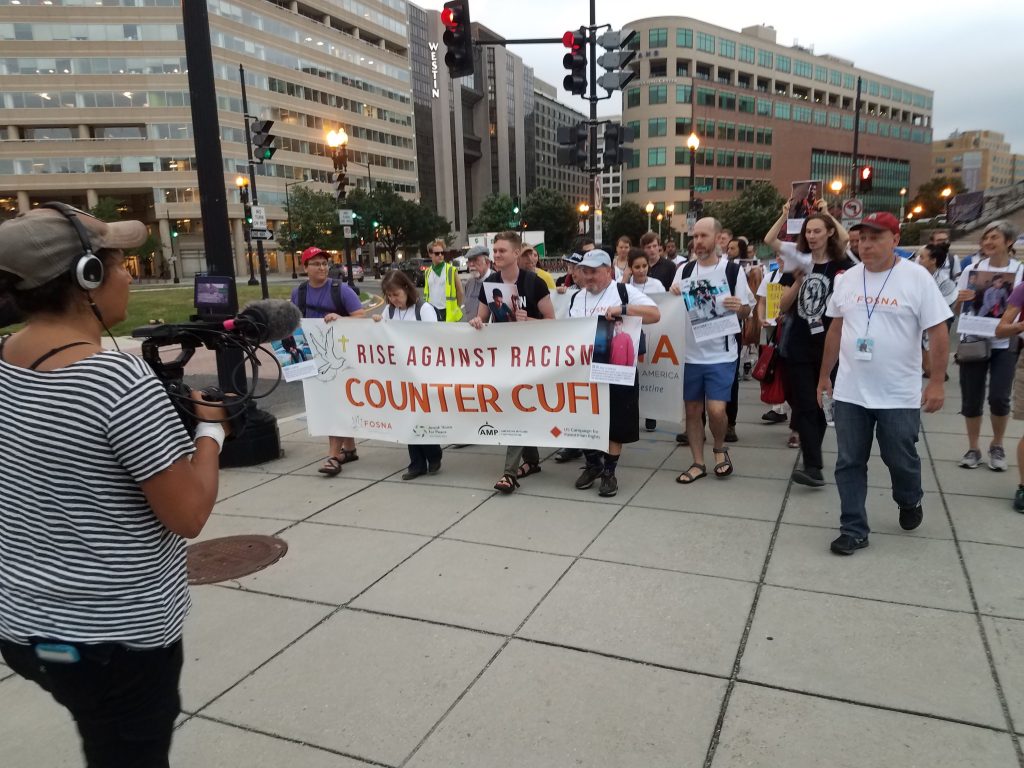
As we march from our starting point to the convention center, the group took over Massachusetts Avenue for some blocks, walking in the middle of the street chanting, singing and carrying our banners.

When we arrived at the entrance, security tried to keep us out. A few of us made it inside the doors. Tarek Abuata, the executive director of FOSNA, was one of those who made it inside. Security immediately restrained him and carried him outside.  We were able to stop people from coming in and forcing them to go to another entrance in the pouring rain of a flood alert here in DC.  Since that time we have been chanting and pounding on the windows demanding entrance ‘Hey Hey, Ho Ho, Apartheid has got to go!’

I picked up another badge this morning. Sama is a two year old who was severely injured by an air-to-surface missile in the pre-dawn hours at her home in a residential section of Gaza City. I am wearing her badge on your behalf this morning. Pray for her parents, her siblings, and all those who continue to endure the longest siege in modern history.

In addition to the outside action, we had several insiders who had registered for the conference and planned internal disruptions at (in)opportune moments. The first of those moments came during John Hagee’s address when several of our group stood to give witness. They were soon shouted down but refused to be escorted out. Going limp, they had to be carried from the assembly.  One of the group, who is Jewish, related her extended conversation with a man sitting next to her, about how much they loved Jews. She also noted the surprised look on his face when she stood up to object to the way they demonstrated their “love”.

Our second group of insiders waited until some point in the address by Mike Pence, certainly the most high profile of the elected officials attending the conference. Once again, their protest was quickly shouted down and they were hustled from the auditorium. But at least they were aware that not ALL the Christians present agreed with their racist theology.

Earlier we were pounding on the doors (knock, and the door shall be opened!). The police came and warned us to stop. The encounter ended without arrest when one of our ministers, Chad, prayed with Sargeant Taylor of the DC Metro police.  Later we marched in two groups around the Convention Center.  We took apart the barriers and occupied the steps leading to the south entrance. We have been warned we are on private property and risk arrest. We responded that Israel steals private land ever day. We will not be moved.

We finished our action about an hour ago. In the pouring rain.

There was a slight drizzle when we stepped off the curb on to Mt Vernon, blocking traffic on the westbound side. That expanded to take up the entire intersection at Massachusetts and Mt Vernon, blocking traffic in all 4 directions as we linked arms/held hands and read the names of the Palestinian children we were representing.

The pouring rain, and the disappearance of the media with the intensification of the storm, led Tarek and the other action leaders to call an end to our demonstration, which ended with sopping hugs and promises to see each other “next time”. So no arrests, but in a small way we made our presence known to those attending the Conference. We also may pick up a few column inches in the papers or in a someone’s blog. Most importantly, we hope it will raise the level of consciousness and conversation about Christian Zionism in our churches.

Jerusalem A Rock and A Hard Place: A Review from Kathy Christison

Palestinian Jerusalem has been gradually disappearing for decades—in literal physical terms, as well as culturally and spiritually—under the constant pressures and encroachments of Israel’s domination, and for the first time the United States is openly abetting and accelerating this process.

Israel captured and Judaized the western sector of Jerusalem in 1948 and, for the half century of its occupation of the Palestinian eastern sector, it has been steadily expanding efforts to empty this sector of much of its Palestinian population and turn all of Jerusalem into a Jewish-majority city.  This recent two-part Al Jazeera video, Jerusalem: A Rock and a Hard Place, presents the personal perspectives of several “people in the street” who live in Jerusalem and are daily experiencing the city’s continual evolution.  Omar Harami, the executive director of Sabeel in Jerusalem and a lifelong resident whose Christian family traces its origins to the first Pentecost, is the principal narrator.

Because the Israeli occupation is illegal under international law and, until the Trump Administration, the United States never recognized Israeli sovereignty over Jerusalem, the Judaization process in East Jerusalem has moved forward in general with little fanfare and thus little notice from the outside world.

Israeli settlement construction has been gradual over fifty years; Palestinian residency permits have been revoked quietly; thousands of Palestinian homes have been demolished with hardly a witness; aggressive Israeli settlers have taken over Palestinian homes and evicted Palestinian families, with police assistance but virtually no meaningful protest; and questionable archeological digs designed to “prove” an ancient Jewish presence have proceeded underground and almost out of sight except by the unfortunate Palestinian families whose house foundations are crumbling.

Only in the last year, since the Trump Administration’s recognition of Jerusalem as Israel’s capital, has the city’s makeover into a Jewish entity become so noticeable, and US complicity so blatant, that even the mainstream media remark on it.  Early this week, blatant complicity by US officials—particularly Ambassador to Israel David Friedman and Special Middle East envoy Jason Greenblatt, who both identify enthusiastically as Israel-firsters—turned to obscene collusion when these “diplomats” led ceremonies marking the opening of a tunnel under the Palestinian neighborhood of Silwan.

The tunnel project and associated archeological digs have already caused the collapse of structures at ground level and undermined the foundations of some Palestinian homes.  Even the rarely disapproving New York Times referred to the tunnel opening as quite a bit more than the usual ribbon-cutting, as Friedman wielded a sledgehammer to open the tunnel.  The Times has seldom noticed Israel’s heavy use of bulldozers to demolish Palestine’s structures, but now seems to believe the use of a sledgehammer will have reverberations both “literal and metaphorical.”  

This week’s events occurred after the Al Jazeera video was produced, but the video captures the essence of Israel’s decades-long and recently accelerating conversion of Jerusalem from a multifaith, multiethnic, multi-cultural community into a city of racist exclusivity for Jews.  The video presents a human picture of what Jerusalem is like today for its Palestinian residents.  A Muslim cleric and Harami discuss the close ties between Muslims and Christians, the Muslim noting that diversity has always been part of Jerusalem’s social fabric, that the city has never been homogeneous with one people or one tribe.  This same cleric’s son, however, has lost his residency rights under Israel’s restrictive permit system.  Another family originally displaced from western Jerusalem in 1948 is now being evicted by Israeli settlers from its home in the center of the Old City.  Israel’s designs on the city are colorfully represented by a rightwing settler who, despite having moved only recently from Australia, claims that he and all Jews were “born in Jerusalem,” that it is in their blood and belongs to them and them alone.

The video (Part 1 and Part 2) offers little hope for the Palestinian future, beyond Harami’s conclusion that Palestinians of all faiths have always stayed together and that, although empires have come and gone in Palestine, the people always remain.  This is a thin reed, but those reverberations from David Friedman’s sledgehammer may hold a ray of hope.

Rise Against Racism: Counter CUFI

On July 7, the first organized protest demonstration against the ideology and policies of Christians United for Israel [CUFI] will take place in Washington D.C. during the annual CUFI summit.  Representatives from the highest levels of our government will be present. Secretary of State Mike Pompeo is listed as a speaker; last year Vice President Pence was guest speaker.  As a Christian Zionist organization, CUFI has clout in Congress through its powerful lobby, pressuring our government to support the Israeli Occupation as well as promoting Islamophobia, white supremacy, and, ultimately, anti-Semitism with its apocalyptic vision of global warfare leading to the Second-coming of Christ to his Kingdom in Jerusalem. 

EPF PIN endorses this protest and supports the objectives of the sponsors:  Friends of Sabeel North America, Jewish Voice for Peace, American Muslims for Palestine and the U.S. Campaign for Palestinian Rights. PIN activists in the D.C. area are involved in the planning and are actively organizing Episcopalians locally and regionally to take part in the demonstration.  PIN fully supports our allies as we confront together the misuse of Christianity as a moral cover for violence and racism.  PIN is also committed to raising consciousness in our church about the breadth and depth of CUFI’s influence in our government and funding by Christian Zionists of the Settlement movement in Palestine.  Knowledge is power:  power to hold ourselves accountable as a church to the teachings of Jesus in response to CUFI’s assault on the Gospel.

What can PIN activists do from a distance?  If traveling to D.C. is not possible, how can we join the protest against CUFI’s dangerous impact on U.S. foreign policy and their funding of Palestinian dispossession of both land and rights?  

PRAY:  Prayers of the People: consider crafting a prayer petition for your parish worship, asking for Christ’s Spirit to empower our Gospel witness against Christian Zionism.

STUDY:  Follow this link to an introductory FAQ sheet on our PIN website.  Visit the CUFI website: and this definitive site on Christian Zionism.

Read  Challenging Christian Zionism:  Theology, Politics and the Israel-Palestine Conflict edited by Naim Ateek (Palestinian Episcopal priest and founder of Sabeel), Cedar Duaybis and Maurine Tobin (recipient, with her husband Bob, of PIN’s inaugural Cotton Fite Award).  Consider a study group in your parish or community using these resources and others.

ACT:  Use the information you gain through study for action.  Consider writing letters to your Representatives and Senators, expressing concern about the objectives of the CUFI lobby and the dangers of an ideology that actively promotes global warfare, Islamophobia and anti-semitism.  Submit a “did you know” op-ed in your local paper … because many Americans don’t know what CUFI is promoting in the name of its 4 million Christian Zionist members. Perhaps a letter of concern to your bishop or the social justice committee in your diocese, expressing the moral imperative of Episcopalians to raise consciousness and organize a Gospel response to Christian Zionism : “Not in OUR name.”   Reach out to local allies like JVP or the Muslim community to plan educational events or demonstrations.  Include Christian Zionism as a topic in other organized events on behalf of Palestinian human rights.  Shed light on the relationship of convenience between Christian Zionists and Jewish Zionists.  Carpe diem!

Tropes, Canards and anti-semitism

EPF PIN member Linda Gaither, also a member of the Ithaca (NY) Comm. for Justice in Palestine/Jewish Voice for Peace, reflects on the recent controversies around Ilhan Omar’s comments.

Recently an op-ed aimed at Ilhan Omar and anti-semitic tropes appeared in our local Upstate New York paper.  The pro-Israel author attempted to smudge or ‘gaslight’ the position of Rep. Omar’s defenders by saying, “no serious person claims criticism of Israel is ipso facto anti-Semitic.”   

So what are the boundaries of ipso facto?  When do serious people have to worry that they’ve tripped over a facto and stumbled into the dreaded mine-field of tropes and canards?  Inquiring minds want to know, as David Samel points out in Mondoweiss:

This trope/canard nonsense could be used to immunize Israel from virtually any criticism. Anyone who dared suggest that Israel, throughout its history, has deliberately killed civilians could be accused of appealing to the anti-Semitic “canard” that Jews place a lower value on the lives of non-Jews. Accusing Israel of conducting espionage in foreign countries, whether spying on the US or stealing New Zealand passports, would invoke the anti-Semitic “trope” of the devious, dishonest Jew. There surely is an anti-Semitic trope, canard, or slander, real or imagined, to fit every criticism of Israel. 

How do we evaluate a random selection of factos such as those listed below?  Do they rise to the level of canard?  Perhaps even the dreaded trope?

The Israel lobby donates to the majority of politicians, spending money on 269 Representatives’ and 57 Senators’ campaigns last year.  One example, Democrat Eliot Engel, who chairs the House Foreign Affairs Committee (of which Rep. Omar is now a member), accused her of invoking an “anti-Semitic trope” by suggesting that money from pro-Israel groups affects political discourse. Engel has received $1.07 million from the Israel lobby during his career – more than he’s received from any other industry. See more here.

15% of Jewish settlers are Americans with dual citizenship. They vote in Israeli elections in support of settlement expansion; they are granted full rights of Israeli citizenship, although they live in illegal settlements in the West Bank.  They vote again in American elections on behalf of pro-Israel positions and candidates.  Their agenda is supported by the U.S. Ambassador to Israel as well as U.S. “peace brokers,”  Jason Greenblatt and Jared Kushner.   The Kushner Companies Charitable Foundation is funding the construction of the Bet El settlement, which Jared  failed to disclose on financial forms.  Read more n Trump and the Golan Heights here.

Settler violence continues to escalate.  Last month, Jewish settlers surrounded a Palestinian school in the West Bank city of Hebron, assaulting several children. Israeli occupation soldiers then fired tear gas bombs and concussion grenades at the school; thirty children suffered severe effects. 230 children under 18 were held in Israeli military detention centers as of Jan. 31, 2019. 

What factos come into play for U.S. voters and taxpayers who recognize and wish to challenge the human rights catastrophe that has befallen Palestinians since 1948?  

The United States gives Israel a 10.5 million dollar chit for U.S. weapons every day.  Our tax dollars are used to advance both the illegal occupation and preemptive attacks by Israel on neighboring states.  U.S. human rights laws, known as the Leahy Amendment, prohibit the  Departments of State and Defense from providing military assistance to foreign security force units that violate human rights with impunity.  Nevertheless, lawmaker Rep. Juan Vargas (D-CA) tweeted during the uproar over Rep. Omar’s observations about AIPAC’s power in our government that “questioning support for the U.S.-Israel relationship is unacceptable.” 

Last month, a Commission of Inquiry formed by the U.N. Human Rights Council reported that Israel may have committed crimes against humanity at the Gaza security fence, killing 189 Palestinians, including 35 children, injuring more than 9000 during the past twelve months. Evidence shows that Israeli snipers deliberately shot unarmed journalists, health workers, children and people with disabilities. Is this something Americans can talk about or challenge?

 When voters cannot depend on our government to enforce human rights laws or allow debate on U.S. foreign aid, the rational option is to engage in and promote nonviolent boycotts, or work for divestment and sanctions on Israel.  But the pro-Israel community in the U.S. has made combating the BDS movement one of its principal goals in recent years.  26 states have regulations on the books requiring businesses or individuals contracting with the state to pledge not to participate in a boycott of Israel.  In essence, they force companies to make a choice between participating in BDS and keeping their business. Federal anti-BDS legislation is on the horizon, as well.

In this environment, ipso facto, serious people want to know: has the definition of anti-Semitism been stretched so far beyond it’s classical meaning – hatred and hostility toward or discrimination against Jews as a religious, ethnic, or racial group —  that it is impossible to avoid the alleged tropes and canards?  This is a dangerous development.  Anti-Semitism is a deadly phenomenon that needs to be named and repudiated at all times, everywhere. Because of the deadly seriousness of anti-Semitism, it must be clearly differentiated from criticisms of the Zionist project and the State of Israel. To be clear, it is not anti-Semitic to support Palestinian rights, demand a change in U.S. policy towards Israel, expose the pressures that the pro-Israel lobby brings to bear on elected officials, or call out Israel’s violations of human rights and international law.  For serious people, these actions are not just an option, but, ipso facto, a necessity. 

Episcopal Church Adopts Human Rights Investment Screen

Episcopal Church Adopts Human Rights Investment Screen to Avoid Profiting from Human Rights Abuses in Palestine/Israel

The Episcopal Peace Fellowship/Palestine-Israel Network (EPF PJN) is pleased to announce that today at its General Convention in Austin, Texas, the Episcopal Church adopted a human rights investment screen to avoid profiting from human rights abuses committed in Israel/Palestine.

Following a week of passionate discussion and debate, Resolution B016 was passed by the House of Deputies earlier this week before being approved today by the House of Bishops easily by a hand vote. It calls for the Executive Council’s Committee on Corporate Social Responsibility “to develop criteria for Israel and Palestine based on a human rights’ investment screen” similar to the one passed by the Evangelical Lutheran Church in America in 2016.

The adoption of B016 marks a new direction for the Episcopal Church, which now joins nearly a dozen other Christian denominations, including the Evangelical Lutheran Church in America, the Presbyterian Church (USA), the United Methodists, and the United Church of Christ, which have all taken economic action to avoid being complicit in human rights violations and injustice in the Holy Land.

EPF PJN hopes the passage of B016 will help contribute towards a peaceful and just resolution of the conflict in Israel/Palestine, and towards a future where Israelis and Palestinians can live together in peace and as equals.

The Episcopal Peace Fellowship (EPF) – called to do justice, oppose violence, and be peacemakers – is a national organization connecting all who seek a deliberate response to injustice and violence and want to pray, study and take action for justice and peace in our communities, our church, and our world. EPF PJN’s goal is to create a network which strengthens the voice of the Episcopal Church in advocating for a just peace in Palestine/Israel.

Why Endangered Jerusalem Matters to Us: A Review by EPF PJN Member Steve France

So, why does Jerusalem particularly matter? What is President Trump exactly threatening in declaring that “Jerusalem is off the table,” moving the U.S. embassy and recognizing Israel’s complete sovereignty over the disputed city?

In a word, Trump’s peremptory gesture threatens to crush the “living stones” of Jerusalem. That, of course, is the poetic term that Palestinian Christians use to describe themselves and their relationship to the ancient holy sites that have drawn pilgrims to their city over the millennia.

But how much do they matter? In the din of international argument about the bloody Israel-Palestine conflict, Jerusalem has seemed to be just one item on the daunting diplomatic to-do list — a “final status” question of legalistic complexity and limited news interest. Even to a practicing Episcopalian, it can seem a bit myopic to prioritize the issue of Jerusalem and the fate of the dwindling minority of Holy Land Christians. There are reasons why the “living stones” are also known as the “forgotten faithful” — relics who never get credit for preserving Christianity in its birthplace for 2,000 years.

To be sure, Trump’s December move provoked protest, putting a spotlight on Jerusalem in the short-term at least, as Christian and Muslim leaders raised the alarm and Palestinians took to the streets. In February, the Christian Patriarchs and Heads of Jerusalem made headlines when they closed the doors of the Church of the Holy Sepulcher to protest Israeli moves to tax churches and expropriate church properties.

Still, when Israel paused its “reforms” and the church doors reopened, the Jerusalem beat recovered its usual calm. The ancient stones still stood, and few gave much thought to the living ones. One who did was Rateb Rabie, head of the Holy Land Christian and Ecumenical Foundation, which supports the welfare of Arab Christians in the Holy Land. HCEF reached out to Christians in Palestine (and elsewhere) to ask a deceptively simple question: “What does Jerusalem Mean to You”? Twenty-three personal essays came back. Together they comprise a new book: What Jerusalem Means to Us.

Reading the words of these essayists is a moving experience. They testify in their varied voices to Jerusalem’s profoundly inclusive – if not always collegial – character as home to so many interrelated Abrahamic cosmologies. The living stones take life in the presence of the ancient stones and in hosting the believers who come from around the world. In turn, the ancient stones exude their mysterious Godliness.  Essayist Michel Sabbah, Latin Patriarch Emeritus of Jerusalem, sums it up: “no one can appropriate exclusively Jerusalem without contradicting its very nature as holy and city of God, and as a universal city for the three religions.” He quotes from the wonderfully entitled 1994 “Memorandum of Their Beatitudes the Patriarchs and of the Heads of the Christian Communities in Jerusalem”: “Indeed, the experience of history teaches us that in order for Jerusalem to be a city of peace, no longer lusted after from the outside and thus a bone of contention between warring sides, it cannot belong exclusively to one people or to one religion.  Jerusalem should be open to all, shared by all.”

This theme of inclusivity emerges in different ways in almost every essay. Many essays also touch on how it is that the place known as Jerusalem – or Al Quds in Arabic (“The Noble Sacred Place”) – is specially imbued with God’s being. Interestingly, it may be a Protestant, David A. Renwick, Senior Pastor at the National Presbyterian Church in Washington, who provides the sharpest insight on this question. Renwick explains that “low-church” Presbyterian Christians like him do not deem particular places to be more holy than others. This same lack of emphasis applies to particular persons or times of the year, he says, noting how Jesus advanced this view of holiness as pervasive and ubiquitous. Yet Jesus chose – or was chosen by — Jerusalem for his death, burial, and resurrection. It had to happen there, leaving The Via Dolorosa. The Temple of Israel had to arise there, leaving The Wall. The Prophet Muhammed had to spring from there in his miraculous journey to the Heavens, leaving The Rock. Pastor Renwick himself has discovered in Jerusalem a living reminder of “God’s patience with his people: that God’s people are never perfect, and yet God bears with us and wants to work here on earth, with us, among us, and through us, as one of us.”

Surprisingly, there is little direct discussion in this volume of Israel’s desire to make Jerusalem its “undivided, capital,” although we hear the church leaders’ warning this past Christmas that such exclusive possession “will lead to a very dark place.” Rather, many of the essayists recount with nostalgic wonder the freedom and sociability of earlier times and lament the constrictions that Israel relentlessly and cruelly imposes on Palestinians’ ability to live, move, and prosper in Jerusalem. In those earlier times it was easier to share essayist Rafiq Khoury’s experience that “Jerusalem has taught me even to consider the Holy Places of the others as my own Holy Places and the feasts of the others as my own feasts.”

It seems that Jerusalem, viewed by many as the ultimate religious battleground, has itself always wanted to be a city of profound peace.

Rateb Rabie writes, “Jerusalem is in danger.” The book shows that it is a certain belief in peace that lies exposed. We Americans should ask ourselves if that matters to us. Episcopalians will have an important moment to give their answer when The Episcopal Church assembles in convention in Austin in July.

Copyright Steve France, April 2018

A review of ‘Why Palestine Matters: The Struggle to End Colonialism’, a new resource from IPMN

One of the most fundamental misunderstandings about the struggle between the Palestinians and Israel over which people has rights to the small parcel of land that many of us call the Holy Land, lying between the Mediterranean Sea and the Jordan River, is that the struggle is of little geopolitical importance.  For most Americans, the Jewish people and their right to a sanctuary in the aftermath of their horrific persecution in the mid-20th-century Holocaust are of great emotional importance.  For those who know something about the struggle, the United States’ enduring support for Israel is seen as wholly appropriate—because of that initial Jewish need for a sanctuary and Israel’s continuing need, even decades later, for protection against its enemies, and because Israel is a US ally, always standing with us against “those Arabs” and Muslims who “hate” us.

But the notion that Palestinians, as they struggle for liberation from Israeli dominance, are of any political importance except as a supposed threat to Israel, or at best a nuisance to its emergence as an advanced Western state, rarely occurs even to most educated, well informed Americans, including among the media.  Even among political progressives who may have struggled against South African apartheid a quarter century ago, who today recognize racism and white privilege as the moral evils they continue to be in this country, who actively oppose 21st-century US militarism, who stand in solidarity with Native Americans and immigrants and others struggling for justice, often nonetheless fail to recognize that Palestinians are fighting a key battle for their own liberation and play an integral role in today’s global postcolonial movement against fascism, racism, and oppression of all kinds.

As its title indicates, Why Palestine Matters places Palestinians front and center as an important cog in the 21st century’s moral and political struggle against oppression.  Bringing Palestine into focus through a lens of intersectionality, this colorful, graphically stunning, 110-page study guide is the third in a series of study guides on the Palestine situation published by the Israel/Palestine Mission Network (IPMN) in the last decade.  IPMN is a Presbyterian mission network with a mandate to “create currents of wider and deeper involvement with Israel/Palestine.”  Under this mandate, its two previous publications, Steadfast Hope and Zionism Unsettled, were designed as study guides for congregations with an interest as faith communities in learning more about the Palestine situation and working toward peace and/or aiding the Palestinians in some way.  WPM is also arranged as a study guide but has a broader, more secular orientation and is intended as an educational text for any group—established or ad hoc, secular or faith-based, including non-Christian—desirous of knowing more about the current political situation in Palestine-Israel.

“The quest for justice in Palestine,” WPM’s Introduction begins, “is rooted in values found not only in religious texts of all Abrahamic faiths, but in the secular founding documents of the United States and other democratic nations, and in the founding principles of the United Nations.  Justice is indivisible.  Peace is indivisible.”  Martin Luther King, Jr.’s admonition that “injustice anywhere is a threat to justice everywhere”—an inspiration that guided justice struggle leaders such as Nelson Mandela and Desmond Tutu and that, well before King, shaped the philosophy of Mahatma Gandhi—is the mantra of today’s intersectionality movement, and a full chapter of WPM is devoted to a montage of photographs and text showing how inextricably resistance movements against empire, colonialism, racism, patriarchy, heteropatriarchy, mass incarceration, and so on are linked.

WPM leads off with a thorough examination of international law as it applies to Palestine—and has been consistently violated by Israel—written by noted international scholar Richard Falk, emeritus professor of international law at Princeton University who served as UN Special Rapporteur for the Occupied Palestinian Territories from 2008 to 2014.  Falk concludes strikingly that, whatever the level of Palestinian violence, it should not distract from the fact that Israel is imposing an apartheid system in its control over and fragmentation of Palestinians, or from the reality that Israel’s “discriminatory structures of domination” are “far in excess of any reasonable security justifications.”  Sustainable peace, Falk says, will be possible only if Israel first disavows and abandons its apartheid regime.

The remainder of WPM covers all aspects of Palestine geographically, politically, culturally, and economically.  The situation in Gaza is thoroughly examined, along with Palestinian East Jerusalem, and the West Bank.  Veteran British correspondent Jonathan Cook, who lives in Nazareth, contributes a detailed look at the situation of Palestinians living inside Israel who, despite being Israeli citizens, enjoy few of the benefits of citizenship.  There is a chapter, including main articles and informative sidebars, on Palestinian refugees; another on resistance, including Palestinian sumud or steadfastness and the boycott, divestment, and sanctions (BDS) movement; yet another on Israel’s cultural appropriation of such things as Palestinian foods and clothing items like the kufiya.

Why Palestine Matters has a dedicated website, that provides numerous videos, organized to accompany the various chapters; news updates; further depth for the four- to five-session Discussion Guide laid out in the book; an extensive bibliography; and other resources.  The contributors to this book, all with extensive expertise in various aspects of the Palestine situation, are talented and numerous.  Three merit special mention: Noushin Framke, an editor, writer, and IPMN member who was involved with the publication of IPMN’s two previous books; Susan Landau, a clinical social worker and member of Jewish Voice for Peace, who has worked with an interfaith group in Philadelphia for years to teach the two previous books; and Martina Reese, a communications professional who designed WPM and its two predecessor publications.  Framke and Landau conceived WPM, its outline and content; oversaw its gestation and wrote many of its articles; and did a remarkable job of marshaling the contributors and the contributions.  Reese made the book into a beautiful piece of informative art.

Two PJN members contributed articles to Why Palestine Matters: Harry Gunkel wrote, from the heart, two moving reflections on the situation of Palestinians in Gaza and of Bedouin in the South Hebron Hills; and, in the interests of full disclosure, this reviewer wrote articles on the West Bank and on Resistance, as well as two shorter pieces.

Palestine Justice Network | Copyright © 2026 All Rights Reserved

2045 West Grand Ave, Suite B #40058, Chicago, IL 60612-1577

info@epfpjn.org

LOGIN