Voices for Justice: BDS May Soon Have Company 14 May 2020

15 May is Nakba Day.  It’s been 72 years and there is still no justice in the land.  Many say the two-state solution is long dead.  Others say to move ahead with annexation and then there will be one apartheid state and workers for justice can move towards a one-state solution  EPF PIN member Steve France reports on a program where the founders of the One Democratic State Campaign reflect on next steps.

Activists and others who long for real change in the Israel-Palestine horror show generally agree that BDS is by far the most effective available strategy to press the issue. The proof, of course, is the rage and ferocity of Israel and the discomfort it causes even the most liberal of Zionists.

The sad part is that BDS reigns supreme because everything else seems almost useless. Israel is running the table on the ground and in its rhetoric and happily defying all diplomatic critics. It must seem like 1948 and 1967 all over again, in many Zionists’ minds.

From the Palestinian perspective, the situation “has returned to its existential roots,” before 1948, when all Palestinians faced the same threat of exile or subjugation. Those were the words in February of more than 80 percent of Palestinians in the West Bank and Gaza polled by the Palestinian Center for Policy and Survey Research.

From the perspective of Palestinian citizens of Israel, who have 70 years of experience living inside the Jewish State as a despised non-Jewish minority, the original existential moment has been their daily reality. “We show that Israel has not been normal ever. We expose the inherent Apartheid nature of Israel,” Awad Abdelfattah says. He is the coordinator of the One Democratic State Campaign (ODSC).

But Abdelfattah has a bigger, far more important message. Along with his ODSC colleague Jeff Halper, an Israeli Jew who founded the Israeli Committee Against House Demolitions, he believes this moment will see ’48 Palestinians take a leading role. They plan to spark a mobilization of all Palestinians worldwide – along with what they call “global freedom partners” and civil society – to press for “One Democratic State” (ODS) for all the people from the River to the Sea.

The two veteran opponents of Israel were interviewed online in April by Mike Spath, director of the Indiana Center for Middle East Peace in Fort Wayne, Indiana.

Green Line Palestinians never had much hope for Oslo, Abdelfattah said. The “Marxist Nationalist” group of which he was deputy secretary-general from 1986 to 96, Abnaa Albalad, “always wanted one democratic state.” It helped form the National Democratic Party (Balad) in 1995, of which he was secretary-general from 1997 to 2016.  “We always viewed Oslo’s two-state program as a catastrophe.” Aside from being “a big illusion,” it left out “internally colonized Palestinians inside the Green Line,” like himself, and it marginalized refugees in camps outside Palestine. “Every family inside the Green Line, including mine, has relatives who are refugees and cannot come home,” he said. His point is that ’48 Palestinians connect intimately to all segments of the Palestinian people.

Sadly, “the ’48 Palestinians have always been considered an internal domestic issue for Israel to deal with,” he told Spath. “We have been marginalized three ways, first, by the Israelis; then, by other Palestinians, who have seen us as forgetting our Palestinian identity; and finally, by the larger Arab world. But we never forgot our identity.”

Halper believes, “It’s natural for those Palestinians to take the lead. Plus, they have more space to move around and organize. They don’t get interference from the Palestinian Authority,” not to mention Hamas. Other Palestinians seem inclined to agree, Abdelfattah emphasized. Recently, he heard from groups in Gaza and Ramallah that his group inside the Green Line should lead the ODS Campaign.

“Things are changing. The mindset is changing,” Abdelfattah said. “If Hamas and Fatah can’t work together, we should start from below at the grassroots for mass mobilization.” Moreover, united support for the democratic vision “can capture the imagination of certain sections of Israeli society – and also freedom partners and civil society around the world.”

“Our whole [ODS] plan … is based on a settler-colonial analysis,” Halper said. In that analysis, “the Palestinians never really were a side.” In that sense “this really isn’t a conflict with two sides arguing over something they could compromise about. … With settler-colonialism there’s really only one side and that’s the way Israel has always seen it … this country belongs to the Jews exclusively.” The upshot is that “conflict resolution doesn’t get to the problem. The only way you can resolve this is through decolonization.”

In light of Israel’s reveal of its sweeping ultimate goals, along with the manifest impotence of the Palestinian Authority and Hamas, as well as of the surrounding Arab nations, ODS supporters see the potential for a massive reorientation of the Palestinian struggle in their direction.

“We can’t just stay on BDS and protests all the time,” Halper said, though, like other ODS leaders, he strongly supports BDS. Abdelfattah noted that BDS pulled its three key points from the Balad Party platform. In fact, the ODS leaders are eager for the BDS leadership to formally endorse One Democratic State.  “We’ve got to have a political program,” Halper said. “And the Palestinians have to lead.”

We Are the Body of Christ

EPf PIN member Kathy Christison wrote this Holy Week reflection.  This first appeared in the EPF email sent on Good Friday 10 April 2020.

We Are the Body of Christ 

On a Sunday in Gaza at the start of Lent, Israeli snipers on the other side of the border fence shot a young Palestinian man named Mohammed al-Naem.  Initially, there seems nothing especially significant about the shooting or its occurrence during Lent.  The special somberness of Lent means little to Gaza’s overwhelmingly Muslim inhabitants, who live in somber circumstances the year ‘round.  The fact of a shooting in Gaza is also not unusual, Israel having shot thousands of Gaza Palestinians and killed hundreds in the last two years of Palestinian protests over being imprisoned and blockaded inside this small territory.  

What was unusual on this day was that, as several other Palestinians ran to al-Naem and began carrying him to safety (it is unclear whether he was still alive at this point), an Israeli tank and a bulldozer entered the territory and chased the rescuers, shooting at them until they dropped the body.  Then, in a grotesque scene captured on amateur video, the bulldozer attempted repeatedly to scoop up al-Naem’s body but kept missing, until finally the bulldozer blades caught him by the shirt and drove away with his now-mangled body hanging limply by his clothing.

No one in the western world paid attention to this atrocity, but Palestinians grieved and, on websites and social media, they raged.  And suddenly out of nowhere, almost as if in a mystical vision, an image appeared on Facebook that takes one’s breath away.

pastedGraphic.png

We are the Body of Christ.

It is unclear who created this image, or whether the creator quite understood its power.  But the parallels are striking:  Jesus was a Palestinian Jew tortured and crucified by Roman imperial occupiers; al-Naem was a Palestinian Muslim tortured and crucified by Israeli imperial occupiers.  Jesus lived under oppressive Roman rule; Palestinians of all faiths live under oppressive Israeli rule.

The agony of Jesus on Good Friday (which in Arabic translates as Sorrowful Friday) was strikingly corporeal—in the garden, where he sweated blood; in Pilate’s chambers, where he was brutalized with beatings and a crown of thorns; on the way to Golgotha, where he bled under the burden of the cross; and on the cross.  Al-Naem’s agony was also notably corporeal.  Jesus hung, stripped of all human dignity, from a gross instrument of torture; al-Naem hung, also stripped of human dignity, from a gross instrument of torture.  In Palestine, the bulldozer has become a symbol of suffering, just as the cross is a symbol of suffering.  The bulldozer is the preeminent symbol of Israeli destruction, used to demolish Palestinian homes, to raze Palestinian agricultural land, to pave over the traces of Palestinian existence, to kill.  In 2003, a bulldozer ran over and killed a young American solidarity activist, Rachel Corrie.

It matters not at all that this image showing Jesus in agony was created to symbolize the agony and death of a young Muslim.  For Jesus is in each of us, Jesus Christ as God is in each of us.  The divine is in all of us, no matter our faith.  Jesus enters into and shares our suffering, as we share his.  He died on the cross in order to save all of us.

Tarek Abuata, the Palestinian Christian executive director of Friends of Sabeel North America, has said that in Palestine divinity is being revealed in the midst of destruction; like the moon against the darkness of night, we can see divinity more clearly against the darkness of destruction.  The image of Jesus hanging on a bulldozer is a glimpse of that divinity in the midst of destruction.

Behind the Israeli Blockade: Reflections on a Medical Delegation to Gaza [pre-COVID-19]

EPF PIN member Tom Foster traveled to Gaza in early March.  One can extrapolate from his report what might be the effects of COVID-19 so long as the blockade stays in place.

In early March, I was privileged to join a ten-person medical delegation to Gaza organized by the Washington state chapter of Physicians for Social Responsibility.  Several among our group have long histories and deep personal ties with Gaza, which has been subjected to a harsh Israeli blockade for fourteen years.  The staff of our host organization, the Gaza Community Mental Health Programme, worked tirelessly to tailor our daily schedules to our specialties and interests.  We were provided with personal interpreters and transportation.  In my capacity as a medical physicist, I visited six hospitals, where I left behind textbooks and electronic files of my medical imaging teaching materials.  I met and spoke with hospital administrators, medical directors, radiologists, radiology technologists, and other medical professionals.

Dr. Mahu Ayyad is Medical Director of the Ahli Arab hospital, which is supported by the Episcopal Diocese of Jerusalem.  He explained:  the five-year survival for a newly-diagnosed breast cancer patient in Gaza is 50%.  In Israel, just a few miles away, the five-year survival is 85%.  There is no radiotherapy in Gaza.  Chemotherapy is in short supply, creating conditions in which a patient is often unable to complete a full course of treatment.  Appeals to cross the blockade to receive care in Israel or the West Bank are routinely delayed or simply denied.  These patients suffer and die. 

I wonder, Israel, how is this anything other than depraved indifference to human life?  What possible security do you realize by denying a breast cancer patient the standard of care for her disease?

Radiologists at the Nasser Hospital described the many difficulties they face. There are no radiation dosimeters in Gaza and thus no means to measure radiation exposure of patients and radiology personnel.  There is no nuclear medicine in Gaza and no tests based on radioactive tracers.  Israel, you would not allow even one of your technologists to participate in a fluoroscopy procedure without wearing a proper, calibrated dosimeter.  Of course, you know that the isotopes used in nuclear medicine cannot be fabricated into weapons.  With no scientific rationale to support your blockade of these medical necessities, what sense are we to make of it?  At the Al Awda Hospital, a fluoroscopy system sits dormant awaiting a $3,000 circuit board, the delivery of which Israel has blocked for months.  This is common in Gaza.  At the Al Quds Red Crescent Hospital, a new CT scanner has been delivered, but the workstation that enables its advanced cardiac applications has been held up at the blockade. 

Israel, you are well aware that the fluoroscopy board is specific for that imaging system and could not be used for anything else.  And the workstation is specific to that Philips CT scanner.  Your blockade is capricious; it is malicious.  When applied to medical devices and supplies, to isolation of physicians and support staff from their international professional networks, and to technical support from equipment providers, your blockade serves no military or security purpose.

The consequences of the Israeli blockade of Gaza go far beyond these stories and touch every aspect of life.  The UN has declared that Gaza would be unlivable by 2020.  The water is unsafe to drink, sewage is untreated, food supplies are inadequate.  The Israeli organization Gisha reports that unemployment in Gaza is roughly 50%.  Gazan teenagers have endured three wars; the psychological effects of sustained trauma are widespread.

In your collective soul, Israel, do you recognize in the suffering and trauma created by your violent blockade something of your own people’s history of persecution?  Will you allow those elements of shared history to open a path to compassion?  

Voices for Justice: A Journeyman’s Pilgrimage to Israel/Palestine

EPF PIN member The Rev’d E. Clifford (Cliff) Cutler traveled in Israel/Palestine last year and wrote this reflection of his time on the ground.

I retired in May 2019 and took a pilgrimage to the Holy Land from Sunday, November 3 to the 16, 2019.  It was a time to reflect on “retirement” which is a word that nobody likes to use. I have decided to say with only a trace of humor that I am now a “Freelance Journeyman” in the Episcopal Church. After an apprenticeship of 43 years in ordained parish ministry, I am now qualified to freely pursue the spiritual path of the Master Carpenter from Nazareth. So why not follow in the Carpenter’s steps?

I realize that this pilgrimage is an exercise in unearned privilege. Peggy McIntosh in a classic paper “White Privilege and Male Privilege” (1988) observed that in the United States whiteness is like having an invisible knapsack provisioned with presumptions that one is articulate, possesses leadership, has access to places one wishes to go, and options that one may choose from without considering whether one’s own race would be accepted. As I begin this pilgrimage I enter Israel/Palestine provisioned with the unearned privilege of not being Palestinian. Those of us like me who are white are less aware of this invisible knapsack than those among us who are African-American and our knapsacks are fuller with more presumptions. We are unfairly advantaged. Because of settlements, restricted roads, checkpoints, and the wall, Palestinians have little freedom of movement. Their leadership is questioned (The State of Israel complains, “We have no partner with whom to negotiate.”). All options are freighted with the consideration of race.

Luke’s version of the Beatitudes concludes with four ‘Woe’s. It is as though Jesus wants us to unpack our invisible knapsack of unearned privilege. Woe to those who carry the presumptions to unearned power and unfair advantage yielding riches, fullness, laughter, and acclaim. The way race impacts each of us in the Holy Land and at home, and continues to do so, needs to be unpacked. In the space that is opened up by this unpacking there is emptiness for God to fill. That is why Jesus declares, bereft of unearned privilege, we are surprisingly blessed.

Blessed are you who are poor (with an empty “knapsack”). Why? Because God will mend you with unearned, overflowing grace; and God will use you to be agents of one another’s mending. Blessed are you who hunger, and recognize the hunger of others. God will fill you with the passion to care for those who are in need. Blessed are those who weep. This is the conversion of tears. We see suffering and cannot sit still. We find in God’s power of renewal and healing the energy to hope and laugh. Finally, blessed are you when you are excluded. Why? Because you then discover compassion for the other.

As I begin this pilgrimage, Jesus wants me to shine a spotlight on the invisible knapsack of privilege that I as a non-Palestinian carry in this place so that it is no longer invisible and can be unpacked.

On Monday, my first full day in East Jerusalem, Yumna Patel, the Palestinian correspondent for Mondoweiss, reported that over the weekend a video had leaked from the year prior showing an “Israeli border police officer shooting a Palestinian in the back as the man walked away from the officers, his hands raised in the air.” Stationed at a checkpoint, the officers told the man to turn around and walk away hands still raised before shooting him in the back. It reminded me of the shooting of Michael Brown in Ferguson, MO on August 9, 2014 who according to witnesses put his hands in the air before being shot and killed by a police officer. My friend Susan Landau and Rachael Kamel write “threads of connection exist across issues and geography” (Why Palestine Matters, p. 20). David Brooks in the New York Times wrote on August 14, “As the protests in Ferguson have escalated over the past week, the international community has increasingly turned its attention to the demonstrations stemming from the fatal shooting of an unarmed 18-year-old black man. Surprisingly, the images and videos of the police crackdown on protesters have resulted in shows of sympathy and support coming all the way from Palestinians in Gaza” (quoted in Why Palestine Matters, p. 26). Discovering these threads of connection is called intersectionality that seeks to understand the interaction between connected systems and structures of power. How do we unpack the shooting of an unarmed black man and a Palestinian both of whose hands were raised? A verse from the Daily Office for that day reads: “Be merciful to me, O God, be merciful, for I have taken refuge in you; in the shadow of your wings will I take refuge until this time of trouble has gone by” (Psalm 57: 1).

Black rooftop containers throughout Palestine are used to store water when Israel cuts off the supply. “…Ramallah has more annual rainfall than London. At the same time Israel has denied Palestinians control over their own water resources and successfully controlled all water aquifers in the region, both in Israel and the Palestinian territory…. While the UN’s World Health Organization recommends a daily allotment of 100 liters/day/person, Palestinians are limited to 70 liters/day/person. However, Israelis are given access to 300 liters/day/person” (Why Palestine Matters, p. 18). Three years prior, I participated in a witness with over 500 clergy at Cannon Ball, ND to support of the Standing Rock Sioux Tribe protesters against the Dakota Access Pipeline. The tribe argued the oil pipeline could harm drinking water and damage sacred sites. In September, 2016 over 90 signatories of Palestinians from around the world including Tarek Abuata, executive director, Friends of Sabeel North America, sent a statement of solidarity to the Standing Rock Sioux Tribe. In part, the statement read: “We hereby declare our unqualified and heartfelt solidarity with the Standing Rock Sioux Tribe in their epic struggle to protect what remains of their ancestral lands, waters, and sacred sites.” Here in the right to control one’s water resources is another instance of intersectionality.

A college classmate of mine, a Jew, has Lou Gehrig’s Disease (ALS). I told him I would pray for him and tuck the prayer into the Western Wall. He replied that would be a blessing. He would die a month later. After praying, young Jews singing preceded me up to the Temple Mount. They went to what Muslims call Elharam Esh Sharif (the Noble Sanctuary) not to pray but to make a statement of dominance. Rather than power over others, I was reminded of a line from Willa Cather’s novel My Antoniá, “The prayers of all good people are good.”

It is Saturday, November 9. This is the anniversary of Kristallnacht that took place in Germany on the night of November 9-10 in 1938, 81 years ago. At www.yadvashem.org, Kristallnacht is described as a “Pogrom (massacre or riot against Jews)… The name Kristallnacht refers to the glass of the shop windows smashed by the rioters…. The Nazi Minister of Propaganda, Joseph Goebbels, told the other participants that the time had come to strike at the Jews…. Some 30,000 Jews, many of them wealthy and prominent members of their communities, were arrested and deported to the concentration camps at Dachau, Sachsenhausen, and Buchenwald, where they were subjected to inhumane and brutal treatment and many died. During the Pogrom itself, some 90 Jews were murdered.” In Nazareth on the night of November 9, 2019 I joined a Rosary Procession that began at the Church of the Annunciation.

Earlier that day I passed Hanthala, a cartoon creation of Naji al-Ali. He is standing as usual, turned away, hands clasped behind his back. What he is looking at are the results of what Palestinians call the Nakba (Catastrophe). The sign before him reads, on May 15, 1948 more than 780,000 Palestinians were forced out of their homes and land. More than 500 villages were destroyed by Zionist forces. More than 50 civilian massacres were committed, more than 15,000 martyrs.” Cartoonist Al-Ali at the age of 11 was among the 780,000 who were forced from their homes in 1948. Hanthala, the cartoon figure, was never allowed to grow older than 11. Hanthala in hundreds of cartoons is always seen from the back as though we must join the ugly, poor child with spikey hair and patched shirt looking upon some cruelty or hypocrisy. With a child’s eyes, we cannot understand; we can only rage, judge, and in silence know that what we are looking at is broken and wrong. 

How is it possible to hold together in one’s heart, at the same time, Kristallnacht and the Nakba ten years later? Perhaps as Christians we can only gather where the deep and embracing compassion of God was embodied among humankind at the Annunciation, and conclude with Mary, God “has shown strength with his arm; he has scattered the proud in the thoughts of their hearts. He has brought down the powerful from their thrones, and lifted up the lowly” (Luke 2:51-52). 

Also November 9 is the 30th anniversary of the fall of the Berlin Wall. Three days later I would be at the Israeli wall in Bethlehem, begun in 2002. In 2004 the International Court ruled that the wall on occupied lands was illegal. The wall when it is finished will extend 435 miles, 85% of which will wander through the West Bank. Part of the strategy of the wall has been to enclose West Bank settlements thus annexing 10% of the occupied land. There is more than a thread of connection between the proposed U.S. wall separating Mexico, and that of Israel. Netanyahu supports Trump’s Mexican Wall, and Trump uses Israeli assurances to push this agenda. One finds a high degree on intersectionality in reliance upon walls. One message painted on the Israeli Wall reads: “Walls don’t work here, and they won’t work in America.”

The day before during lunch I watched video remembering Yasser Arafat’s life on the 15th anniversary of his death. The next morning I learned that Israeli forces had killed a Palestinian man during a yearly West Bank march commemorating Yasser Arafat in the Al-Arroub refugee camp. Entering the camp and reacting to the march, soldiers fired live ammunition, tear gas, and sound or stun grenades. One of the tear gas canisters exploded next to the house of Omar al-Badawi, 22, causing a small fire. When Omar went out with a bottle of water to douse it, a soldier fired hitting him in the abdomen and killing him. I visited the al-Arroub refugee camp in 2008. The Camp was built in 1948 for 40 separate villages whose inhabitants were displaced. The camp covers 1 square kilometer with a population of 10,000.  It is one of the most crowded areas in the world.  Since the closure of Israel, unemployment here stands at 51%.  A high percentage of the population is incarcerated in Israeli prisons, especially among youth 18 to 26 years old.  

Also at Bethlehem I visited the Peace Center. Located in Manger Square, it is Bethlehem’s first cultural center whose aim is to promote and enhance the Palestinian yearning for peace. In the Peace Center there was a display of crèches from all over the world. One that caught my eye was a miniature, blue collar, African-American Holy Family from the United States. There was a heart on Jesus’ diaper! While at the Peace Center Israeli forces killed a top Islamic Jihad commander in an air raid on his home in Gaza City. Shortly after the attack, salvos of rockets were launched from Gaza into Israel.

The Oslo Accord in 1995 divided the West Bank into Areas A, B, and C. Area A comprises about 18% of the land in the West Bank. A red warning sign declares this area is under the control of the Palestinian Authority (PA). The road into Area “A” is forbidden to Israeli Citizens and Dangerous to Their Lives, the sign implausibly warns. Area B comprises about 22% of the West Bank encompassing mostly rural regions. Israel retains security control of this area with civil matters handled by the PA. Area C covers 60% of the West Bank. Israel has nearly complete control of this area. “The division into areas was to have been temporary and meant to enable an incremental transfer of authority to the Palestinian Authority.” (Why Palestine Matters, p. 58).  Since the Oslo Accord in 1995 however the number of settlers in the West Bank has tripled from 200,000 to 600,000.

The pilgrimage over, I walked along the jet way to our plane at Ben Gurion airport. Signs on either side advertised the International Fellowship of Christians and Jews (IFCJ). While perhaps not strictly a Christian Zionist group they certainly make common cause with them. Of Yechiel Eckstein the organization’s founder, Christian Zionist John Hagee said: “His impact on the state of Israel and on bringing Jews and Christians together will be felt for generations.” Christian Zionists will not accept any peace that would weaken Israel’s hold on the land. They believe there is a divine mandate to support the modern state of Israel, “I will bless those who bless you, and the one who curses you I will curse.” Christian Zionism fuses religion with politics, rather than places them in dialogue or in prophetic challenge. The removal of settlers, they argue, is not blessed by God. Any criticism of the State of Israel is not only anti-Semitic but also against God’s will. The fact that 4 million Palestinians under occupation (some of whom are Christian) are suffering losses is inconsequential to Christian Zionism.
Rashid Khalidi Steps Up His Game

EPF PJN member Steve France reports on a program featuring Rashid Khalidi discussing his new book.  A version of this article appeared on Mondoweiss earlier this week.

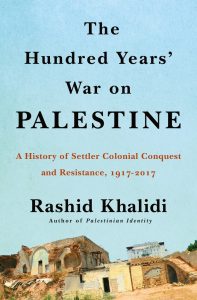
There was an urgency about Rashid Khalidi when the dean of Palestinian-American historians addressed a jam-packed crowd at the prestigious Politics & Prose bookstore in DC, Feb. 10. He told us he was taking off the academic gloves in his new book, “The Hundred-Years’ War on Palestine.” “This book is more personal,” he said. It draws on his illustrious family’s more than hundred years’ experience witnessing and directly confronting the “colonial invasion” of his country, continuing to this day in his own work as an academic truth-teller.

A questioner challenged Khalidi as to whether he was faithful to the historian’s duty of “objectivity.” He replied, “The fact is there is a hegemonic narrative about Israel and Palestine, which takes the Western, pro-Zionist perspective. Eighty percent of what is said about the issue in the U.S. sticks to the hegemonic narrative. It’s not my job to repeat that narrative. Besides, historians, in fact, usually advance an argument or thesis. They don’t just say, ‘On the one hand or on the other hand.’ ”

Khalidi said the book deliberately aims at “general American readers,” who often know next to nothing about Palestine-Israel and, at best, see the conflict as a tragedy of two peoples struggling for their rightful national destiny. But, he argues, the real story is of a “colonial conquest” by the West of the small land of Palestine – and a subsequent endless crushing of Palestinian resistance. “The Palestinians are David; Israel is Goliath, with its external supporters.” Since 1917, supporters have always included the world’s hegemons: Great Britain, the U.S., the U.S.S.R. (in the run up to statehood), and France (in the 1950s). Just as essential has been the material and political support of vast ethnic and religious networks of Zionists (think Christian Zionist).

People need to understand that Israel is a settler-colonial state, Khalidi said, but a unique one. The European Jewish colonists — who literally called themselves colonial before colonialism fell into disrepute after World War II — did not come from a “mother country” and were not part of another nation, such as Great Britain. Rather, they came from many countries and were members of a “totally modern national movement.” The history of the Jews began in Palestine in Biblical times, but “establishing a national state was not what Jews ever wanted” before the late 1800s invention of Zionism.

In 1899, Khalidi’s great-great-great uncle, Yusuf Diya al-Din Pasha al-Khalidi, understood the motives and aims of the early Zionist settlers. A former mayor of Jerusalem, fluent in Turkish, German, French and English, he knew about European anti-semitism and the writings of Zionism’s founder, Theodor Herzl, calling for a Jewish State. He sent a long letter in French to the French chief rabbi to be passed on to Herzl, who had long lived in Paris. He expressed sympathy and understanding for Zionist aspirations. But he warned it would be “folly” to try to impose a Jewish State on the Palestinians, who fully inhabited Palestine. He beseeched Herzl to abandon any such intentions. He pointed out such a move would undermine the extensive Jewish communities that long had existed throughout the Middle East. Herzl’s reply was polite, Khalidi told his audience, but it “simply ignored” Yusuf Diya’s basic point that Palestine was already inhabited by people unwilling to be supplanted.

And so began the continuing pattern of Zionists and their state sponsors dismissing Palestinians as insignificant, if not nonexistent. On that point, Khalidi cited as landmarks the 1917 Balfour Declaration; the League of Nations Mandate for the U.K. to rule Palestine; the 1947 UN Partition Resolution, which was “bulldozed through the General Assembly by the U.S. and the U.S.S.R”; the U.S. greenlight given to Israel in 1967 to conquer the West Bank, Gaza and the Golan Heights from neighboring Arab states; the UN response to that aggression in Resolution 242; all the way to President Trump’s just-released “peace plan.”

In closing, Khalidi asserted that “all nationalisms fabricate a history to justify themselves.” But the “particular and peculiar” thing in the case of Israel is that the “trauma and ideas that generated Jewish settler-colonialism all happened in Europe, but were moved to Palestine.” In other words, for more than 100 years the Palestinian people have had a Jewish nationalist dream working itself out in their land, taking their property and destroying their rights and dignity and their very lives.

In the beginning, there was Palestine. Transforming it into the “The Land of Israel” has meant looking past the Palestinians who live there, “disappearing” them physically when possible, and all the while delegitimizing their story. Khalidi, the scion of an ancient and honored family, breaks the spell of the nationalist dream by exposing us to the existence of the Palestinian people, then and now, and telling their bittersweet story.

Palestinian-Native American-Israeli Tempest in Small-Town Teapot

A Reflection from EPF PIN Member Kathy Christison

A propaganda war centering on indigenous rights—involving Native American solidarity with the Palestinian struggle against Israeli oppression—has lately been raging on public walls and local newspaper columns in Santa Fe, New Mexico.  Although Santa Fe is a mere teapot of a city, the tempest is sizable.  Not only does it involve the Palestinian-Israeli conflict, raising automatic charges from some in the Jewish community that lies and antisemitism are at its core.  The tempest is also becoming a vehicle through which Native Americans are putting forth their own protests against colonialist oppression, in solidarity with the Palestinian struggle, and it is fast becoming an edifying symbol of intersectionality, the 21st century’s prevalent sense that each struggle by marginalized, oppressed people is inextricably interlinked with all others.

It all began on a small scale about five years ago, when a long-time Santa Fe resident, who happens to own a large corner lot on a main thoroughfare into the city—a property surrounded, like many Santa Fe-style residences, by a five-foot-high adobe wall—allowed a local Palestine solidarity organization to use his wall to post occasional pro-Palestinian signs.  Santa Feans for Justice in Palestine, a small but persistent group of pro-Palestine activists, began pasting signs on the wall protesting the billions in US military aid given to Israel, lamenting the killing by Israeli sharpshooters of nonviolent protesters in Gaza’s Great March of Return, urging support for bills in Congress aimed at preventing Israel’s jailing of Palestinian children, and highlighting various other instances of Israeli oppression of Palestinians.

The signs were always vandalized—ripped off the wall, sometimes painted over, even on one occasion side-swiped by a pickup truck driver who either drunkenly or with sober malevolence crashed into the wall in the pre-dawn hours, taking out not only a sign but a small power installation as well, which cost the city $100,000 to replace.  This last act was witnessed by a morning newspaper delivery person, but the culprit was never identified.  The sign activists responded by strengthening the signs’ durability, moving gradually from simple wheat paste to display boards mounted on posts buried in the ground.  Even these were taken out.

The city eventually got into the act and, because the wall is in a designated historical district where the city’s public face is controlled by a set of architectural standards, imposed restrictions on the signage.  The property owner was required to obtain a city permit, to confine the display to one sign, and to limit the dimensions to just 3’ x 4’.  The vandals nonetheless persisted.

Then, suddenly one Sunday in early January, a Navajo artist from Arizona named Remy stepped up and literally plastered the entire long wall with multiple large digitized images of Israeli soldiers aiming weapons at Palestinian women and children, soldiers arresting Palestinian boys, Israeli tanks, and one sign saying simply “Stop Military Aid to Israel.”

Remy’s wall images appear on his website, along with a brief video showing overhead footage of the full extent of the wall and the art.  This site in turn links to Remy’s story, “In the Spirit of Faris,” of how he came to know Palestine and Palestinians and why he began this project, as well as to his defiant reaction to the criticism and vandalization of his art, “Here’s Why You Can’t Exterminate Us.”

“Faris” is Faris Odeh, a 14-year-old Palestinian shown in one of the wall images throwing a stone at an Israeli tank.  Faris was shot to death by Israeli soldiers several days after the photo was taken.  With this story in mind, Remy brings in the intersection of Native American with Palestinian struggles.  He writes that “What the average American does not understand is that Indigenous children in cages have been normalized on our continent since ships landed on our shores….Not much has changed for us in over 520 years of continued genocide, but we still exist and in the spirit of many Indigenous warriors like Faris, we still resist.  [Faris] did what he did for the love of his people and he was not afraid and we shouldn’t be either.”

Not surprisingly, there has been both criticism and vandalization.  The image of Faris standing in front of a tank has been torn off totally; another iconic image of a blindfolded teenage boy surrounded by 20 Israeli soldiers is in shreds.  But—and this is something always to be hoped for with the oft-silenced Palestinian struggle and the even more thoroughly suppressed story of our colonialist oppression of Native Americans—there has also been wide publicity.  Prominent articles about the wall art have appeared in both Santa Fe and Albuquerque newspapers, on local television newscasts, on Palestinian websites, and on Hyperallergic, a national site that describes itself as a “forum for serious, playful, and radical thinking about art in the world today.”

The brouhaha continues.  Santa Fe city authorities (no doubt less interested in being playful or radical than in dealing with criticism from irritated Jewish community members) ruled that the art violates city codes, not because of the location or the subject matter but, oddly, because of the medium, papier maché.  The ruling has been appealed, and the city has another two weeks to decide what to do.  In the meantime, local Native Americans, led by The Red Nation, a New Mexico-based but nationally known Native rights organization, is sponsoring a rally at the wall in a few days, to demonstrate solidarity with “our Palestinian relatives,” to protest the fact that all of Santa Fe sits on original Native land, and to proclaim that “You Can’t Exterminate Us.”

Important aspects of Native-Palestinian intersectionality have played out at Standing Rock, where several social justice activists and lawyers from Santa Fe, including members of Santa Feans for Justice in Palestine, participated actively in that long-running protest.  Members of The Red Nation have in turn been particularly active in Palestine, sending individuals and small groups there to assist, to be educated, and to be in solidarity with fellow indigenous strugglers.  This is a heartfelt solidarity struggle: Remy speaks of how emotionally draining his project has been: “As hard as this project was physically, mentally and spiritually to endure,” he asserts, “this is nothing compared to what our Indigenous brothers and sisters go through in Gaza and other settlement prisons on a daily basis.”  He and his Native relatives have been there.

All public criticism has come from the Jewish community, and most critics take the breast-beating stance of the victim: all the images are lies, all are antisemitic, and all are likely to ignite further antisemitism.  The latest op-ed, by a local academic, laments, not unreasonably, that Jews in the US today feel under siege as they have not felt since the 1930s.  But he goes on to liken the appearance of the wall images at least implicitly to recent attacks at synagogues, labeling the artwork incendiary and provocative of greater antisemitism.  Blaming Israelis in general, who are Jews, for Netanyahu’s policies, however execrable, he says, amounts to blaming Jews in general—and “once it becomes a Jew problem, the match is lit.”  This author’s contorted reasoning would mean that no people are ever responsible for their government’s actions.

Another myopic criticism came from a local orthodox rabbi interviewed for the initial newspaper report.  His objection is to Remy’s comparison of the Palestinian struggle to the Native Americans’ anti-colonialist struggle.  There can be no comparison, the rabbi declared, because Jews are a native population returning to their original homeland, the implication being that Palestinians are not native to Palestine.  Even were this good history (it is not), his suggestion that indigeneity gives permission to oppress the “other” is most un-rabbinical.

The power of intersectionality and the inspiration oppressed peoples today take from each other  are beautifully spiritual and empowering: “This was for you Faris,” Remy writes, “and as long as I live, so will you because you are me and I am you.”

EPF/PJN Reacts to the Trump Administration’s “Peace to Prosperity” Plan

As an organization dedicated to working for true justice and peace for both Palestinians and Israelis, emphasizing political and human rights for Palestinians, the Palestine Justice Network of the Episcopal Peace Fellowship (EPF/PJN) condemns virtually every aspect of the US plan for resolving the Palestine-Israel conflict issued by President Trump on January 28, 2020.

This plan should be of paramount interest to members of the Episcopal Church, for the Church has lent ardent support to the parish, educational, healthcare, and hospitality ministries of the Diocese of Jerusalem for many years.  The many Palestinian Christians who are served by these ministries will be severely and adversely affected by this plan.  Our baptismal covenant to seek justice for all peoples compels us to speak out on what is at stake.

Although subtitled A Vision to Improve the Lives of the Palestinian and Israeli People, the plan does none of this.  As conceived, it does not bring peace or freedom, or especially any kind of justice, to Palestinians.  It violates international law, and violates Palestinian political and human rights.  Neither, in the long term, we believe, will it bring peace to Israelis.

Although it is intended as such, this plan is not a peace agreement or even a reasonably framed blueprint for a peace agreement: Palestinians themselves have had no say in its design, and there has been no negotiation between sides.  The plan is rather a diktat imposed unilaterally by the United States on behalf of Israel to further Israel’s illegal consolidation of permanent control over all the territory of Palestine, from the Mediterranean Sea to the Jordan River.

The plan essentially puts a seal of official US endorsement and recognition on the status quo, which has existed since Israel captured the West Bank, Gaza, and East Jerusalem in 1967.  As one Palestinian has aptly noted, this simply “normalizes our oppression.”  The borders and restrictions imposed are not new, only being drawn with bolder lines on maps.

The plan puts a further seal of approval on unilateral diplomatic steps already taken by the Trump Administration, including its official recognition in May 2018 of Jerusalem as Israel’s capital, and its declaration in late 2019, in contravention of all international law, that Israeli settlements in occupied territories do not conflict with this international law.

Major provisions of the plan:

  • It calls for establishment of a Palestinian state, but this is limited to a small area of disconnected land segments, together constituting far less than one-quarter of the territory of Palestine-Israel.  As depicted on a “conceptual map” accompanying the plan, the area designated for the Palestinian state is much smaller than the West Bank, which itself constitutes only 22 percent of Palestine-Israel
  • Palestinian state sovereignty would be limited: Palestinians would have “all the power to govern themselves but not the powers to threaten Israel,” meaning that Israel should retain “certain sovereign powers in the Palestinian areas” that have to do with ensuring Israeli security
    • This would give Israel virtual total control over all governance in the Palestinian state
    • The state would be demilitarized, with no means of self-defense
  • The state would be surrounded on all sides by sovereign Israeli territory.  Israel is given sovereignty over the Jordan Valley, which would enclose the Palestinian state on the east, as it is similarly surrounded on all other sides by Israeli territory
  • The state would be broken up into multiple disconnected segments, making it into an archipelago of small areas, each surrounded by Israeli-controlled territory.  This includes
    • Israeli “enclaves” where existing Israeli settlements would remain, inside the Palestinian state’s area; Israelis living there would retain Israeli citizenship
    • criss-crossing Israeli-controlled roads linking these enclaves
    • tunnels and underpasses where Palestinian roads would link Palestinian towns
  • Palestinian-Israelis living in the “Triangle” area of east-central Israel might lose their Israeli citizenship, becoming disconnected citizens of the Palestinian state
  • Israel would maintain sovereignty over virtually all of Jerusalem, allowing the Palestinian state to establish a capital on the periphery of the city, east of the Separation Wall
    • Genuine Palestinian sovereignty over this so-called capital would be virtually non-existent
    • Most Jerusalem Palestinians, living west of the Wall, would be given the choice of becoming citizens of either Israel or the Palestinian state, or maintaining their present status as “residents” but not citizens of Israel
  • The plan has little meaningful provision for Gaza, laying responsibility for Gaza’s dire humanitarian situation entirely at the feet of the Palestinians themselves and particularly Hamas
    • There is barely any mention of Israel’s 13-year blockade of Gaza, and no mention at all of Israel’s three massive air and ground assaults on the territory between 2008 and 2014, which killed thousands and inflicted massive destruction on residential and commercial properties
    • A tunnel is to connect Gaza to the southern West Bank
    • As part of territorial “swaps” envisioned to expand the territory of the Palestinian state, the plan designates two small, disconnected areas south of Gaza along the border with Egypt as Palestinian industrial and agricultural zones
    • There is no provision for normal entry to and exit from Gaza by land, except through the envisioned tunnel to the West Bank
  • Palestinian refugees are treated in the plan not as a population deserving any rights, but as a potential security problem for Israel: no refugees will be allowed to return to Israeli territory, and those wishing to move to the Palestinian state will be vetted as possible security risks

As many observers—including several Israeli commentators—have noted, this is a de jure apartheid plan.  Although it allows some Palestinians to opt for Israeli citizenship, for the most part it envisions officially separating the intertwined Jewish and Palestinian populations along ethnic/religious lines.  Far from connecting geographic areas and populations, the supposedly connecting roads, tunnels, and bridges separate rather than unite, and this is deliberate.

Significantly, the plan puts a physical seal on Israel’s recent adoption of a law that officially renders it a “Jewish state.”  The Israeli parliament enacted the “nation state law” in July 2018, declaring Israel to be “the national home of the Jewish people” and explicitly asserting the exclusionary claim that “the right to exercise self-determination in the State of Israel is unique to the Jewish people.”  This apartheid provision would clearly extend to the areas Israel will annex under the Trump plan.

It is important to keep in mind a little-noted reality: that the number of Palestinians living under Israeli control in Israel and the occupied territories equals, and may slightly exceed, the number of Israeli Jews; there are approximately seven million Israeli Jews and also seven million Palestinians, including citizens of Israel and non-citizen inhabitants of the occupied territories.  In the relatively small geographical area of Palestine-Israel, keeping these numbers of people separated by religion and ethnicity will necessarily require stringent controls and restrictions on the subordinate population, the Palestinians.

This plan is a classic example of colonialist planning and domination, designed with the participation only of parties that have the power to implement it.  Israel plans to declare the annexation of West Bank territory very soon, and new Israeli settlements are being built at a rapid pace.  Neither Palestinians nor anyone else has the power to stop any of this.  Although the plan is being broadly condemned, not least by the Palestinian leadership that was excluded from its conception, only those with no power to undo it are objecting.

Kathleen Christison, who authored this statement on behalf of EPF PJN, is a member of the EPF/PJN Steering Committee, and the author of several books on the Palestine situation.  She lives in Santa Fe, New Mexico.

EPF’s Palestine Justice Network: Our Focus in 2019 – the Year in Review

2019 saw the third delegation in four years to the West Bank and Gaza led by members of EPF’s Palestine Justice Network. Through these trips, many members have been able to see firsthand the consequences of settler colonialism, which has helped to inform our work. By going on the ground in Israel and Palestine, we have been able to verify with our own eyes the injustice of displacement, the pain of poverty, and the tragic result of state violence. We have seen the manifold ways the situation there resonates with so many concerns of groups at home: racism, the privileging of a few and the ‘othering’ of many, victimization of children, militarism, and xenophobia.

Within the Church in the US, our work in 2019 focused on monitoring the progress of implementation of six resolutions passed by the 2018 General Convention:

  • the House of Bishops has appointed a committee to address the mandates of B003: On the Status of Jerusalem.
  • B021: Support Aid to Palestinian Refugees and C038:Safeguard Rights of Palestinian Children were cited in action alerts by Office of Government Relations’ Episcopal Public Policy Network and the Presiding Bishop in support of reinstating UNRWA funding and a US House bill, Promoting Human Rights for Palestinian Children Living Under Israeli Military Occupation Act.
  • The Church’s Executive Council voted to put in place a Global Human Rights Investment Screen, with specific criteria for the Palestine/Israel conflict. The adoption of the screen creates a No-Buy List for our church, to be administered by the Council’s Committee for Corporate Social Responsibility. In addition, three corporations – Motorola, Caterpillar and the Israel Discount Bank – were placed on the No-Buy List, with a mandate to sell church holdings.

Another emphasis for PJN in 2019 was local organizing. A new PJN Bulletin for Local Organizers is being circulated among PJN activists to build up our network and share tactics and local initiatives.  This fall, the dioceses of Rochester and Chicago passed resolutions on freedom of speech and the right to boycott.  The resolutions were modeled on a resolution adopted in the Diocese of Vermont in 2018 and circulated in the Bulletin with advice for a successful process.  The Bulletin also highlights materials from PJN’s Tool Kit.

PJN continues our regular media outreach through PJNontheGo and Facebook. Our group is actively engaged with a wide circle of allies, representing denominations and interfaith organizing.   

In 2019, PJN endorsed four action initiatives from our allies at Jewish Voice for Peace, Friends of Sabeel North America and  the U.S. Campaign for Palestinian Rights.  

  • An initiative from Jewish Voice for Peace: Fight white supremacy & antisemitism, not students and their freedom of speech: As civil rights organizations, we want nothing more than for our elected leaders to take strong, decisive action against antisemitism. But President Trump’s Executive Order is a harmful, authoritarian act that will not protect Jews.  President Trump’s Executive Order uses an overly broad and dangerous definition of antisemitism that was never designed to be used on college campuses. By defining criticism of Israel as antisemitism, it will lead to the censoring of student activism, faculty research, and teaching about Palestine.   The Executive Order does nothing to make Jewish students safer on college campuses, but it does play into the hands of Trump’s antisemitic, white nationalist base, by using language that could be interpreted as defining Jewish people as a separate nation.  We say: We should be fighting white supremacy and antisemitism, not students and freedom of speech.
  • Friends of Sabeel North America (FOSNA) and Black4Palestine (B4P) have partnered to initiate a Black church outreach project that seeks to raise awareness in Black congregations about Palestinian freedom and justice. “We invite Black Clergy, Black Christians, as well as members of the Black community and anyone who supports this statement to sign on in support of a Black church call to end Israeli apartheid and to uplift Palestinian demands for justice.”  Read the full statement here.
  • Freedom is the Future A Call from Palestinians in the US: EPF PJN is a solidarity endorser.  The Call was featured in the December Voices for Justice email.
  • Rise Against Racism: #CounterCUFI: FOSNA and other groups acted on a public witness at the annual CUFI (Christians United for Israel) gathering in Washington DC last summer.  Read the statement here.

EPF PJN looks forward to building on this important work in the coming year.  

Thanks to Linda Gaither, EPF PJN convener, and Harry Gunkel, communications coordinator for writing most of this report.

A New Voice from the Grassroots of the South Hebron Hills

Cody O’Rourke was about 25 back in Michigan when a friend at the Church of the Brethren shared about his recent stint in Hebron with Christian Peacemaker Teams – “getting in the way,” as CPT likes to say, of IDF soldiers harshly detaining children on their way to school. That was 2005 and O’Rourke didn’t know a Palestinian from a Palomino. (He was a poor student, who had gone from high school to ironworking and drinking and brawling after work.) “Good talk Bob,” he told his friend, but actually he remained mystified by the whole thing. Bob, however, said, “You should do it, too,” which was ridiculous, except when he said he would pay all the expenses. And so, “totally by accident,” O’Rourke went to serve in Hebron, still thinking that CPT was just a generic humanitarian group helping the needy. 

“First couple days, some of the local guys were taking me around. They kept getting detained and mistreated by heavily armed patrols. I saw discrimination then, really for the first time. It made feel powerless; it shook me up,” he told us in December at the Palestine Center in Washington. He didn’t let it pass. Now he speaks as Communications and Advocacy Coordinator for Good Shepherd Collective (GSC), an NGO based in the South Hebron Bedouin village of Um al-Khair. His four fellow-staffers are all members of the Hathaleen family, which largely populates the village. 

O’Rourke settled permanently in Palestine in 2012, but he lives in Israel with his wife and their son. She is the daughter and their boy is the grandson of Jeff Halper, the remarkable co-founder and former director of the Israeli Committee Against House Demolitions. Cody was an unlikely son-in-law. Before that he had been an unlikely ICAHD staffer – except that he had a lot of skills useful in building and rebuilding houses.  

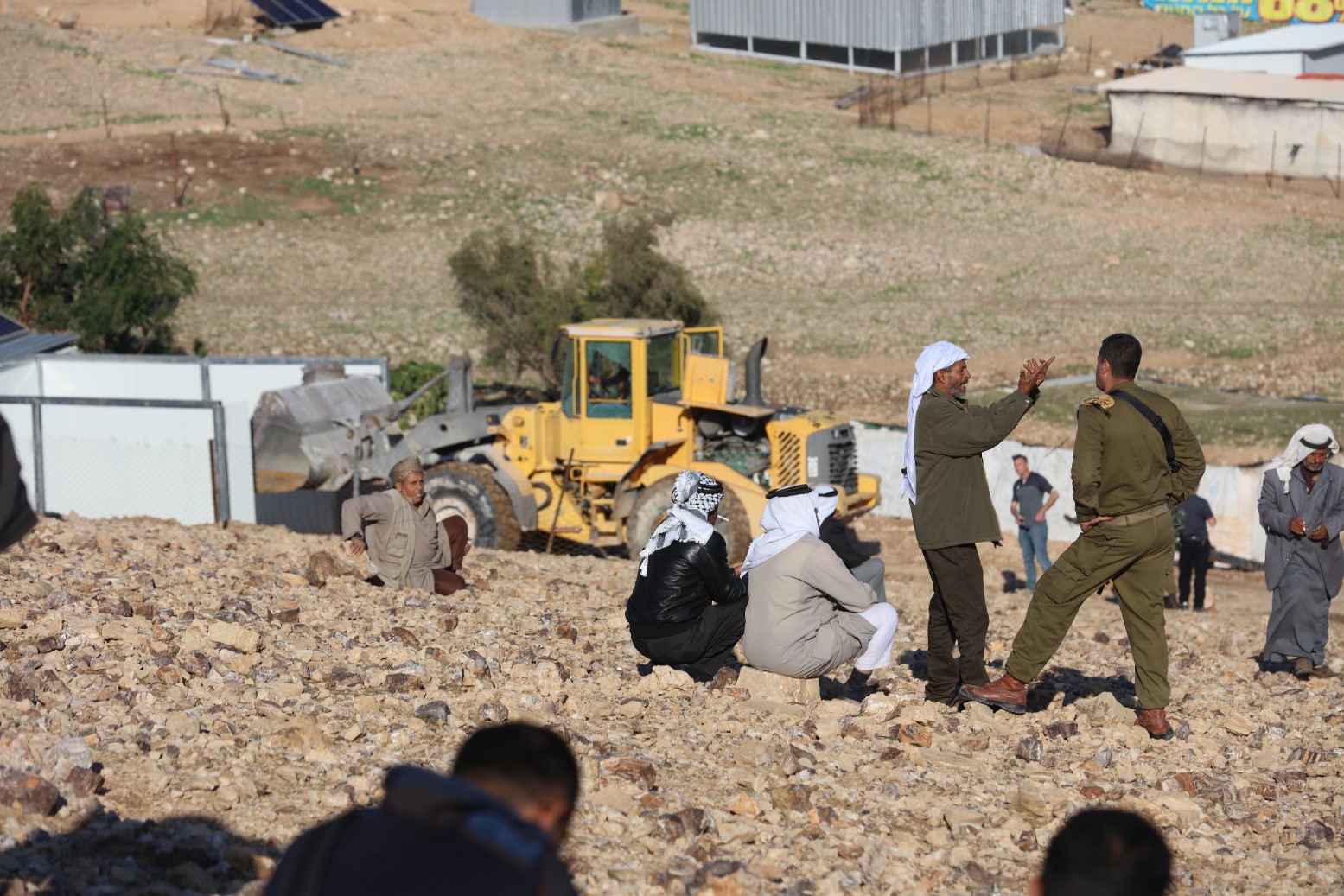
The inescapable reality in Um al Khair village is pressure from the illegal Carmel settlement nextdoor. Most painful are the house demolitions. Every house but two face demolition orders from the Israeli military authority. The orders are enforced at will. This “Sword of Damocles” existence can be unbearable, O’Rourke says: “A friend of mine was stressed prepping for big exams at Hebron University and broke down, telling me, ‘I almost wish they’d just demolish the house and get it over with and I could just focus on the exams.’ So, the Israelis have created a situation where someone literally wants his house demolished.”

In his current position O’Rourke helps GSC build programs and campaigns to shield the houses in Um al-Khair and throughout Palestine-Israel. GSC’s brochure says it “raises awareness of the violent and unjust structures operating in the Holy Land … and organizes to change the policies and laws that underpin these structures through grassroots campaigns.”

He showed a beautiful and heartbreaking video about the people of Um al-Khair. GSC offers visitors many ways to learn about and sample life in the village, with a guest house, camping or hiking in the desert, shepherding, goat-milking, Bedouin breadmaking, textile crafts and even conversation with a traditional Bedouin judge. O’Rourke also wanted to promote a campaign in the U.S. to target an aggressive settler NGO called Regavim (regavim.org) that GSC sees as highly threatening but also as vulnerable. 

The magazine +972 said in September 2012 that “Regavim has one clear goal: the brutal and selective implementation of planning and construction laws, encouraging the state to demolish Palestinian homes or public buildings. The demolition orders issued lately for the entire Palestinian village of Susya in the South Hebron Hills are the fruit of its labors.” O’Rourke credited Regavim with obtaining the destruction — on pretext of environmental protection — of a communal oven in Um al-Khair in 2014 that had operated continuously since 1962. They also procured legislation that cut the period before a new demolition order can be enforced to a mere 96 hours.

Regavim’s heavy fundraising campaigns in the U.S. say its mission is “to ensure responsible, legal, accountable and environmentally friendly use of Israel’s national lands and the return of the rule of law to all areas and aspects of the land and its preservation.” The key, of course, is that they deem the Occupied Palestinian Territories to be part of “Israel’s national lands.” Accordingly, Palestinians are deemed aggressors for simply living on their own property (which in the case of Um al-Khair the Hathaleen family purchased during the Jordanian regime after they were ethnically cleansed from their homes in 1948). 

On its website, Regavim paints a grim picture: “Acre after acre, house after house, buying, squatting, illegally cultivating the soil that is not theirs, sometimes with guile, other times with violence, with huge sums of money and firmly backed by anti-Zionist organizations in Israel and abroad, Israel is losing its hold on the Jewish people’s lands. … Under the auspices of the hesitant Israeli leadership and the bound hands of the enforcement authorities, time is slipping away and with it, the land reserves that belong to us and future generations.”

O’Rourke says Regavim gets 25 percent of its budget from charitable donations in the U.S. It is that funding stream GSC is targeting. The idea is straightforward: Charitable organizations must serve purposes that meet IRS standards for 501(c)(3) programs. Regavim masks its activity as in the public interest but they invariably target indigenous people, whether in Hebron, the Negev, the Galilee, the Golan or Jerusalem. Such discrimination violates the IRS rules. Key to the GSC strategy is the fact that 501(c)(3)s like Regavim – or the Central Fund of Israel in New York, which provides assistance – also must register in every state within which they operate, O’Rourke says. IRS probes are difficult to generate but GSC believes state attorneys general could be persuaded because they are elected officials who must pay attention to the complaints and petitions of voters. Rather than challenge mega corporations such as Caterpillar, for which BDS is the merest pinprick, this target is to scale, O’Rourke says. Even modest success would be impactful.

The campaign against Regavim is still in development, O’Rourke told us. But the village of Um al-Khair clearly has developed its strengths working with him and GSC. The voice of the people came through powerfully in the short video. It’s an unique communal voice that is new to the world and that includes a new note from deepest Michigan, but their song of love for their land is ancient and indomitable.

Editor’s note: Thanks to EPF PIN member Steve France for this report.  Check out the Community section of our website for other reports and writings.   Check out the Good Shepherd Collective’s website.

Ian Lustick’s “Paradigm Lost”: The End of a Zionist Dream

EPF PIN member Steve France reports on a book talk.

A large, excited crowd came to political scientist  Ian Lustick’s December book talk at the Middle East Institute in Washington. His new book, “Paradigm Lost: From Two-State Solution to One-State Reality” gave an autopsy of the Two-State Solution (TSS) steeped in his 50-year experience of calling for Israel and the U.S. to make it happen (he assumed the Palestinians would accept a decent offer). Most PIN members might ask, “Where’s the news in that?” But he was addressing mainly other liberal Zionists.

For those who gave up on TSS a long time ago the news was about the growing disillusionment of liberal Zionists and many pragmatic backers of TSS, a prominent example being, Ambassador Philip Wilcox, who interviewed Lustick at the MEI event. Wilcox praised the book as“groundbreaking,” and “blowing up the solution we’ve clung to for years.”

The interesting question was whether Lustick’s emphatic death notice for TSS will open more minds to the One-State Reality (OSR). Lustick said reviews hadn’t yet begun flowing, but his email is burning hot with reactions. He condemned with the force of a man who has sworn off drinking all attempts to save TSS or to chart a sure path to a new paradigm for a viable One-State Solution. Such visions are “just pretty pictures,” he said repeatedly. People who cling to TSS “are being played for suckers by those who want to slide into endless Apartheid,” he said. But he warned that it will take decades of struggle to move from the current reality to a stable democratic reality for all the people living between the Jordan and the Sea.

Recounting his own evolution, Lustick said he “finally got so bored” with his TSS truth never progressing that he entertained “unwelcome ideas and views, trading boredom for anxiety.” He concluded that “the core problem is what Israel has become,” which he termed a “deeply red state.” He cited three forces that brought Israel to this point: 

  1. the partial success of what early-Zionist Vladimir Jabotinsky called the “Iron Wall” strategy to “keep on crushing” inevitable and understandable Arab resistance to dispossession until it cracked and “moderate” Arab voices would emerge to make a deal. The problem has been that great successes in the brutal first phase made Israel forget about the crucial need to make a deal.
  2. Israeli Holocaust consciousness became “Holocaustia,” meaning the obsessive fear of a new Holocaust. At first, the Israeli attitude toward Holocaust victims tended to be that they were non-Zionist losers who had been too trusting of non-Jews; the lesson was Jews must never again be so naïve. Others believed the Holocaust was a crime against all of humanity and reflected universal risks of genocidal psychosis. After Ben Gurion accepted reparations from Germany, based on worries that Holocaust guilt might begin to fade, he felt the need to counter ferocious criticism by Begin, Shamir et al. and launched the Eichmann trial. But the trial traumatized Israeli Jews, who came to feel like they were all survivors, a belief that has grown ever more dominant.
  3. The power of the Israel Lobby turned U.S. policymakers into yes men and women for Israeli policies toward Palestinians, no matter how harsh and extreme. Lustick said the framers accepted the necessity of lobbying in the political arena, but George Washington warned that “lobbying on behalf of a foreign interest is different because it faces no domestic counter lobby.”  Hence the old saying that U.S. politicians don’t view the Israeli-Arab conflict as a foreign policy issue but as a domestic political issue. 

“Now we have a gestalt switch,” Lustick said. “The new problem is inequality or the lack of democracy.” The practical question, he said, is similar to dealing with Apartheid South Africa, which also was only a partial democracy. “Do you favor ‘constructive engagement’ to foster change or boycott?.” (After the talk he agreed with a questioner that the democratic goals of BDS, as laid out by Omar Barghouti, are compatible with his views.) 

Despite his pessimism concerning the Israeli electorate soon accepting his views, Lustick offered some hope that the political system in Israel could begin to open up. For example, he said, Jerusalem currently has a far-right mayor, but that’s in part a result of the fact that almost no Arab residents vote in the elections. If they voted the mayor would be more moderate and looking to work out some deals. The problem is that leaders of the Palestinian Authority insist on an electoral boycott, arguing that voting would be a de facto acceptance of the Occupation. But the Palestinian Authority has vested interests in maintaining the two-state delusion because it underpins the PA’s status and pays its bills. He also saw some hope in the possibility that the centrist Blue and White Alliance in Israel, headed by Benny Gantz, might reluctantly accept to partner with the Arab-Israeli Joint List to break the seemingly insoluble stalemate preventing selection of a prime minister. That kind of pragmatic, if grudging, coalition seems the only way toward actual progress, he suggested.

The Episcopal Church Will Sell Stock in Companies Profiting from the Occupation 22 October 2019

A STATEMENT by the Episcopal Peace Fellowship’s Palestine Justice Network (EPF PJN) on Action by Executive Council re Resolution B016 (2018):  Adopt Evangelical Lutheran Church in America’s Action on Israel/Palestine.

The Steering Committee of EPF PJN commends Executive Council for positive action on three Resolutions implementing the mandate from the 79th General Convention expressed in Resolution B016: Adopt Evangelical Lutheran Church in America’s [ELCA] Action on Israel/Palestine.

Meeting in Montgomery, Alabama on 18-21 October the Council voted to receive the June 2019 Report of its Committee on Corporate Social Responsibility (CCSR) on resolution B016 and adopt the recommended Global Human Rights Screen (GHRS) with “criteria for the Israel//Palestine conflict.”  The GHRS is modeled on the ELCA’s human rights screen and is consistent with policy adopted by General Convention or Executive Council over the last six decades.  PJN lauds the clear criteria established by the GHRS for deciding if a corporation supports or benefits from denial of human rights in the Occupied Palestinian Territories (OPT).  These are,                       

1) Does a corporation have a record of any of the following: supplying or doing business or providing goods or services in or to illegal settlements (as defined in international law) or contributing to the construction or maintenance of housing or other facilities in such settlements or seeking otherwise to profit from human rights violations in the OPT, or

 2) Does a corporation have a record of directly or indirectly supplying or doing business with or providing goods or services to, or otherwise contributing to, the Israeli Defense Forces as the IDF operates in the OPT.

Adoption of the Global Screen & Criteria puts in place an Episcopal Church Human Rights No Buy List, administered by CCSR, to apply to corporations that resist effective engagement on human rights.

In a second action, Council approved a Resolution to place Caterpillar Inc., Motorola Solutions, and the Israel Discount Bank on the Human Rights No Buy List, directing the church’s money managers to sell holdings in these companies without delay.  Efforts over many years (Caterpillar 15 years, Motorola 25 years, Israel Discount Bank: refusal to engage) to engage with these companies have been unproductive.  Council asks CCSR to continue engagement with Facebook, Booking.com and TripAdvisor for human rights violations through complicity in the Occupation.  

Executive Council also acted to fund future applications of the Global Human Rights Screen as well as continuing corporate engagement.  

EPF PJN is grateful for the meticulous work of CCSR in preparing its twenty-one page Report to Council.  We appreciate documentation of the applicability of the ELCA Human Rights Screen to TEC and the elaboration of both the legislative history of Episcopal policies on Palestine-Israel and CCSR’s practice of corporate engagement over many decades.  The Report elaborated on the actions of our ecumenical partners on human rights screens, the diverse views in the Jewish community with respect to use of economic pressure to end the Occupation, the distinction between TEC’s on-going corporate engagement and the BDS Movement, along with many other important questions.

The Steering Committee of EPF PJN commends the entire Council for this work to address the Episcopal Church’s complicity, through its investment funds, in the Occupation.

This action is timely as prospects for a two-state solution have diminished since the 2018 General Convention. EPF PJN has noted with alarm recent actions taken by the U.S. and Israeli governments, including the Trump Administration’s actions to recognize Jerusalem as the undivided capital of Israel as well as Israel’s sovereignty over the contested Golan Heights, the Nation-State bill passed by Israel in July 2018, which is widely seen as enshrining the rights of Jewish citizens and immigrants above all others within Israel, and statements by members of the governing coalition, including the Prime Minister himself, openly committing to “legal” annexation of fertile agricultural land and settlement areas in the West Bank and East Jerusalem that have been understood to be land for a future Palestinian state.

A Visit to the Palestinian Heirloom Seed Library 10 October 2019

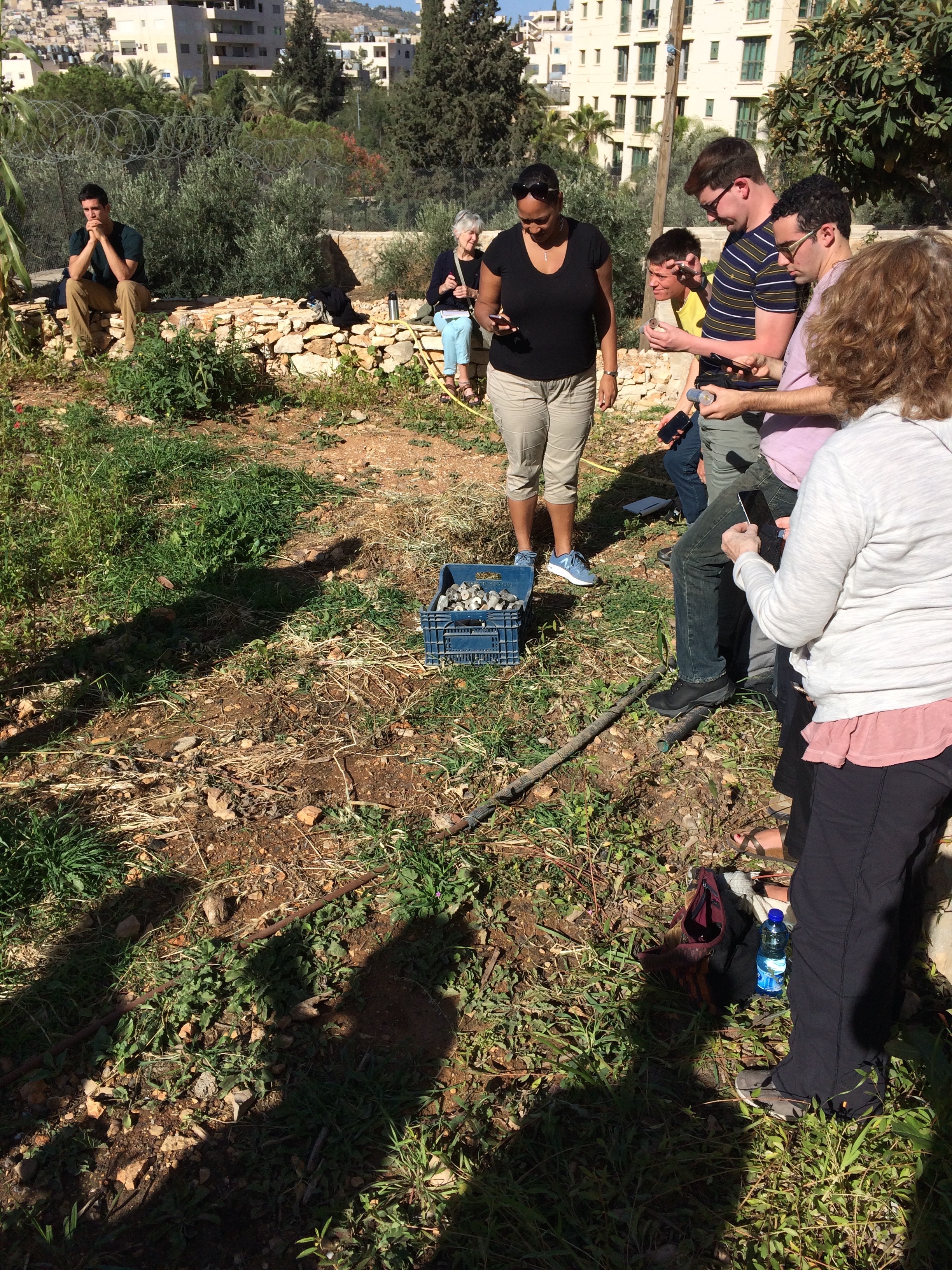
EPF PIN member Tom Foster who convenes the local organizing work group for PIN, traveled with Eyewitness Palestine  last year.  He reflects on the Palestinian Heirloom Seed Library and we also share a link to an interview with its founder Vivien Sansour.

The Palestinian Heirloom Seed Library is based on the property of a beautiful, recently restored Palestinian home just beyond the annexation/ expansion wall in Bethlehem.  The beauty of the house, of the terraced gardens, and of the vision guiding this work stand in profound contrast to the slabs of cement, the barbed wire, and the violence of wall.

The land, yes.  

And on the land grow the Palestinian trees, the shrubs, and the flowers.  All have, through centuries of meticulous attention of farmers, adapted to this dirt.  These conditions.

The seeds collected, catalogued, and preserved here are an expression of a radical hope.  New challenges have arisen – how will the plants respond to so much exposure to tear gas?  We may not know what form a free Palestine will take.  But the people’s seeds will be ready.

Check out this interview with founder Vivien Sansour here.

Palestine Justice Network | Copyright © 2026 All Rights Reserved

2045 West Grand Ave, Suite B #40058, Chicago, IL 60612-1577

info@epfpjn.org

LOGIN