Tag Archive for: #Palestine

Statement of Support for BDS Leader Omar Barghouti

As the fiftieth anniversary of Israel’s occupation of the West Bank and East Jerusalem nears, the Israeli government has intensified its efforts to criminalize the Boycott, Divestment, and Sanctions movement – BDS – which seeks, through non-violent economic pressure, to bring about a peaceful end to the occupation. In recent weeks, for example, it has passed legislation denying entry into Israel/Palestine by foreign advocates of BDS, denied travel abroad by Israeli BDS activists, and threatened the latter with “civil targeted assassination.” This has included the arrest and extended interrogation of BDS co-founder Omar Barghouti on charges of tax evasion.
In conjunction with those charges against Barghouti and his wife Safa, the Israeli government has imposed a gag order on him preventing him from telling his side of the story. It has moreover revoked his permission to travel abroad to receive the Gandhi Peace Award (presented by Promoting Enduring Peace) on April 23, 2017, in New Haven, Connecticut.
The Palestine Justice Network of the Episcopal Peace Fellowship calls on the Israeli government to drop the gag order against Omar Barghouti, dismiss the charges against him, and restore his permission to travel abroad and to return to his home.
We also call on the Israeli government to cease its efforts to intimidate and harass domestic and foreign advocates of BDS and, in particular, to rescind orders that restrict free speech and entry into and/or exit from Israel/Palestine.
We would note, in this regard, the long and honorable history of BDS in achieving positive action through peaceful non-violent means. This history has included the Montgomery bus boycott of 1955-56; the nationwide grape boycott 1965-66 in support of farmworkers in California’s Central Valley; the South Africa boycott which the Episcopal Church supported in 1985; and, most recently, the boycott of North Carolina stemming from its anti-LGBTQ legislation.
We would also note the March 7 and March 9, 2017 statements by David Harris, the Chief Executive of the American Jewish Committee (AJC) and Olaf Fykse, the General Secretary of the World Council of Churches (WCC), expressing their concerns regarding the just-enacted “Entry to Israel Act,” which would ban entry to foreigners who publicly advocate BDS.
Stating that he was “troubled” by the Act, Harris said that the AJC “as a long-time staunch friend of Israel and opponent of the BDS movement, fully sympathizes with the underlying desire to defend the legitimacy of the state of Israel….[but] as history has amply shown throughout the democratic world, barring entry to otherwise qualified visitors on the basis of their political views will not by itself help to defeat BDS, nor will it help Israel’s image as the beacon of democracy in the Middle East it is.”
Calling it a “shockingly regressive law,” Fykse said the Act “would be a clear violation of freedom of expression, that is critical for those who want to visit Israel, for those who have to live under the occupation, and for those who want access to the Palestinian territories. It is also a significant violation of freedom of religion.”

Voices for Justice: EPF PJN Member Kathy Christison on the Ground in Palestine

I once listened to a priest preach on searching for God by likening this to the search for a restaurant in an unfamiliar city: when you’re looking for a restaurant, you tend to see restaurants everywhere; if you intentionally look for God, you will see God everywhere. On this my tenth trip to Palestine (from March 4 to 21) since 2003, I found—as I had expected—that the situation on the ground for Palestinians, the realities of oppression, have never been worse. But something else I saw this time, only because I was looking for it, was Palestinian resistance. It is everywhere, and never have I been as aware as I was this time of the truth of Italian Marxist Antonio Gramsci’s much-quoted statement about the need to have optimism of the will even if one feels the pessimism of the intellect. Palestinians talk about this explicitly: they have no optimism about achieving freedom or receiving justice from Israel, certainly not for the near term, but they have hope, they live on hope, for the long term. One Palestinian told me that he had no optimism but he had hope, because without it he would not be able to get up every day. This hope is resistance.

RESISTANCE: BURNING TIRES, GRAFFITI, LIBERATION THEOLOGY

Resistance for the Palestinians fundamentally involves struggling against erasure, the denial of their very existence. On my trip, I saw this everywhere. For Palestinians, because Israel is bent on their removal, sumud, or steadfastness, is the governing philosophy. Sumud means remaining on the land, in Palestine, and not fleeing or surrendering to expulsion as occurred in 1948; rebuilding when homes are demolished; publicly honoring—with elaborate funeral processions, in graffiti painted on walls, in “martyr posters” plastered on the sides of buildings—any Palestinian, whether militant or activist or civilian, killed by Israel. A “martyr,” a shahid, is any Palestinian killed for Palestine.

Resistance takes many forms. There were terrorist attacks in the past, but today it comes in largely non-violent ways. In March, while I was in Palestine, the Israeli military assassinated a 33-year-old Palestinian activist, Basel al-Araj, whose story is a classic one of resistance by someone who was a Palestinian patriot, a resister, a nurturer and sustainer of community, and a visionary and intellectual whose optimism of the will overrode his pessimism of the intellect. He knew that the work he was doing would not bring liberation for his own generation but would lay the groundwork for the next generation’s successful resistance. He was described in various tributes as a lover of Palestine, of the “land, its details, every single stone,” and he had studied its history, particularly the history of past Palestinian revolutions. He knew the writings of other intellectuals and resisters such as Antonio Gramsci and Frantz Fanon. His own resistance was nurtured by his grandfather in the village outside Jerusalem where he grew up; his grandfather taught him that Palestinians needed to reclaim their history, and as he grew up and continued to study, he worked to make knowledge accessible to everyone, teaching people through stories of Palestinian revolutionaries and intellectuals. One friend, who regards Basel as a model of resistance, writes that Basel taught him that to be part of a genuine liberation movement, you must love and respect your people, treat them as equals, and think beyond your own individual salvation. In this way, al-Araj has been an inspiration to others. Graffiti portraits and printed posters of him dot many walls in East Jerusalem and Ramallah, and his funeral brought out a large protest demonstration in Ramallah—not only against Israel but against the Palestinian Authority, which had tortured and imprisoned him for months because of past protests. His friend, writing on ElectronicIntifada.net, pointedly noted that “[e]very Palestinian martyr leaves us with an added sense of responsibility.”

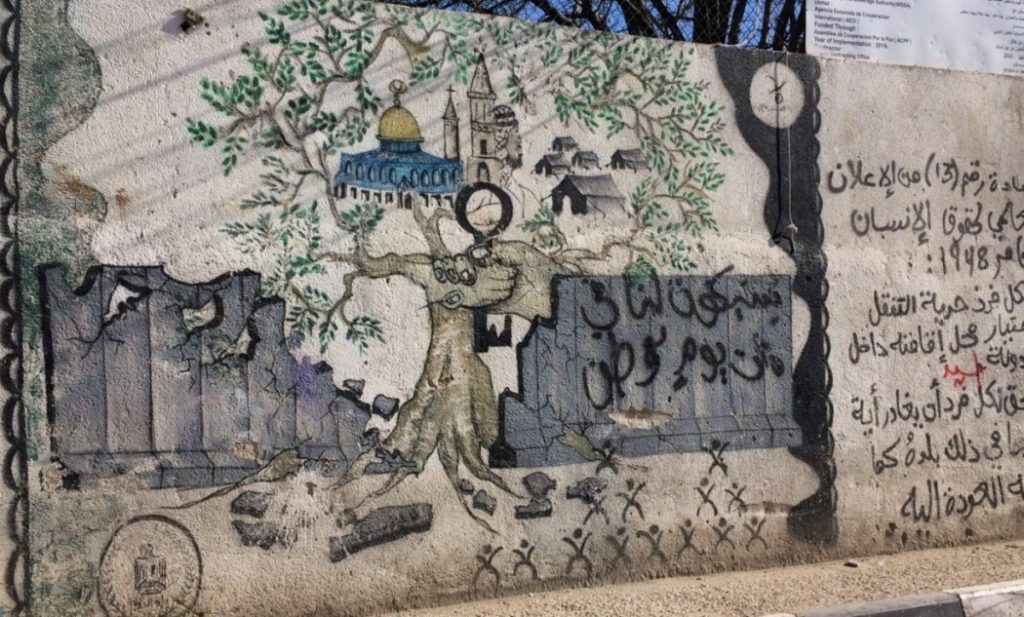
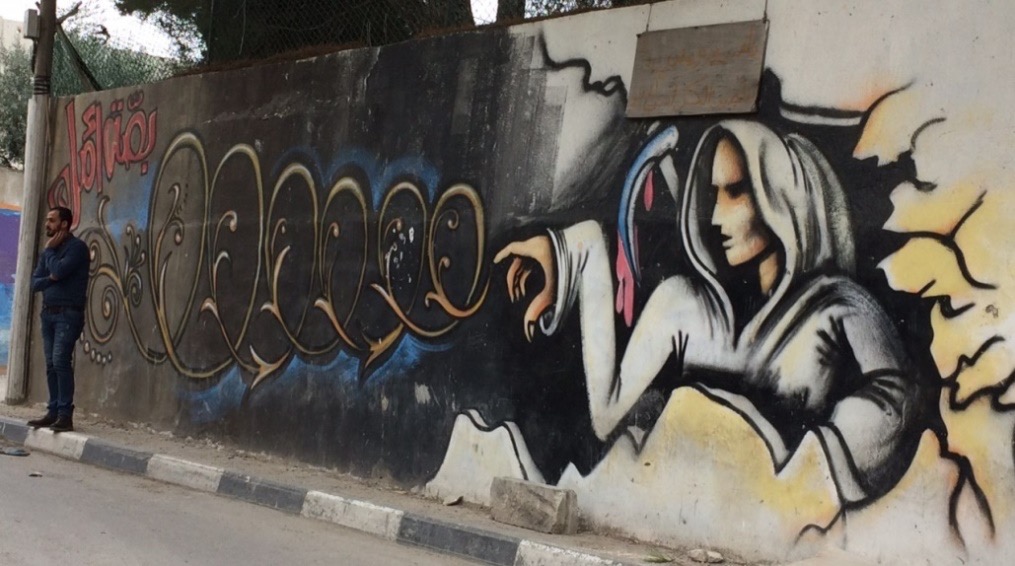
Perhaps the most obvious sign of resistance is in graffiti, some of it quite artistic. I visited the refugee camp Aida in Bethlehem on this trip and found graffiti and other symbols of Palestine everywhere. Entering the camp, you walk through an archway topped by a large facsimile of an old-fashioned key symbolizing the front-door keys that refugees took with them in 1948, expecting to be able to use them upon their return. This photo  shows a large piece of graffiti depicting the Separation Wall being broken down by an olive tree, a universal symbol of Palestine, growing through it. A hand from the tree grasps another hand meant to symbolize the Palestinian people, and together they hold a key. In the background are the Dome of the Rock in Jerusalem, as well as a church steeple topped by a cross and several tents, the first habitation of many refugees in 1948. 
 

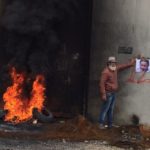
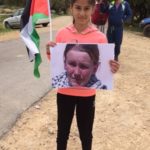
Graffiti also appears, in several layers painted one over the other, everywhere on the Separation Wall built by Israel deep inside the West Bank—a 25-foot high concrete structure that tramples on Palestinian land, separates Palestinian villages from their agricultural lands, and cuts off Palestinian students from their schools, businesspeople from their businesses, and often one side of the street in a Palestinian neighborhood from the other. The graffiti symbolizes not only Palestinian resistance, but also the solidarity of some few Israeli sympathizers and of visiting international activists. The photos below demonstrate that graffiti and protests are not always, or even usually, violent. A picture from Aida camp is of a dove of peace chained to an olive tree but offering a symbol of love as a heart emerges from its scroll. Another shows a Palestinian girl preparing to join in the weekly protest against the Wall in the village of Bil’in, where a large section of village land has been lost to an Israeli settlement on the other side, carries a photo of Rachel Corrie, whom the village was commemorating on the fourteenth anniversary of her death. Another shows a Palestinian man who had unsuccessfully tried to throw a picture of Corrie over the wall toward Israeli soldiers tries here to throw a bouquet of wild poppies over.

The same man poses next to Corrie’s picture, behind which he has put more poppies, the first batch having failed to clear the Wall. The burning tires were intended to rouse the Israeli soldiers on the other side of the Wall. This protest in Bil’in has been going on every Friday since February 2005, and the Academy Award-nominated film 5 Broken Cameras was filmed here. Although in the early years the protest was usually joined by hundreds of international activists and sympathetic Israelis, in recent years the protest has been smaller and Israeli soldiers sometimes do not respond. They did not on this day, despite stones thrown over, loud banging on the gate, and the heavy plume of black smoke from the tires. The usual response now is teargas and occasional rubber bullets, and the Israelis are more frequently employing night raids on villagers’ homes. A few years ago, one Palestinian protester, a favorite in the village, was killed by a high-velocity teargas canister that hit him in the chest. A few months later, his sister died of teargas inhalation. Just recently, one son of a village leader was shot in the leg with a rubber bullet and is permanently injured. A second son was shot in the head a few weeks later but only lightly injured. During a subsequent night raid on the village, this 16-year-old boy was arrested and briefly detained by Israeli soldiers.

The persistence of the protest, despite and indeed probably in considerable measure because of the deaths and injuries, has been an inspiration and a spur to further resistance for the community in Bil’in and throughout Palestine. Other villages affected by the Wall also stage regular protests, which serve to nurture more resistance. As so often occurs, resistance spawns more resistance. And resistance has on rare occasions brought some results. Several years ago, the protests in Bil’in induced the Israeli Supreme Court to order the Wall moved back closer to Israel, restoring some, although by no means all, of Bil’in’s agricultural land to the village. Even small successes resonate loudly.

The kind of Palestinian resistance that most fascinates and inspires me is actually the least well known and probably the most limited. Palestinian Liberation Theology, formulated under the guidance of Palestinian Episcopal priest Rev. Naim Ateek, is a beautiful, fulfilling, reassuring theology that unites and inspires the small Christian community in Palestine. Christians once made up twenty percent or more—some say as much as 25 percent—of the Palestinian population, but the numbers have dwindled dramatically, to about two percent or less, in the decades since 1948 and 1967, when Israel captured the occupied territories, where large concentrations of Christians lived, particularly in East Jerusalem and West Bank cities such as Bethlehem.

For many Palestinian Christians, that inner peace and sense of divinely-inspired determination come precisely from remaining in the land that is the birthplace of their faith. The knowledge that they are descended from the Christians of Jesus’ time and that God is with them in their struggle for justice is of surpassing importance. One Palestinian woman told those at the Sabeel conference held in Bethlehem March 6-13 that she remains in Palestine because this is “where Jesus was and where Jesus wants me.” In a similar vein, the Christian mayor of Bethlehem, Vera Baboun, addressing the conference, spoke of the Christians’ link to Palestine in vivid personal terms, declaring that Jesus brought “us”—the Palestinians—“a legacy of justice.” Being in Bethlehem is liberating, she said, because Bethlehem “is all about liberation, the liberation of mind and heart.”

The Sabeel Ecumenical Liberation Theology Center in Jerusalem was founded in the early 1990s to study and preach a theology of liberation for Palestinians. The Arabic word sabeel means “the way” and was adopted because the very early Christians called themselves “people of the Way.” Sabeel co-founder Naim Ateek is the leading Palestinian liberation theologian, having authored or co-authored a number of books of biblical interpretation about justice and Christian liberation. He declares forthrightly that the Palestinians “are up against evil” in the Israeli occupation, and they must resist. Although Ateek’s writings are directed toward and primarily intended for Christians, he told me that he envisions and works for liberation for everyone in their own particular context. His own context is Christ-centered, but he says that Christ calls on him to work for liberation not only for his people, the Palestinians, but for everyone, even the Israelis. Describing the evolution of his own thinking and his faith, he says that he is first a Christian who recognizes that “in Christ I’ve been liberated from sin, from evil. Then when I look at the context, I recognize that I have a responsibility to others.” Although he doesn’t put it in these words, he essentially sees this responsibility as nurturing a community of resistance among Christians. His liberation theology is comforting and reassures Christians, through such promises as appear in Romans 10:13: “Everyone who calls on the name of the Lord shall be saved.” Ateek is leading a spiritual resistance. He is leading Christians to resist any biblical interpretation, by Israel and by Christian Zionists, that diminishes Christian equality by claiming Jewish supremacy, Jewish chosenness, Jewish exclusivity in the land.

Below: Graffiti in Aida camp. The Arabic label on the left says “There is still hope.”
Palestine, the oppression visited on the Palestinian people, is a haunting problem. Haunting because it is so morally reprehensible on its face; Palestinians are being squeezed and ethnically cleansed only because they are not of the “right” ethnicity and religion, not Jews, not of the Jewish faith. Haunting also because the perpetrators of this oppression are Jews who themselves suffered so horribly in pogroms through the centuries, culminating in the genocide of the Holocaust. Haunting because the oppression of Palestinians is paid for by our US government; the United States gives Israel, as grant aid, $3.8 billion a year in military equipment, a cynical process that not only enables Israel’s oppression but also directly benefits US arms manufacturers and the predatory military-industrial complex, since Israel is required by the aid agreement to spend all of the annual $3.8 billion to purchase US-manufactured military equipment. Haunting finally because Israel’s oppression and its exclusively Jewish motivation depict God as a God of injustice, an evil God who would murder and dispossess and steal from one segment of humanity solely for the benefit of another. In his first book on Liberation Theology almost thirty years ago, Naim Ateek wondered on behalf of Palestinian Christians what, in light of Israel’s creation and Palestine’s oppression, God is really like. Palestinian Christians, he wrote, are questioning the very nature and character of God. “Is God partial only to the Jews? Is this a God of justice and peace?….The focus of these questions is the very person of God. God’s character is at stake. God’s integrity has been questioned.”

This is serious, fundamental resistance—resistance that goes to the heart, the root, of the Palestinian-Israeli issue and that, for that reason, speaks to all Palestinians, Muslim as well as Christian. This is resistance to Zionist thought and founding principles, resistance to Protestant theological support for Jewish supremacy put forth in the aftermath of the Holocaust out of guilt over Christian complicity with centuries of anti-Semitism, resistance to the widespread Christian Zionism in the United States that preaches the Jewish right to supremacy from a distortion of biblical texts. Naim Ateek calls on us to see God not as the instrument of any government’s injustice but as a just God who loves humanity equally and gives no special rights to anyone.

Ateek’s is a prescription for building hope from resistance—telling the oppressed that they do not struggle alone. This is a huge assurance. The mere act of resistance, even in the absence of any reason for hope, nurtures and builds hope, for without resistance there is only surrender. My trip to Palestine shows this to be very true.
 

Bishop’s Committee for Israel/Palestine of the Episcopal Diocese of Olympia

Periodically we lift up work being done at the grassroots. This week, it’s the Bishop’s Committee for Israel/Palestine of the Episcopal Diocese of Olympia. Thanks to our friend and colleague Cabby Tennis for connecting us with this committee.

From their website: “The Bishop’s Committee for Israel/Palestine is a special committee of the Episcopal Diocese of Olympia. We are committed to a future in which everyone in Israel and Palestine enjoys security, justice, and equal rights. We work toward this future by raising awareness, advocating for change, and with prayer. We partner in this effort with people and groups of all faiths. This website is intended to be a platform for us to provide information and make announcements to our community. Over time we hope to create a library of background information on Israel and Palestine, a selection of current events, and links to other organizations working for peace and justice in Israel and Palestine.”

Rennie Colt, one of the organizers, says:
Over the past 6 months, we have been working two fronts… Firstly, we have written and published a number white papers on Israel/Palestine, collectively titled You Can’t Say We Didn’t Know.
Secondly, we have been establishing a social media presence using three overlapping channels: a website, a Facebook page, and a Twitter feed.
In addition to publishing our writings, we have used our website to announce an promote events — most importantly a conference on Islamophobia last fall, Islam in the Public Square — and to post articles of interest on Israel/Palestine, refugees, and religious intolerance.

Check out the series of white papers here.  Writers include Mary Segall, the Right Rev’d Gregory H. Rickel, Rennie Colt, Randolph Urmston, Claude Soudah, Tim Hill, the Rev’d John-Otto Liljenstolpe and Carolyn Sherrard. Brief biographies are on the website.

An update from the Diocese of California on Palestine resolutions for 2016

From the Diocese of California’s annual convention weekend before last, Vicki Gray reports that “With near unanimity, they passed four resolutions placing the diocese on those front lines with regard to the death penalty, gun violence, legal threats against BDS proponents, and support for Native Americans at Standing Rock.” We report here on the resolution concerning legal threats against BDS proponents.

This resolution “urged repeal of AB2844, a recently signed law that threatens to penalize individuals and institutions who support boycott and/or disinvestment in any way related to Israel.”

We reported on earlier work in the Diocese of California in a posting on our Community blog on 30 August 2016. Follow-ups on the Anti-BDS legislation AB2844 were posted on 13 September 2016 and 27 September 2016.

Thanks also to Randy and Doni Heyn-Lamb of the EPF PIN chapter in the Diocese of Los Angeles for their postings on AB2844 in the Community blog.

The text of the Diocese of California resolution follows:

RESOLUTION NO. 5
FREE SPEECH WITH REGARD TO
BOYCOTT, DIVESTMENT AND SANCTIONS

Resolved, That the 167th Convention of the Diocese of California reiterates the principles of Resolution 7, Promoting Justice and Peace in Israel/Palestine, adopted by the 165th Convention, that urged The Episcopal Church to divest from any investments it might have in certain companies whose products and/or actions support the infrastructure of the occupation and urged Episcopalians to boycott products that are manufactured in Israeli settlements in the West Bank and East Jerusalem;

Resolved, That the Convention considers such peaceful activities to be clearly protected speech under the First Amendment to the United States Constitution and equivalent provisions of the Constitution of California and other States;

Resolved, That this Convention condemns the legislative and/or executive actions proposed or adopted in many States that seek to prohibit public agencies and pensions from investing in or doing business with pro-boycott companies and institutions, or which may subject such companies and institutions to costly legal investigations; and

Resolved, That this Convention urges the repeal of recently enacted AB 2844, which is likely to spur costly and unnecessary civil and criminal investigations against companies and institutions that have adopted BDS policies, and it calls upon the courts to protect the free speech rights of all Californians by enjoining it from ever taking effect.

Explanation:

The Boycott, Divestment, and Sanctions (BDS) movement began in 2005, when representatives of Palestinian Civil Society called upon “international civil society organizations and people of conscience all over the world to impose broad boycotts and implement divestment initiatives against the government of Israel similar to those applied to apartheid South Africa until Israel meets its obligation to recognize the Palestinian people’s inalienable right to self-determination and fully complies with the precepts of international law. And, in their 2009 Kairos Document, the leaders of the Palestinian Christian community urged the international community to “put pressure on Israel and take legal measures in order to oblige its government to end its oppression and disregard for international law.”

In 2014, the people of the Diocese of California responded to these calls by adopting the resolution that “encourage[d] the Church to divest from any investments it might have in Caterpillar, G4S, Hewlett-Packard, and Motorola Solutions, whose products and/or actions support the infrastructure of the occupation” and “encourage[d] Episcopalians to boycott products, such as Soda Stream, that are manufactured in Israeli settlements in the West Bank and East Jerusalem.” (165th Convention, Resolution 7)

Thanks largely to the economic pressure generated by the BDS movement, G4S has ceased its operations in Israel related to running prisons and checkpoints and Soda Stream has pulled out of the West Bank.
As similar actions have been approved on the national level by the United Church of Christ, Lutherans, Presbyterians, and Methodists, and others, opponents of BDS have sought state legislation that would label support for such measures anti-Semitic and would penalize supportive companies and organizations with the loss of state contracts and assistance. Several states have passed such legislation, or adopted it by executive order.

The focus of this resolution calls attention to the fact that the California Legislature has recently passed one such measure, AB 2844.

As far back as the 1955-56 Montgomery Bus Boycott, the Supreme Court has consistently considered boycotts protected speech under the First Amendment.

Boycotts and disinvestment have a long and honorable history of achieving positive action through peaceful means. In addition to Montgomery, there have been the 1965-66 grape boycott in the Central Valley that birthed the UFW, the South Africa boycott which The Episcopal Church supported (Res. 1985-D073) in 1985, and, most recently, the boycott of North Carolina stemming from its anti-LGBT legislation.

The current anti-BDS legislation at the state level is opposed by, among others, the ACLU, the Center for Constitutional Rights, and the Anti-Defamation League of B’nai B’rith. Addressing such legislation on June 28, 2016, the World Council of Churches not only expressed “its concern regarding efforts in legislative bodies throughout the world to silence and penalize calls for non-violent measures to resist illegal occupation, but rather reiterates its support for freedom of expression in all contexts and non-violent means for transforming conflicts.” This Diocese should do no less.

Submitted by: The Rev. Vicki Gray, Deacon, Christ the Lord, Pinole.

Endorsed by: The Rev. Susan Champion, Rector, Christ the Lord Pinole; Janet Chisholm, Delegate, All Souls, Berkeley; The Rev. David Ota, Rector, St. Ambrose, Foster City; The Rev. Katherine Salinaro, Deacon, School for Deacons, Berkeley; Elsa Stevens, Delegate, Christ the Lord Pinole, The Rev. Margaret Trezevant, Deacon, St. Luke’s, San Francisco; Mary-Jane Wood, St. Giles, Moraga.

Voices for Justice On the Ground in Palestine: Coexistence or Normalization?

Editor’s Note: 
Fayrouz Sharqawi is the Local Mobilization Coordinator at Grassroots Jerusalem, a Palestinian organization amplifying Palestinian voices from Jerusalem in order to help create a Palestinian long-term strategy for the Palestinian capital.

Coexistence of Normalization?

Around ten years ago, when I was a student at the university, I needed to take part time jobs to pay my rent. One job I took was to help with the logistics of a trip by an American group to visit “Israel and Palestinian territory in order to learn about the political situation”. The program included a visit to the Lipski plastic factory in the settlement of Ariel in the north of the West Bank. Speaking to the guests, the manager of the company said they were “proud to prove industry can be a model to foster coexistence,” loudly emphasizing that the factory hires Palestinian workers.

The manager’s words infuriated me, and I thought to myself: how dare he speak of co-existence when his factory is built on lands seized by force from these very same people he is proud to say he hires? When the water his factory uses is at the expense of these people’s own thirst? When the settlements and their industrial zones are aggressively eating up more Palestinian lands, drying them of natural resources, severing the West Bank and suffocating the Palestinian economy?

Normalizing the occupation means engaging in any type of political, economic, cultural or educational relationship with Israel, in a way that suggests that the current reality of colonization is ‘normal’. From a Palestinian perspective, it simply means having such relations while disregarding the fact that this occupation State is continuously demolishing our homes, suffocating our economy and brutally controlling every single aspect of our lives.

Considering the case of the Lipski factory as an example of coexistence might, to some, seem ridiculous and rude. The Israeli industrial zones in the West Bank are the economic engine of the illegal settlement blocs, and one of the greatest obstacles to building a viable Palestinian economy. These settlement blocs strategically commandeer main transportation routes, appropriate water resources and agricultural lands, and destroy the flow of Palestinian goods. Accepting the description of the Lipski CEO would clearly be an act of normalizing this economic colonization.

Some not so clear cut cases are those of “peace-building” initiatives between Palestinians and Israelis. These initiatives, starting as early as the 1970s (between Israelis and 1948 Palestinians) and enhanced following the signing of the Oslo Agreement in 1993, bring together Palestinians and Israelis to foster “dialogue and build peace”. The rationale stated behind such initiatives is to develop mutual understanding and bring the participants closer together. According to Rabah Halabi, a Palestinian academic who developed and implemented such dialogue projects for over two decades, the ultimate objective being that the oppressed understand the fears of the oppressor. The goal, then, has been to normalize and preserve the existing situation, by attempting to make Palestinians empathise with their oppressors.

When I was a student, and not half as politically aware as I am today, I also took a job as an interpreter at “dialogue groups” between Palestinian and Israeli youth. During these “dialogue-meetings”, I always felt unease. Something in the dynamics of the group bothered me, but I never could explain what, not even to myself. The settings supposedly secured a “neutral atmosphere where both sides were equal”. Yet, as a Palestinian, I did not feel free or powerful. Even though participants enjoyed freedom of expression within the group, it did not feel the two sides were really equally powerful.

Moreover, after each meeting, I would head to my neighborhood and think how easily the officer asking for my ID on the way could be someone from the Israeli group; how someone’s mother could be the judge signing the demolition order of my uncle’s home tomorrow, or the arrest warrant of my friend the day after. I was expected to tolerate how the Israeli participants justify such actions (using the “magic word” – security) or, at best, alienate themselves as individuals from their Government’s policies. I was angry that  I eventually quit my job because I could not handle the dissonance.

Today, I can explain the negative political implications of such projects. First, while they have proven to fail in bringing about real change, they create a fake impression that there is a keen Israeli will to solve the so-called “conflict”. Second, as Halabi states, Israeli participants believe that in order to have peace, they must hold control, and any Palestinian speaking out with a firm tone is a threat to the convenient status-quo where they call the shots. As a result,

It is impossible to build peace between the oppressor and the oppressed. No true peace can be achieved while maintaining policies of Zionization, colonization and control. The military occupation, ethnic cleansing, land theft and killing must end before we can sit and talk as equals. Peace and normality cannot co-exist with oppression.

EPF PJN Mission Statement Coming Out of Our Leadership Retreat February 2016

To establish a network dedicated to a more robust Episcopal Church witness for justice and peace for our Palestinian and Israeli brothers and sisters for the purposes of responding to
• The promise made in our baptismal covenant to “ … strive for justice and peace among all people, and respect the dignity of every human being”;
• The call of Palestinian Civil Society for Boycott, Divestment, and Sanctions against Israel until it complies with International Law and Universal Principles of Human Rights; and
• The prayerful call of Palestinian Christians expressed in the Kairos Palestine Document.

We believe the Episcopal Church can and should play a vital role in seeking justice and peace for Palestinians and Israelis.  We believe that without justice, there will be no lasting peace which both people deserve.

PJN invites all Episcopalians to commit to active engagement in the quest for just peace in Palestine and Israel through PRAYER, STUDY, and ACTION.

We encourage prayer undertaken individually, in community with parish and/or other local organizations and initiatives pursuing common goals, and in response to petitions or requests such as the Sabeel Wave of Prayer and Kairos USA.

We encourage study and education through
• witness trips to Israel/Palestine;
• study and familiarity with the Kairos Palestine Document; and study and familiarity with the publications Steadfast Hope and Zionism Unsettled.

We encourage action in
• supporting the Palestinian community, their congregations and institutions;
• supporting efforts to disengage and divest from companies that profit from the Israeli occupation;
• supporting efforts to introduce resolutions at diocesan and general conventions to pursue financial divestment;
• supporting the non-violent resistance of the Palestinian people to the occupation; and
• encouraging partnerships with other organizations, groups, and initiatives that seek just peace through non-violent means.

Nonviolence, BDS and the Children: EPF PJN member Dick Toll reflects

Editor’s Note: EPF PIN member Dick Toll shared his sermon from 25 September at Spirit of Grace Lutheran/Catholic Community.

My name is Richard Toll, I am a retired Episcopal Priest having been ordained for 49 years. My first trip to the Holy Land was 33 years ago and I have taken over 30 trips to the region since then. I have studied at our college there, I have taken church groups, I have been to 8 Sabeel International Conferences and have visited Gaza 4 times, the last visit to Gaza was last spring a year ago.

My task for today it to speak to nonviolence and nonviolent actions and to do so in the context of Israel and Palestine. Not an easy task but an issue that I am more than willing to address.

First of all, to read from today’s Gospel Matthew 38 thru 44, “You have heard that it was said, ‘An eye for an eye and a tooth for a tooth.’ But I say to you. Do not resist an evildoer. But if anyone strikes you on the right cheek, turn the other also, and if anyone wants to sue you and take your coat, give your cloak as well; and if anyone forces you to go one mile, go also the second mile. Give to everyone who begs from you, and do not refuse anyone who wants to borrow from you. You have heard that it was said, ‘You shall love your neighbor and hate your enemy.’ But I say to you, Love your enemies and pray for those who persecute you.”

These words come from the Sermon on the Mount one of the most important teachings offered by anyone, anywhere and have influenced humanity as ripples extending out over time into individual lives and cultures that can only be measured as we look at ourselves and our faith communities. Yes. These words alone have influenced humankind and still do.

It is out of the mouth of Jesus who as a Jewish person under Roman military occupation has every right to seek retribution and relate to the Old Testament teaching of an eye for an eye and a tooth for a tooth.

But no….this Jesus we listen to has lived for 33 years under Roman military occupation. He has especially seen what the military occupation has done to the Jewish people in the Galilee. He has watched friends and neighbors be arrested, tortured, crucified. Many of his followers have tried to convince him that there must be a violent revolution in order to rid themselves of the hated Roman dominance.

Jesus is the one we claim to be the reflection and image of the Living God. Living amongst us, flesh of our flesh, teaching, preaching, giving himself for us so that we might know life in all of its fullness. His way of doing that is to show us the path to nonviolence.

The Church over the centuries has had great difficulty in coming to terms with the nonviolence taught by Jesus. The human instinct is to move toward violence, punishment, control, dominance……as our answer to the need to be in charge.

In the early years of Christianity, one of the criteria of being a follower of Jesus was to NOT serve in the Roman army.

Church history shows us what happened as the Church became the official religion of the Roman empire in the 4th century AD. We see witnesses such as Francis of Assisi come to the forefront of nonviolent spirituality in the 12th century AD. But then we see Pope Julian in the 15th century AD leading Vatican armies into battle.

There is not a one of us who has not had to face into our own issues of violence and nonviolence in just about every aspect of our lives….whether it be in gun control, militarism, neighborhood watch programs, community policing, our families, our politics, our understanding of religion, our vision of God and our attempt to understand Jesus.

Violence is so much a part of our world. How about nonviolence and nonviolent actions? How about putting to work our faith with nonviolent actions. I remember the civil rights training I went through in the 1960’s. We were taught how to respond or how not to respond when we were shouted at or spit upon in demonstrations. Not to lash out when abused. It goes against our human nature but it works. When we know our cause to be just, we know that the forces of nonviolent resistance are able to be heard. We saw it in the civil rights movement in the 60s. We saw it in the struggles of apartheid South Africa. We see it in the Black Lives Matter movement unfolding before our eyes here in the United States. We see it in Charlotte, N.C. and other cities.

When we do or say nothing, we can be taken over by forces that are often revealed as “evil”. We know from lessons we have experienced or know from history.

You have in your bulletin today information regarding the call from Palestinian civil society to enter into nonviolent resistance to the Israeli military occupation….through BDS…boycott, divestment, sanctions regarding the military occupation of 4 million Palestinian people in the West Bank, East Jerusalem, and the siege of Gaza.

It is a huge issue. I want to address a portion of what military occupation means and what it is doing to the Palestinian people. I am not going to talk about illegal settlements and the confiscations of Palestine land for those settlements….I am not going to talk about the 45,000 homes of Palestinians that have been destroyed since 1967 to accomplish the building of settlements and bypass roads….I am not going to talk about the separation wall that takes land, water and olive trees from the Palestinians….I am not going to talk about the bypass roads in the West Bank that can only be used by Jewish settlers (400 miles of bypass roads in the West Bank paid for by US tax dollars 20 years ago)…..I am not going to talk about divesting from companies such as Caterpillar, Hewlett Packard, G4S, and other companies that add to the burden of the military occupation and profit from it.

I am going to talk about the military occupation and what it is doing to children and families. Military occupation means that military law is in place in the West Bank and East Jerusalem. What that means is that military courts decide what to do regarding ANYTHING AND EVERYTHING relating to Palestinians.

Palestinian children have become a target for arrest because of their stone throwing that takes place when they demonstrate against their homes being demolished or their land being confiscated. Seven hundred children are imprisoned yearly…ages from 12 to 16. They are often arrested in the middle of the night, dragged from bed, blindfolded, placed in a jeep, taken to a prison without parents or access to a lawyer.

They are interrogated by the police without anyone present, often put into solitary confinement for days, weeks and even months. 99% of the children plead guilty to get out of prison. They sign documents in Hebrew that they do not understand, and then they go home frightened, wetting their bed at night, withdraw from their school and family and have prison records for the rest of their lives.

You can imagine what this does to the fabric of the family, village life and the threat to the future.

On the other hand, civil law from the state of Israel applies to the 500,000 illegal settlers on the West Bank and in East Jerusalem. Civil courts seldom punish or hold settlers accountable for any harm done to Palestinians.

There are two systems of law….one used by the military occupation of Palestinians…and one for the illegal Jewish settlers….and the children of the occupation are very damaged by the system.

The Palestinian civil society call for BDS is to change what is taking place and to end these Israeli practices what are in violation of International Law.

You will hear the argument often…”why pick on Israel”…”look at the injustice of other countries”.

My answer to that is that we are complicit as a nation and as citizens when our US tax dollar is funding the military occupation of the West Bank, East Jerusalem and the siege of Gaza.

If our 3.8 billion dollars a year to the state of Israel was withdrawn, Israel would probably come to terms with how to solve their own problems with the Palestinians and their neighbors rather than have us complicit with the occupation.

I have met with children that have been arrested and have been in prison. I have met with their parents. I have heard many stories. It is not a way to treat children. This is one of the many reasons to support BDS.

We are watching a crisis unfold on many of our streets and cities such as Charlotte, NC. Violence on the streets is not the answer. Nonviolent actions are attempting to overcome the violence. Right now we are in a crisis situation in our own country and in the world.

There is much power in nonviolent resistance that speaks loudly and clearly to human abuse. It is often very much feared because it speaks to injustice. Jesus is still speaking to us through His words and scripture. May we hear and respond in the name of Jesus Christ.

Amen

2015 Action in Dioceses on Palestine Israel: Los Angeles

2015 Action in Dioceses on Palestine Israel: Los Angeles

The resolution posted here was passed by the Diocese of Los Angeles at its convention in early December 2015. EPF PIN member Randy Heyn-Lamb comments, “Although it doesn’t use the words ‘Boycott’ or ‘Divestment’ or ‘Sanctions’ it urges members to refrain from purchasing settlement products, investing in companies doing business in the settlements and urges our government to cut off funding to Israel until settlement construction ceases.”

The EPF PIN LA Strategic Planning Committee developed the resolution from a first draft prepared by the Rev’d John Forney. Father Steve Huber and Father John Conrad both spoke for it, as did a young man who had been on the Diocesan youth pilgrimage a couple years ago.
Resolution regarding Israeli Settlements

Resolved, that the One Hundred Twentieth Annual Meeting of the Church in the Diocese of Los Angeles go on record vigorously oppose any further expansion of Israeli settlements in the occupied territories of the West Bank and East Jerusalem; and be it further
Resolved, that the Diocese of Los Angeles urges our government to cut off further funding to Israel until all settlement construction ceases; and be it further
Resolved, that the Diocese of Los Angeles urges its members to refrain from purchasing products produced in such illegal settlements or investing in companies doing business in these settlements; and be it further
Resolved, that the Diocese of Los Angeles urges both parties to return to the negotiating table and resume talks on all outstanding issues, including, but not limited to, establishment of borders, the end of the occupation, allocation of natural resources, the “right of return,” and the status of Jerusalem, that in time there may be true reconciliation and cooperation to the mutual benefit of both Palestinians and Israelis; and be it
Resolved, that the Diocese of Los Angeles urges the Presiding Bishop and the Executive Council of the Episcopal Church to pursue these resolves on a national level until the time of the 79th General Convention; and be it further
Resolved, that a copy of this resolution be sent to the Presiding Bishop of the Episcopal Church, the Episcopal Archbishop of Jerusalem, the President of the United States, the Secretary of State, and all Members of Congress who represent the areas encompassed by this Diocese.

Submitted by:
The Reverend John Forney
Assisting (Retired), All Saints, Pasadena

Explanation:
The Episcopal Church has previously recognized that “Israeli settlements in the occupied territories of the West Bank and East Jerusalem are illegal under international law” and named them “an obstacle to peace.”

The Episcopal Church is on record requesting that the President and Congress “take appropriate steps to ensure that no assistance provided the State of Israel shall be used…for new settlements to be located in the occupied areas of the West Bank, Gaza, and East Jerusalem. Further relocations and new settlements result in the immediate curtailment of aid from the United States.”

The continued construction and expansion of settlements is a violation of United Nations Security Council resolution 446 and the 4th Geneva Convention. Such settlements constitute a theft of land from a future Palestinian state and such settlements are the source of great enmity between Palestinians and Israelis and a continuing obstruction to any reconciliation and lasting peace between the two groups. A just foreign policy mandates that the United States should do all in its power to discourage the continued construction of illegal settlements.

Palestine Justice Network | Copyright © 2026 All Rights Reserved

2045 West Grand Ave, Suite B #40058, Chicago, IL 60612-1577

info@epfpjn.org

LOGIN